Daniel 1
Biblica® Open Nueva Biblia Viva 2008 · Tap a verse to see its cross-references.
About this book
About Daniel
- Jews place the book of Daniel in the Hagiographa, the division called Khethubim in Hebrew. The book itself presents Daniel as its writer. Easton's Bible Dictionary (1897) notes that the book's genuineness has been much disputed.Sources: Easton: Daniel, Book of
- The historical chapters treat the period of the captivity. Easton calls Daniel the historian of that time, whose narrative fills out the Chronicles sketch: Nebuchadnezzar carried the survivors to Babylon, where they served him and his sons until the reign of the kingdom of Persia. A notice of Cyrus dates the fall of Babylon to his army in 538 B.C., on the night of Belshazzar's feast; Belshazzar is called the last king of Babylon, and the city stood on the Euphrates.Sources: Easton: Daniel, Book of · Cyrus · Belshazzar · Babylon
- The book consists of two distinct parts. The first six chapters are chiefly historical, and the remaining six are chiefly prophetic, consisting of three visions and one longer prophetic communication.Sources: Easton: Daniel, Book of
- One notable feature is its language. Certain portions, Daniel 2:4 and chapter 7, are written in Chaldee, while the Hebrew portions have a close affinity with the later books of the Old Testament, especially Ezra. The writer passes from one language to the other as the subject requires.Sources: Easton: Daniel, Book of
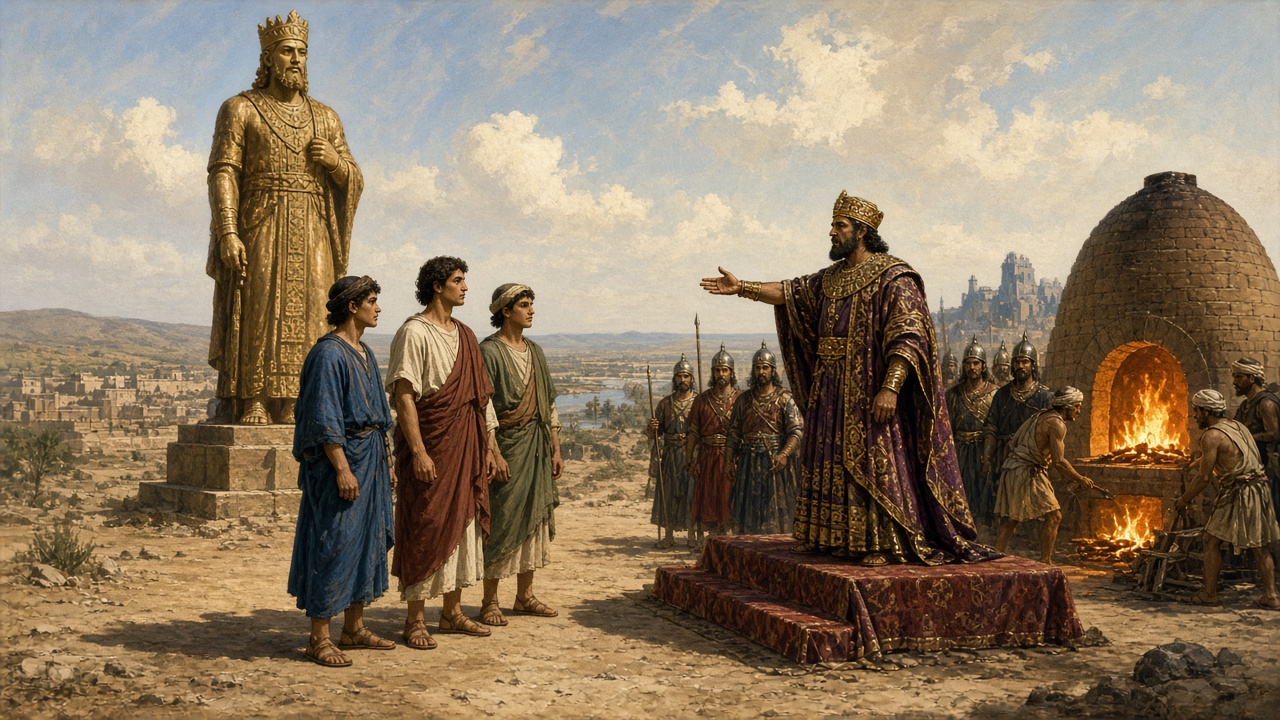
- Nebuchadnezzar gave Daniel a Chaldean name meaning "Beltis protect the king!" Hananiah was given the Chaldean name Shadrach, "Aku's command," and Azariah, of the royal family of Judah, was given the name Abed-nego. Meshach, one of the three Hebrew youths trained with Daniel in Babylon, was later promoted to the rank of the Magi.Sources: Daniel · Shadrach · Azariah · Meshach
Notes written with AI assistance from open sources (Theographic Bible Metadata, CC BY-SA 4.0; Easton’s Bible Dictionary, public domain) and reviewed before publishing.
Daniel en Babilonia
1Tres años después que el rey Joacim comenzó a reinar en Judá, Nabucodonosor, el rey de Babilonia, vino a Jerusalén y la sitió con sus ejércitos. 2El Señor le permitió que venciera sobre Joacim, el rey de Judá. Al volver a Babilonia, se llevó algunas de las copas sagradas del templo de Dios, y las colocó en la casa del tesoro de sus dioses, en la región de Sinar. 3Luego ordenó a Aspenaz, quien estaba a cargo del personal de servicio de su palacio, traer al palacio a algunos de los jóvenes judíos que habían sido traídos cautivos, jóvenes de la familia real o de la nobleza de Judá. 4«Escoge muchachos fuertes, sanos y de buen parecer, le dijo, que tengan una amplia cultura; jóvenes bien educados, inteligentes, despiertos, sensatos y capaces de servir en el palacio. Enséñales a estos jóvenes la lengua y la literatura de los babilonios».
5Y el rey les asignó a estos jóvenes la mejor comida y el mejor vino, todo de lo que él mismo consumía, durante el periodo de entrenamiento de tres años, con la idea de hacerlos sus consejeros al graduarse.
6Daniel, Ananías, Misael y Azarías fueron cuatro de los jóvenes escogidos, todos de la tribu de Judá. 7Sin embargo, el jefe del personal les dio nombres babilónicos: Daniel fue llamado Beltsasar; Ananías fue llamado Sadrac; Misael fue llamado Mesac; y Azarías fue llamado Abednego.
8Pero Daniel se propuso no contaminarse comiendo la comida y el vino que el rey les daba. Por lo tanto, pidió permiso al jefe del personal para comer otras cosas. 9Dios permitió que Daniel se ganara el respeto del jefe del personal. 10Este estaba preocupado ante la petición de Daniel. «Mi señor el rey ha ordenado que ustedes coman esta comida y beban este vino, le dijo. Tengo miedo de que se pongan pálidos y delgados en comparación con los otros jóvenes de su edad, y luego el rey me cortaría la cabeza por no cumplir bien con mis responsabilidades».
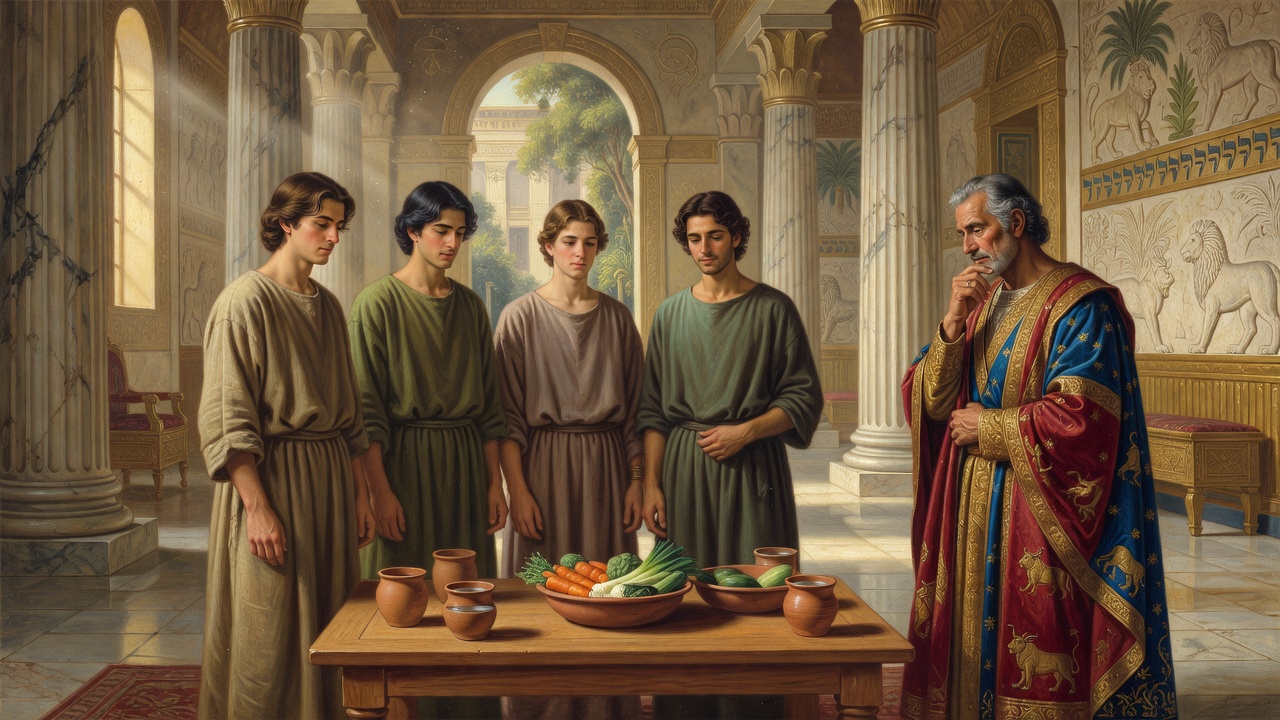
11Daniel conversó sobre este asunto con el mayordomo a quien el jefe del personal había encargado el cuidado de Daniel, Ananías, Misael y Azarías. 12Dijo Daniel: «Haz una prueba con nosotros. Por diez días danos de comer vegetales y de beber sólo agua. 13Al final de los diez días, compara nuestro aspecto con el de los jóvenes que comen la comida del rey, y entonces decide si nos dejas continuar comiendo vegetales y bebiendo agua».
14Por fin el mayordomo aceptó que se hiciera la prueba por diez días. 15Al finalizar los diez días, ¡Daniel y sus tres amigos parecían más saludables y mejor alimentados que los jóvenes que habían estado comiendo de la comida del rey! 16Así que después, el mayordomo los alimentó solamente con verduras y agua, retirando del menú los ricos manjares y vinos.
17Dios concedió a estos cuatro jóvenes gran facilidad para aprender y pronto ellos habían llegado a dominar toda la literatura y ciencia de aquel tiempo. Y a Daniel además le dio la habilidad de poder entender el significado de sueños y visiones.
18Cuando se completó el periodo de tres años de entrenamiento, el jefe del personal llevó a todos los jóvenes ante el rey Nabucodonosor. 19El rey habló con cada uno de ellos, y ninguno le impresionó tanto como lo hicieron Daniel, Ananías, Misael y Azarías. Por eso pasaron a ser miembros de su cuerpo permanente de consejeros. 20Y en todos los asuntos que requerían información adecuada y juicio equilibrado, el rey encontró que el consejo de estos jóvenes era diez veces mejor que el de los magos y agoreros de su reino. 21Daniel mantuvo este puesto de consejero del rey hasta el primer año del reinado del rey Ciro.
Did you know?
Faithfulness in the Babylonian Court
- Nebuchadnezzar selected handsome and educated young men from the Judean nobility to undergo three years of training in the language and literature of the Chaldeans (Dan 1:3–5). As part of their court integration, the chief official assigned them Babylonian names: Daniel became Belteshazzar, Hananiah became Shadrach, Mishael became Meshach, and Azariah became Abednego.Sources: the Bible text itself · Daniel · Shadrach · Azariah
- Rather than consume the assigned royal food and wine, Daniel requested a ten-day dietary test consisting solely of vegetables and water (Dan 1:8, 12). The steward overseeing their diet permitted the trial, and at the end of ten days, the four Hebrew youths appeared healthier and better nourished than those eating the king's fare.Sources: the Bible text itself · Melzar
- The opening chapter concludes by noting that Daniel continued until the first year of King Cyrus (Dan 1:21). Cyrus was the Persian ruler who conquered Babylon and later issued the decree allowing the Jewish captives to return home.Sources: the Bible text itself · Cyrus
Notes written with AI assistance from open sources (Theographic Bible Metadata, CC BY-SA 4.0; Easton’s Bible Dictionary, public domain) and reviewed before publishing.
Places in this chapter
- Babylon · 32.543, 44.422 · verses 1, 3
- Jerusalem · 31.777, 35.234 · verse 1
- Shinar · Today: Babylonia · 32.543, 44.422 · verse 2
- Chaldea · 30.962, 46.104 · verse 4
Only places identified with high confidence are shown (90% or more according to the scholarly sources compiled by OpenBible). Period map: DARE (Digital Atlas of the Roman Empire), CC BY 4.0; modern map: © OpenStreetMap contributors; places: OpenBible.info (CC BY 4.0).
Credits and license for this translation
Biblica® Open Nueva Biblia Viva 2008
The Holy Bible in Spanish: Biblica® Open Nueva Biblia Viva 2008 (Bible)
copyright © 2008 Biblica, Inc.
Language: Español
Contributor: Biblica, Inc.
Biblica® Open Nueva Biblia Viva™
Copyright © 2006, 2008 by Biblica, Inc.
“Biblica” es una marca registrada en la oficina de Patentes y Marcas de los Estados Unidos por Biblica, Inc. Usado con permiso.
“Biblica” is a trademark registered in the United States Patent and Trademark Office by Biblica, Inc. Used with permission.
Creative Commons license
This work is made available under the Creative Commons Attribution-ShareAlike 4.0 International License (CC BY-SA). To view a copy of this license, visit https://creativecommons.org/licenses/by-sa/4.0 or send a letter to Creative Commons, PO Box 1866, Mountain View, CA 94042, USA.
You have permission to copy and distribute this Work, as long as you do not change it and you keep the title as it is. Changing or translating this Work will create a derivative work. When you publish this derivative work, you must list what changes you have made where people can see them, such as on a website. You must also show where the original Work is from: “The original Work by its copyright holders is available for free at www.biblica.com and open.bible .”
Notice of copyright must appear on the title or copyright page of the work as follows:
Biblica® Open Nueva Biblia Viva™
Copyright © 2006, 2008 by Biblica, Inc.
“Biblica” es una marca registrada en la oficina de Patentes y Marcas de los Estados Unidos por Biblica, Inc. Usado con permiso.
“Biblica” is a trademark registered in the United States Patent and Trademark Office by Biblica, Inc. Used with permission.
You must also make your derivative work available under the same license (CC BY-SA).
If you would like to notify Biblica, Inc. regarding your translation of this work, please contact us at https://open.bible/#feedback .
This translation is made available to you under the terms of the
Creative Commons Attribution Share-Alike license 4.0.
You have permission to share and redistribute this Bible translation in any format and to make reasonable revisions and adaptations of this translation, provided that:
You include the above copyright and source information.
If you make any changes to the text, you must indicate that you did so in a way that makes it clear that the original licensor is not necessarily endorsing your changes.
If you redistribute this text, you must distribute your contributions under the same license as the original.
Pictures included with Scriptures and other documents on this site are licensed just for use with those Scriptures and documents.
For other uses, please contact the respective copyright owners.
Note that in addition to the rules above, revising and adapting God's Word involves a great responsibility to be true to God's Word. See Revelation 22:18-19.
2025-05-21
Source: http://ebible.org/spaonbv/ · eBible.org