2 Chronicles 1
Biblica® Open Nueva Biblia Viva 2008 · Tap a verse to see its cross-references.
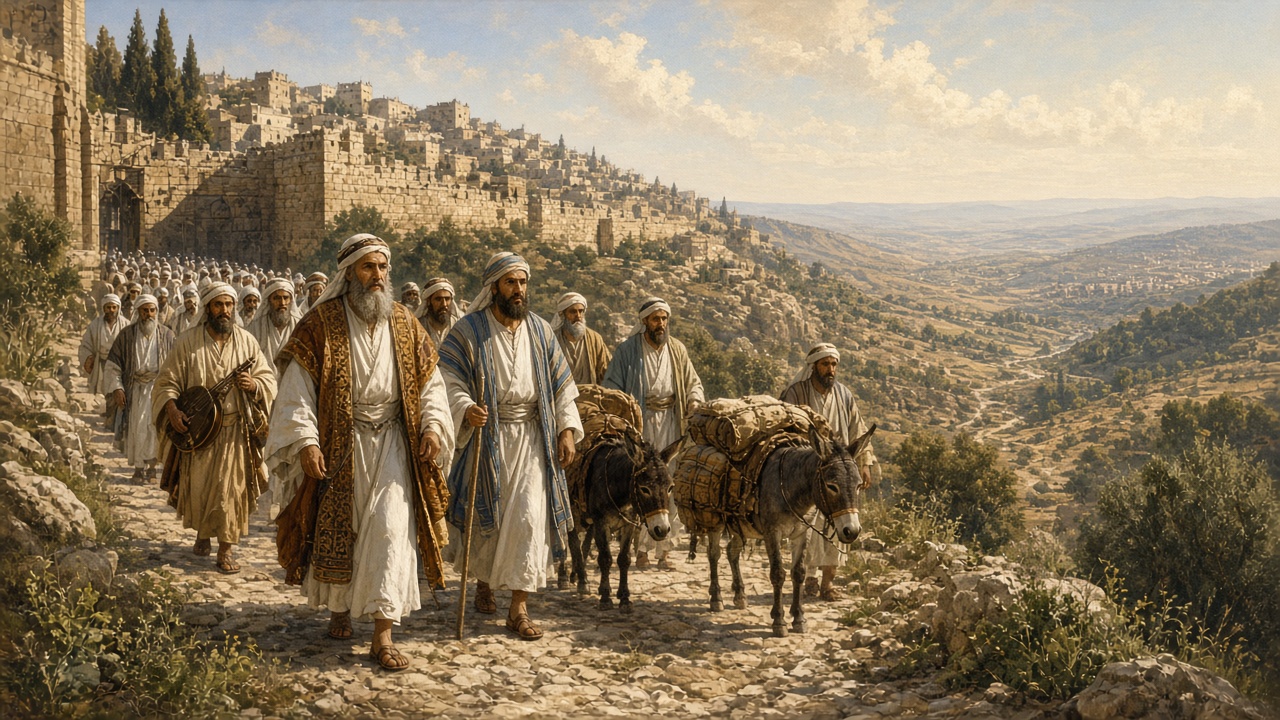
About this book
About 2 Chronicles
- Easton's Bible Dictionary (1897) reports that Jewish tradition, which he says was universally received until the middle of the seventeenth century, regarded Ezra as the author of Chronicles, an opinion he finds supported by many points of resemblance and contact with the Book of Ezra. He dates the composition after the Babylonian exile, probably between 450 and 435 B.C., noting that the language is, in its general character, Aramaean, like other books written after the exile, and that the writer gives details of Zerubbabel's family.Sources: Easton: Chronicles, Books of
- The two books of Chronicles were originally one. In the Masoretic Hebrew the title is Dibre hayyamim, “Acts of the Days,” which Jerome rendered Chronicon, hence Chronicles; the Septuagint divides the work and calls it Paraleipomena, “things omitted” or “supplements,” because it contains many things omitted in the Books of Kings. Easton groups the contents in four parts: genealogies in the line of Israel down to David, the reign of David, Solomon’s reign in the first nine chapters of the second book, and the history of the separate kingdom of Judah until the return from the Babylonian exile.Sources: Easton: Chronicles, Books of
- Easton presents these books as didactic rather than primarily historical: the writer’s principal aim appears to be moral and religious truth, and he gives less prominence to political events than Samuel and Kings do, and more to ecclesiastical institutions. He adds that the genealogies were an important part of the Hebrew state’s public records, the basis both for distributing and holding land and for arranging and conducting temple service, to which the Levites and their descendants alone were entitled.Sources: Easton: Chronicles, Books of
- The first nine chapters of 2 Chronicles recount the reign of Solomon, David’s son by Bathsheba, whom his father chose as successor. The remaining chapters follow the separate kingdom of Judah until the return from the Babylonian exile. Rehoboam succeeded Solomon, while the ten tribes revolted and invited Jeroboam, who had fled to Egypt, to become their first king.Sources: Easton: Chronicles, Books of · Solomon · Rehoboam · Jeroboam
- The book closes with the proclamation of Cyrus permitting the Jews to return to their own land. Easton notes that this ending and the beginning of Ezra are almost identical in expression, and he treats Ezra as a continuation of Chronicles.Sources: Easton: Chronicles, Books of
Notes written with AI assistance from open sources (Theographic Bible Metadata, CC BY-SA 4.0; Easton’s Bible Dictionary, public domain) and reviewed before publishing.
Salomón pide sabiduría
1Salomón, hijo de David, llegó a ser un rey muy poderoso, porque contaba con la ayuda del Señor su Dios.
2Salomón reunió en Gabaón a todos los oficiales del ejército, a los funcionarios del gobierno, a los jueces y a los jefes de las familias patriarcales de Israel. Los guio hacia la parte alta del cerro, donde estaba el antiguo santuario construido por Moisés, siervo del Señor, mientras el pueblo andaba por el desierto. 4(Había otro santuario en Jerusalén, que David hizo construir para colocar allí el cofre de Dios, cuando lo trasladó desde Quiriat Yearín). 5El altar de bronce que había hecho Bezalel hijo de Uri, y nieto de Jur, todavía se mantenía en pie frente al antiguo santuario del Señor. Por eso, Salomón y todos sus invitados se reunieron delante de él y ofrecieron al Señor mil ofrendas quemadas.
7Aquella noche Dios se presentó a Salomón y le dijo:
―¡Pídeme cualquier cosa, y te la daré!
8Salomón contestó:
―¡ Señor, tú fuiste bondadoso y bueno con mi padre David, y ahora me has dado el reino! 9Sólo una cosa puedo pedir, ya que has cumplido la promesa hecha a David mi padre y me has hecho rey sobre una nación tan numerosa como el polvo de la tierra. 10Te suplico que me des sabiduría e inteligencia para gobernar correctamente, porque ¿quién sería capaz de gobernar por sí mismo a una nación tan grande como este pueblo tuyo?
11Dios le respondió:
―Por cuanto tu más grande anhelo es ayudar a tu pueblo, y no has pedido riqueza personal ni honores, ni me has pedido que maldiga a tus enemigos, ni has solicitado una larga vida, sino que has pedido sabiduría y conocimiento para guiar a mi pueblo en forma adecuada, 12¡te doy la sabiduría y el conocimiento que has pedido! ¡Y también te daré riquezas, bienes y honores como ningún rey antes de ti los ha tenido! ¡Jamás habrá otro rey tan grande en todo el mundo!
13Salomón, entonces, salió del santuario que estaba en Gabaón, bajó del cerro, y regresó a Jerusalén para gobernar a Israel.
14Salomón acrecentó el número de sus caballos y de sus carros de combate. Fue así como llegó a tener mil cuatrocientos carros y reclutó doce mil jinetes, los cuales mantenía en los lugares de acuartelamiento y en Jerusalén, cerca de él. 15¡Durante el reinado de Salomón, la plata y el oro eran tan abundantes en Jerusalén como las piedras en los caminos! ¡Y la costosa madera de cedro se utilizaba como cualquier sicómoro común! 16Los comerciantes de la corte compraban en Egipto y Cilicia los caballos para el rey Salomón. 17En esa época, un carro de combate traído de Egipto costaba seiscientas monedas de plata, y un caballo costaba ciento cincuenta monedas de plata. Muchos eran luego vendidos a los reyes de los hititas y de los sirios.
Did you know?
Solomon’s Wisdom and Wealth
- At the start of Solomon's reign, Israel's primary sacred furnishings were divided between two sites. The wilderness Tent of Meeting made under Moses, along with the bronze altar crafted by Bezalel, was stationed at the high place in Gibeon, while the Ark of the Covenant rested in a separate tent pitched by David in Jerusalem.Sources: the Bible text itself · Gibeon · Bezaleel
- When God appeared to Solomon at Gibeon and invited him to make a request, the young king asked specifically for wisdom and knowledge to govern his numerous people. In response, God granted him discernment alongside unmatched riches, wealth, and honor.Sources: the Bible text itself · Solomon
- Solomon established a lucrative international trade network, importing horses from Egypt and Kue and chariots from Egypt. Royal merchants acted as middlemen, exporting these valuable military assets to the kings of the Hittites and of Aram.Sources: the Bible text itself · Kue · Egypt
Notes written with AI assistance from open sources (Theographic Bible Metadata, CC BY-SA 4.0; Easton’s Bible Dictionary, public domain) and reviewed before publishing.
Places in this chapter
- Gibeon · Today: El Jib · 31.847, 35.183 · verses 3, 5, 13
- Jerusalem · 31.777, 35.234 · verses 4, 13, 14, 15
- Kiriath-jearim · Today: Deir el Azar · 31.809, 35.104 · verse 4
- Shephelah · 31.692, 34.875 · verse 15
- Egypt · 30.129, 31.308 · verses 16, 17
- Syria · Today: Aram · 33.511, 36.306 · verse 17
Only places identified with high confidence are shown (90% or more according to the scholarly sources compiled by OpenBible). Period map: DARE (Digital Atlas of the Roman Empire), CC BY 4.0; modern map: © OpenStreetMap contributors; places: OpenBible.info (CC BY 4.0).
Credits and license for this translation
Biblica® Open Nueva Biblia Viva 2008
The Holy Bible in Spanish: Biblica® Open Nueva Biblia Viva 2008 (Bible)
copyright © 2008 Biblica, Inc.
Language: Español
Contributor: Biblica, Inc.
Biblica® Open Nueva Biblia Viva™
Copyright © 2006, 2008 by Biblica, Inc.
“Biblica” es una marca registrada en la oficina de Patentes y Marcas de los Estados Unidos por Biblica, Inc. Usado con permiso.
“Biblica” is a trademark registered in the United States Patent and Trademark Office by Biblica, Inc. Used with permission.
Creative Commons license
This work is made available under the Creative Commons Attribution-ShareAlike 4.0 International License (CC BY-SA). To view a copy of this license, visit https://creativecommons.org/licenses/by-sa/4.0 or send a letter to Creative Commons, PO Box 1866, Mountain View, CA 94042, USA.
You have permission to copy and distribute this Work, as long as you do not change it and you keep the title as it is. Changing or translating this Work will create a derivative work. When you publish this derivative work, you must list what changes you have made where people can see them, such as on a website. You must also show where the original Work is from: “The original Work by its copyright holders is available for free at www.biblica.com and open.bible .”
Notice of copyright must appear on the title or copyright page of the work as follows:
Biblica® Open Nueva Biblia Viva™
Copyright © 2006, 2008 by Biblica, Inc.
“Biblica” es una marca registrada en la oficina de Patentes y Marcas de los Estados Unidos por Biblica, Inc. Usado con permiso.
“Biblica” is a trademark registered in the United States Patent and Trademark Office by Biblica, Inc. Used with permission.
You must also make your derivative work available under the same license (CC BY-SA).
If you would like to notify Biblica, Inc. regarding your translation of this work, please contact us at https://open.bible/#feedback .
This translation is made available to you under the terms of the
Creative Commons Attribution Share-Alike license 4.0.
You have permission to share and redistribute this Bible translation in any format and to make reasonable revisions and adaptations of this translation, provided that:
You include the above copyright and source information.
If you make any changes to the text, you must indicate that you did so in a way that makes it clear that the original licensor is not necessarily endorsing your changes.
If you redistribute this text, you must distribute your contributions under the same license as the original.
Pictures included with Scriptures and other documents on this site are licensed just for use with those Scriptures and documents.
For other uses, please contact the respective copyright owners.
Note that in addition to the rules above, revising and adapting God's Word involves a great responsibility to be true to God's Word. See Revelation 22:18-19.
2025-05-21
Source: http://ebible.org/spaonbv/ · eBible.org