Ruth 1
Biblica® Open Nova Bíblia Viva 2007 · Tap a verse to see its cross-references.
About this book
About Ruth
- The events are set in the days of the judges. A great famine led Elimelech, a man of the tribe of Judah and a kinsman of Boaz, to leave Bethlehem with his wife Naomi and their sons Mahlon and Chilion and settle in Moab, east of the Jordan and the Dead Sea. There Elimelech and both sons died.Sources: Elimelech · Moab · Mahlon · Chilion
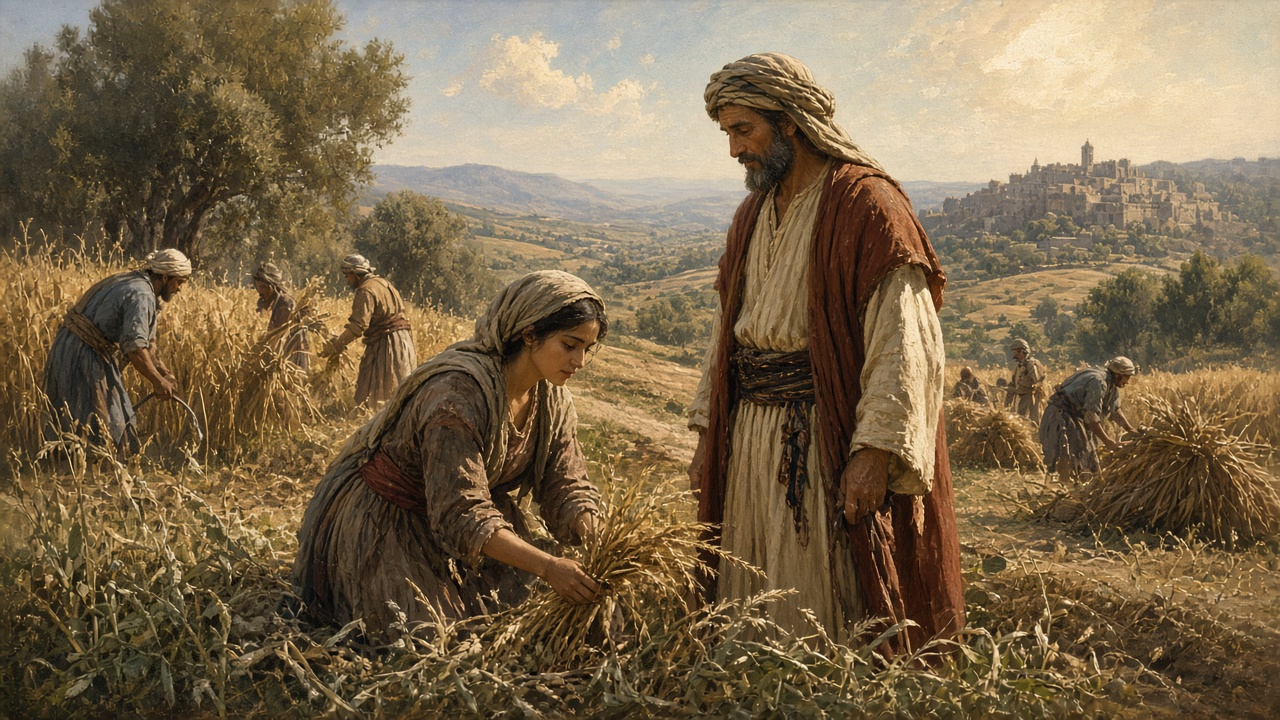
- Naomi then returned to Bethlehem with Ruth, a Moabite and the widow of Mahlon, who refused to leave her. Orpah, Chilion's widow, accompanied Naomi part of the way and then returned to Moab. In the valley east of the town, Ruth gleaned in the fields and was eventually married to Boaz, a wealthy relative.Sources: Easton: Ruth · Orpah · Bethlehem · Boaz
- Easton's Bible Dictionary (1897) says the story of the gleaner Ruth illustrates friendly relations between Boaz and his reapers, the land system, the way property was transferred, and the working of the Mosaic law for the relief of ruined families. By the levirate law, Boaz, a kinsman of Mahlon, took on the duty of marrying Ruth.Sources: Easton: Ruth · Boaz
- Ruth became the mother of Obed, the grandfather of David. The genealogy in Ruth 4:18-22 traces that line, and Matthew 1:5 includes Ruth, a Gentile, among the ancestors of Jesus. Easton also compares her with Tamar and Rahab, who likewise became ancestors of David.Sources: Easton: Ruth · Obed · Ruth
- Bethlehem, in the hill country of Judah, was originally called Ephrath; Ruth 1:2 calls it Bethlehem-Judah and its people Ephrathites. Easton's Bible Dictionary (1897) explains Ruth as meaning a friend, and Naomi as bitter or sad, a symbolic name she gave herself because of her misfortunes.Sources: Bethlehem · Ephrathah · Ruth · Naomi
Notes written with AI assistance from open sources (Theographic Bible Metadata, CC BY-SA 4.0; Easton’s Bible Dictionary, public domain) and reviewed before publishing.
Noemi fica viúva
1Quando Israel era dirigido pelos juízes, houve fome na terra, e um homem que morava em Belém, em Judá, abandonou o país por causa da fome e foi morar na terra de Moabe. Levou consigo a sua esposa e seus dois filhos. 2Esse homem chamava-se Elimeleque, e a sua mulher, Noemi; os dois filhos, Malom e Quiliom. Eram efrateus de Belém de Judá. Eles foram para Moabe e ficaram morando ali.
3Enquanto moravam em Moabe, Elimeleque morreu e Noemi ficou sozinha com seus dois filhos. 4Os dois jovens, Malom e Quiliom, casaram-se com mulheres de Moabe, uma chamada Orfa e a outra Rute, e ficaram morando lá por quase dez anos. 5Depois disso, morreram também Malom e Quiliom, e Noemi ficou completamente só, sem o seu marido e sem os dois filhos.
A lealdade de Rute a Noemi
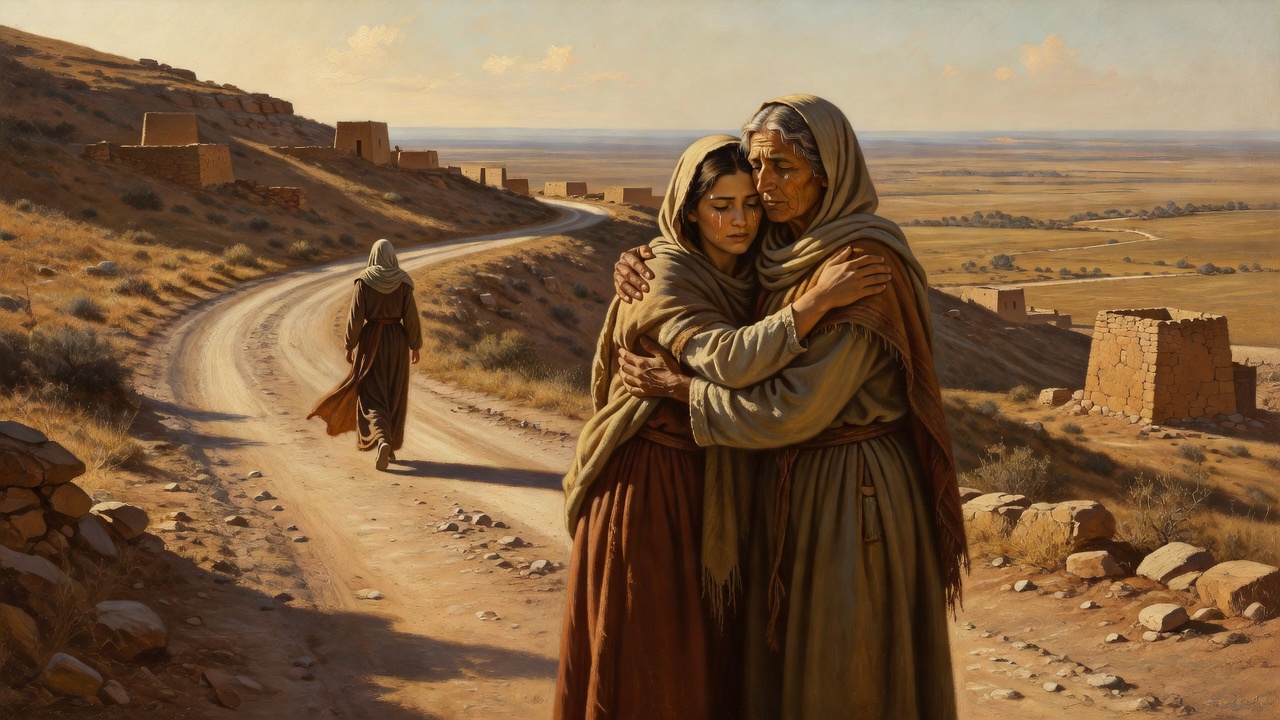
6Ela decidiu voltar para Israel deixando o território de Moabe, pois tinha ouvido que o Senhor havia abençoado o povo judeu com boas colheitas! As noras foram junto com ela. 7Assim, ela e as duas noras saíram do lugar onde tinham morado.
Enquanto estavam a caminho para a terra de Judá, 8Noemi disse às suas noras: “Por que vocês não voltam para as casas de suas mães? Eu desejo sinceramente que o Senhor recompense vocês duas por terem sido fiéis aos seus maridos e a mim. 9Que o Senhor conceda que cada uma de vocês encontre um outro marido”.
Noemi beijou suas noras, e elas começaram a chorar em voz alta, 10e disseram a ela: “Não! Queremos ir com a senhora, viver com o seu povo!”
11Noemi, porém, respondeu: “É melhor que vocês voltem para seu povo, minhas filhas. Por que viriam comigo? Será que eu poderia ter mais filhos para que se tornassem os seus maridos no futuro? 12Não, minhas filhas; voltem para suas casas, pois eu já sou velha demais para ter outro marido. E mesmo se eu tivesse marido, e estivesse esperando filhos, 13vocês iriam esperar até que eles crescessem? Não, é claro que não, minhas filhas! É mais amargo para mim do que para vocês, porque o Senhor voltou-se contra mim!”
14Choraram juntas mais uma vez, e Orfa se despediu da sogra com um beijo, voltando para a casa de sua família; Rute, porém, insistiu em ficar com Noemi.
15“Pense bem”, disse Noemi a ela, “sua cunhada voltou ao seu povo e aos seus deuses; volte também com a sua cunhada”.
16Mas Rute respondeu: “Não insista para que eu a abandone, pois quero ir aonde a senhora for, e viver onde a senhora viver. O seu povo será o meu povo e o seu Deus será o meu Deus! 17Eu quero morrer onde a senhora morrer e aí desejo ser enterrada. Deus pode fazer o que ele quiser comigo se eu deixar que alguma coisa, senão a morte, me separe da senhora”.
18Quando Noemi viu que Rute estava decidida e que não havia jeito de convencê-la, não insistiu mais.
O retorno a Belém
19E partiram. Quando chegaram a Belém, todo o povoado ficou agitado por causa delas.
“Será que é Noemi mesmo?”, perguntavam as mulheres. 20Noemi, porém, lhes dizia: “Não me chamem Noemi; chamem-me Mara. Porque o Deus Todo-poderoso tornou a minha vida amarga! 21Eu parti cheia de alegria, de mãos cheias, mas o Senhor me trouxe de volta de mãos vazias. Por que então vocês me chamam Noemi, quando Deus me voltou as costas e trouxe tanto sofrimento para mim?”
22Quando Noemi e sua nora moabita Rute voltaram das terras de Moabe e chegaram a Belém, a colheita de cevada estava começando.
Did you know?
Naomi and Ruth Return to Bethlehem
- In the days when the judges ruled, famine forced Elimelech and his family from Bethlehem in the hill country of Judah to migrate to the land of Moab, east of the Dead Sea. After the deaths of Elimelech and her two sons, Naomi decided to return to Bethlehem when she heard that food was once again available in Judah.Sources: the Bible text itself · Bethlehem · Moab · Elimelech
- While Orpah returned to her people and gods in Moab, Ruth clung to her mother-in-law and pledged loyalty to Naomi and her God. Ruth, a Moabite woman, traveled to Bethlehem and would later become an ancestor of King David.Sources: the Bible text itself · Ruth · Orpah
- Upon arriving in Bethlehem at the beginning of the barley harvest, Naomi asked the women of the city to call her Mara, meaning bitter, because she felt the Almighty had dealt bitterly with her. She had departed full with a husband and two sons, but returned empty after their deaths.Sources: the Bible text itself · Naomi
Notes written with AI assistance from open sources (Theographic Bible Metadata, CC BY-SA 4.0; Easton’s Bible Dictionary, public domain) and reviewed before publishing.
Places in this chapter
- Bethlehem · 31.704, 35.208 · verses 1, 2, 19, 22
- Moab · Today: Moab 1 · 31.181, 35.701 · verses 1, 2, 4, 6, 22
Only places identified with high confidence are shown (90% or more according to the scholarly sources compiled by OpenBible). Period map: DARE (Digital Atlas of the Roman Empire), CC BY 4.0; modern map: © OpenStreetMap contributors; places: OpenBible.info (CC BY 4.0).
Credits and license for this translation
Biblica® Open Nova Bíblia Viva 2007
Portuguese: Biblica® Open Nova Bíblia Viva 2007 (Bible)
copyright © 2007, 2010 Biblica, Inc.
Language: Português
Dialect: Brazil
Contributor: Biblica, Inc.
Biblica® Open Nova Bíblia Viva™
Copyright © 2007, 2010 by Biblica, Inc.
“Biblica” é uma marca registrada na Oficina de Patentes e Marcas dos Estados Unidos por Biblica, Inc. Usado com permissão.
“Biblica” is a trademark registered in the United States Patent and Trademark Office by Biblica, Inc. Used with permission.
――――――
Creative Commons license
This work is made available under the Creative Commons Attribution-ShareAlike 4.0 International License (CC BY-SA). To view a copy of this license, visit https://creativecommons.org/licenses/by-sa/4.0 or send a letter to Creative Commons, PO Box 1866, Mountain View, CA 94042, USA.
You have permission to copy and distribute this Work, as long as you do not change it and you keep the title as it is. Changing or translating this Work will create a derivative work. When you publish this derivative work, you must list what changes you have made where people can see them, such as on a website. You must also show where the original Work is from: “The original Work by its copyright holders is available for free at www.biblica.com and open.bible .”
Notice of copyright must appear on the title or copyright page of the work as follows:
Biblica® Open Nova Bíblia Viva™
Copyright © 2007, 2010 by Biblica, Inc.
“Biblica” é uma marca registrada na Oficina de Patentes e Marcas dos Estados Unidos por Biblica, Inc. Usado com permissão.
“Biblica” is a trademark registered in the United States Patent and Trademark Office by Biblica, Inc. Used with permission.
You must also make your derivative work available under the same license (CC BY-SA).
If you would like to notify Biblica, Inc. regarding your translation of this work, please contact us at https://open.bible/#feedback .
This translation is made available to you under the terms of the
Creative Commons Attribution Share-Alike license 4.0.
You have permission to share and redistribute this Bible translation in any format and to make reasonable revisions and adaptations of this translation, provided that:
You include the above copyright and source information.
If you make any changes to the text, you must indicate that you did so in a way that makes it clear that the original licensor is not necessarily endorsing your changes.
If you redistribute this text, you must distribute your contributions under the same license as the original.
Pictures included with Scriptures and other documents on this site are licensed just for use with those Scriptures and documents.
For other uses, please contact the respective copyright owners.
Note that in addition to the rules above, revising and adapting God's Word involves a great responsibility to be true to God's Word. See Revelation 22:18-19.
2025-05-20
Section headings adapted from the Berean Standard Bible (public domain); they are not part of this translation’s text.
Source: http://ebible.org/poronbv/ · eBible.org