Revelation 1
Biblica® Open Nova Bíblia Viva 2007 · Tap a verse to see its cross-references.
About this book
About Revelation
- Easton's Bible Dictionary (1897) identifies the author as the apostle John, whose name appears four times in the book (1:1, 4, 9; 22:8). The same entry says the date has generally been fixed at A.D. 96, under Domitian, while some contend for A.D. 68 or 69, under Nero. Those who favor the later date appeal to the Christian father Irenaeus, who had received information about the book from people that had seen John face to face, and who said that the Apocalypse “was seen no long time ago.”Sources: Easton: Revelation, Book of
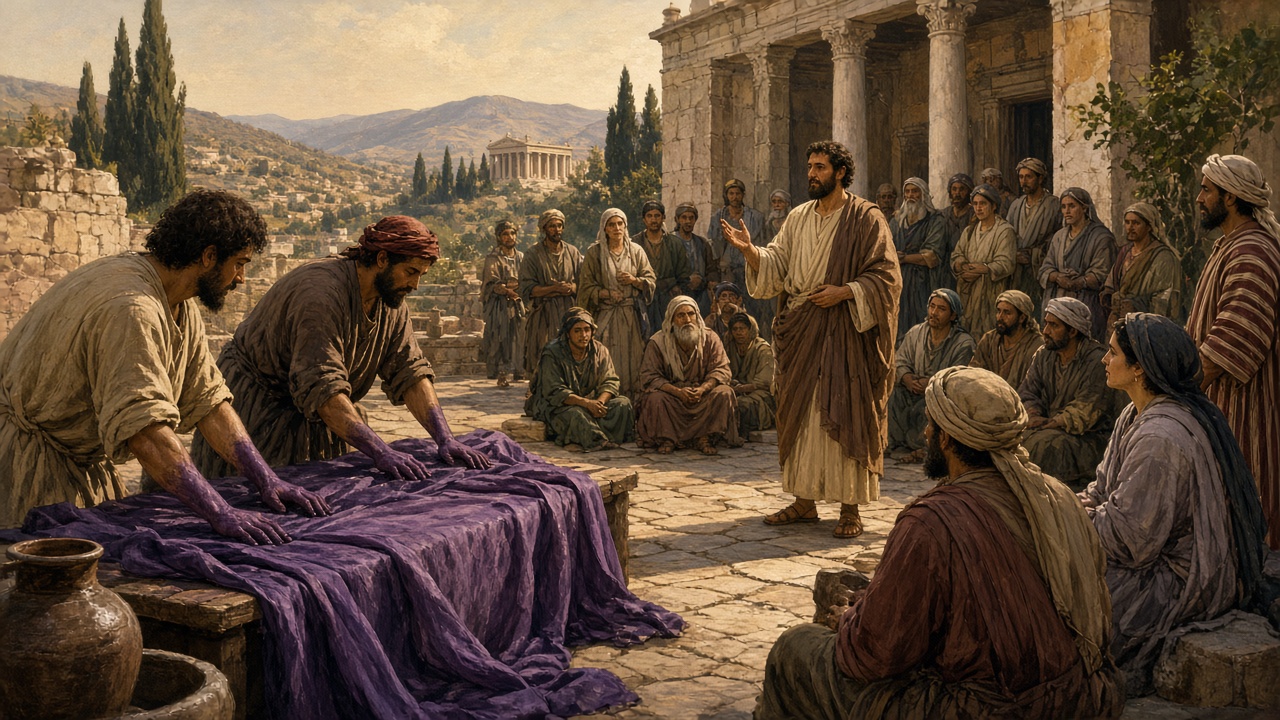
- Revelation names churches in cities of Asia Minor. Thyatira, on the borders of Lydia and Mysia and long famous for dyeing, and Sardis, the metropolis of Lydia on the river Pactolus at the foot of Mount Tmolus, were each one of the seven churches. Laodicea, on the confines of Phrygia and Lydia, beside the Lycus about forty miles east of Ephesus, is also cited; it had been called Diospolis and then Rhoas before Antiochus II of Syria rebuilt it and named it for his wife Laodice.Sources: Thyatira · Sardis · Laodicea
- Easton's Bible Dictionary (1897) calls Revelation the Apocalypse, the closing book and the only prophetical book of the New Testament canon. Citing Plummer, it says this book and the Gospel of John share the same leading ideas: one gives a magnificent vision, the other a great historic drama, of the supreme conflict between good and evil and its outcome. In both, the entry adds, Jesus Christ is the central figure, whose victory through defeat is that outcome, and his warfare and triumph are described in language saturated with the Old Testament.Sources: Easton: Revelation, Book of
- A manuscript of about the twelfth century calls the author “John the divine,” though Easton's Bible Dictionary (1897) says no reason can be assigned for that title. In the book, Satan is called “the dragon” and “the old serpent,” and Antipas is named a “faithful martyr,” of whom nothing more is certainly known.Sources: Easton: Revelation, Book of · Satan · Antipas
Notes written with AI assistance from open sources (Theographic Bible Metadata, CC BY-SA 4.0; Easton’s Bible Dictionary, public domain) and reviewed before publishing.
Prólogo
1Revelação de Jesus Cristo sobre acontecimentos que em breve devem acontecer. Deus permitiu que numa visão ele revelasse estas coisas aos seus servos. Ele enviou um anjo do céu para explicar o significado da visão. 2João pôs tudo por escrito — as palavras de Deus e de Jesus Cristo, e tudo o que ele ouviu. 3Feliz aquele que lê as palavras desta profecia e felizes aqueles que ouvem e guardam o que nela está escrito, pois está próximo o tempo quando todas estas coisas se cumprirão.
Saudação às sete igrejas
4João, às sete igrejas da província da Ásia.
A vocês graça e paz de Deus, aquele que é, que era e que virá, e dos sete espíritos que se acham diante do trono dele; 5e de Jesus Cristo, que revela fielmente toda a verdade a nós. Ele foi o primeiro a se levantar da morte, para não morrer mais. Ele é muitíssimo mais importante do que qualquer rei em toda a terra. Ele nos ama sempre e nos libertou dos nossos pecados ao derramar o seu sangue por nós. 6Ele nos reuniu no seu reino e nos fez sacerdotes de Deus, o seu Pai. A ele seja dada glória eterna! Ele reina para sempre! Amém!
7Vejam! Ele vem chegando, com as nuvens; e todo olho o verá — incluindo aqueles que o traspassaram. E todas as nações da terra se lamentarão de tristeza por causa dele. Certamente assim será! Amém!
8“Eu sou o Alfa e o Ômega, o princípio e o fim de todas as coisas”, diz Deus, que é o Senhor, o Todo-poderoso, o que é, o que era e que virá outra vez!
A visão de João em Patmos
9Sou eu, João, irmão de vocês e companheiro no sofrimento por causa do Senhor, quem lhes está escrevendo esta carta. Eu também tenho participado da perseverança que Jesus concede, e nós participaremos do reino dele!
Eu estava na ilha de Patmos, para onde tinha sido levado por causa da palavra de Deus e por causa do que sabia a respeito de Jesus. 10Era o dia do Senhor, e eu estava adorando e achei-me no Espírito, quando subitamente ouvi uma forte voz atrás de mim. Era uma voz que soava como um toque de trombeta, 11dizendo: “Ponha por escrito tudo o que você vê e mande a sua carta às sete igrejas: à igreja de Éfeso, à de Esmirna e às de Pérgamo, Tiatira, Sardes, Filadélfia e Laodiceia”.
12Quando me voltei para ver quem estava falando, ali atrás de mim estavam sete castiçais de ouro. 13E entre os castiçais achava-se alguém “semelhante a um filho de homem”, vestido de um manto comprido que chegava aos seus pés, e uma faixa de ouro ao redor do peito. 14O cabelo dele era branco como a lã ou a neve, e os olhos eram labaredas de fogo. 15Os pés brilhavam como o bronze polido e a sua voz ressoava como o som de muitas águas. 16Ele segurava na mão direita sete estrelas e da sua boca saía uma afiada espada de dois gumes; e o rosto dele brilhava como a força do sol do meio-dia.
17Quando eu o vi, caí aos pés dele como morto; porém ele pôs a mão direita em cima de mim e disse: “Não tenha medo! Eu sou o primeiro e o último, 18o vivente que morreu, mas que agora está vivo para sempre. Eu tenho as chaves da morte e do inferno! 19Ponha por escrito o que você acaba de ver e as coisas que acontecerão depois. 20Este é o significado das sete estrelas que você viu na minha mão direita e dos sete castiçais de ouro: As sete estrelas são os sete anjos das sete igrejas, e os sete castiçais são as sete igrejas.
Did you know?
A vision on Patmos for the churches of Asia
- John writes that he was on the island of Patmos because of the word of God and his testimony about Jesus. Patmos is a small, rocky, and barren island in the Sporades, in the Aegean Sea, and it is mentioned in Scripture only in this chapter. Easton's Bible Dictionary (1897) states that the emperor Domitian banished John there in A.D. 95, and that he received this revelation on the island.Sources: the Bible text itself · Patmos
- The message is addressed to seven churches in the province of Asia, the Roman province of Proconsular Asia, which covered the western part of Asia Minor and had Ephesus as its capital. John is told to write on a scroll what he sees and send it to Ephesus, Smyrna, Pergamum, Thyatira, Sardis, Philadelphia, and Laodicea, the seven churches of that province.Sources: the Bible text itself · Asia
- Ephesus, the provincial capital, bore the Roman title "the first and greatest metropolis of Asia." It was known for the temple of Diana and for an open-air theatre, the largest in the world, able to hold 50,000 spectators. Thyatira, on the borders of Lydia and Mysia, was famous for dyeing; Sardis, the metropolis of Lydia, stood on the river Pactolus at the foot of Mount Tmolus; and Laodicea lay about forty miles east of Ephesus, on the banks of the Lycus.Sources: Ephesus · Thyatira · Sardis · Laodicea
Notes written with AI assistance from open sources (Theographic Bible Metadata, CC BY-SA 4.0; Easton’s Bible Dictionary, public domain) and reviewed before publishing.
Places in this chapter
- Asia · 38.400, 28.300 · verses 4, 11
- Patmos · 37.325, 26.542 · verse 9
- Ephesus · 37.939, 27.341 · verse 11
- Laodicea · Today: Laodicea on the Lycus · 37.836, 29.108 · verse 11
- Pergamum · Today: Pergamon · 39.132, 27.184 · verse 11
- Philadelphia · Today: Alaşehir · 38.350, 28.517 · verse 11
- Sardis · 38.488, 28.040 · verse 11
- Smyrna · Today: Izmir · 38.419, 27.138 · verse 11
- Thyatira · Today: Akhisar · 38.920, 27.837 · verse 11
Only places identified with high confidence are shown (90% or more according to the scholarly sources compiled by OpenBible). Period map: DARE (Digital Atlas of the Roman Empire), CC BY 4.0; modern map: © OpenStreetMap contributors; places: OpenBible.info (CC BY 4.0).
Credits and license for this translation
Biblica® Open Nova Bíblia Viva 2007
Portuguese: Biblica® Open Nova Bíblia Viva 2007 (Bible)
copyright © 2007, 2010 Biblica, Inc.
Language: Português
Dialect: Brazil
Contributor: Biblica, Inc.
Biblica® Open Nova Bíblia Viva™
Copyright © 2007, 2010 by Biblica, Inc.
“Biblica” é uma marca registrada na Oficina de Patentes e Marcas dos Estados Unidos por Biblica, Inc. Usado com permissão.
“Biblica” is a trademark registered in the United States Patent and Trademark Office by Biblica, Inc. Used with permission.
――――――
Creative Commons license
This work is made available under the Creative Commons Attribution-ShareAlike 4.0 International License (CC BY-SA). To view a copy of this license, visit https://creativecommons.org/licenses/by-sa/4.0 or send a letter to Creative Commons, PO Box 1866, Mountain View, CA 94042, USA.
You have permission to copy and distribute this Work, as long as you do not change it and you keep the title as it is. Changing or translating this Work will create a derivative work. When you publish this derivative work, you must list what changes you have made where people can see them, such as on a website. You must also show where the original Work is from: “The original Work by its copyright holders is available for free at www.biblica.com and open.bible .”
Notice of copyright must appear on the title or copyright page of the work as follows:
Biblica® Open Nova Bíblia Viva™
Copyright © 2007, 2010 by Biblica, Inc.
“Biblica” é uma marca registrada na Oficina de Patentes e Marcas dos Estados Unidos por Biblica, Inc. Usado com permissão.
“Biblica” is a trademark registered in the United States Patent and Trademark Office by Biblica, Inc. Used with permission.
You must also make your derivative work available under the same license (CC BY-SA).
If you would like to notify Biblica, Inc. regarding your translation of this work, please contact us at https://open.bible/#feedback .
This translation is made available to you under the terms of the
Creative Commons Attribution Share-Alike license 4.0.
You have permission to share and redistribute this Bible translation in any format and to make reasonable revisions and adaptations of this translation, provided that:
You include the above copyright and source information.
If you make any changes to the text, you must indicate that you did so in a way that makes it clear that the original licensor is not necessarily endorsing your changes.
If you redistribute this text, you must distribute your contributions under the same license as the original.
Pictures included with Scriptures and other documents on this site are licensed just for use with those Scriptures and documents.
For other uses, please contact the respective copyright owners.
Note that in addition to the rules above, revising and adapting God's Word involves a great responsibility to be true to God's Word. See Revelation 22:18-19.
2025-05-20
Section headings adapted from the Berean Standard Bible (public domain); they are not part of this translation’s text.
Source: http://ebible.org/poronbv/ · eBible.org