Lamentations 1
Biblica® Open Nova Bíblia Viva 2007 · Tap a verse to see its cross-references.
About this book
About Lamentations
- In the Hebrew canon the book is called 'Ekhah, meaning “How,” the formula that opens a song of wailing and the first word of the book. The Septuagint adopted the name rendered “Lamentations” (Greek threnoi, equivalent to Hebrew qinoth) to mark its character, and in the Hebrew Bible it is placed among the Khethubim.Sources: Easton: Lamentations, Book of
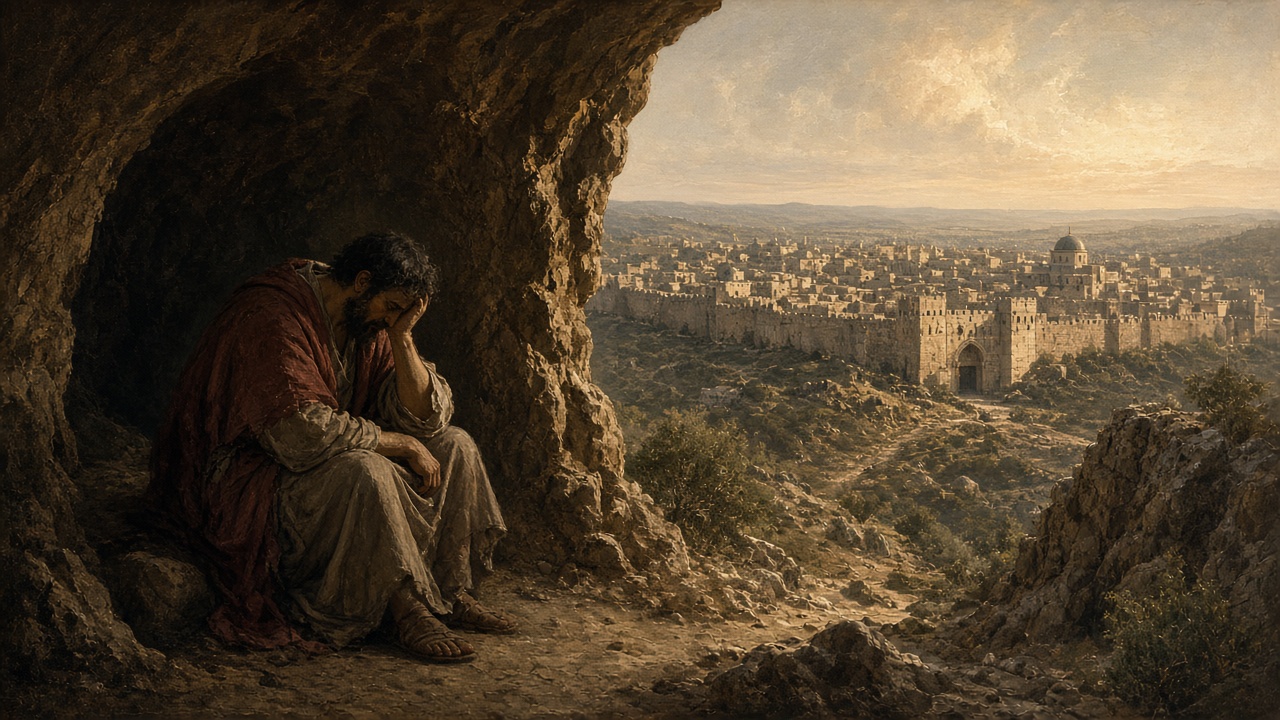
- The Septuagint and the Targum ascribe Lamentations to Jeremiah, and Easton's Bible Dictionary (1897) follows that tradition. Tradition says that after Nebuchadnezzar destroyed Jerusalem he withdrew to a cavern outside the Damascus gate and wrote the book there, mourning the desolations the Chaldeans brought on the city and the holy land; the dictionary notes that the cavern was still pointed out, and local belief placed the “grotto of Jeremiah” in the face of a rocky hill on the western side of the city.Sources: Easton: Lamentations, Book of
- The book consists of five separate poems. The first four are acrostics, like Psalms 25, 34, 37, and 119: each verse begins with a letter of the Hebrew alphabet in order. Chapters 1, 2, and 4 each have twenty-two verses, the number of letters in the Hebrew alphabet; chapter 3 has sixty-six verses, with each letter beginning three successive verses; chapter 5 is not an acrostic.Sources: Easton: Lamentations, Book of
- In chapter 1 the prophet dwells on the many miseries under which the city sits as a solitary widow, weeping sorely. Chapter 2 describes those miseries in connection with the national sins that had caused them; chapter 3 speaks of hope for the people of God, that the chastisement would only be for their good and that a better day would dawn; chapter 4 laments the ruin and desolation of the city and the temple and traces it only to the people’s sins; and chapter 5 is a prayer that the reproach of Zion—the south-eastern hill of Jerusalem, called the city of David—might be taken away in the people’s repentance and recovery.Sources: Easton: Lamentations, Book of · Zion
- At the Wailing-place of the Jews in Jerusalem, a portion of the old wall of Solomon’s temple, Schaff reported that Jews assembled every Friday afternoon to bewail the fall of the holy city, kissing the stone wall and watering it with their tears, and that they repeated the Lamentations of Jeremiah and suitable psalms from worn Hebrew Bibles and prayer books.Sources: Easton: Lamentations, Book of
Notes written with AI assistance from open sources (Theographic Bible Metadata, CC BY-SA 4.0; Easton’s Bible Dictionary, public domain) and reviewed before publishing.
Como jaz solitária a cidade!
1A cidade que antes vivia cheia de gente está deserta! Chora de tristeza a mulher que perdeu o marido. Antes ela era a rainha entre as províncias, mas agora não passa de uma escrava.
2Durante a noite, ela chora sem parar. As lágrimas escorrem pelo seu rosto, e nenhum dos seus antigos amantes vem consolá-la. Os que antes eram seus amigos a traíram e se tornaram seus inimigos.
3Os judeus foram transformados em escravos, sofrendo com o trabalho pesado; eles foram espalhados entre as outras nações; agora não têm lar para descansar. Os inimigos de Judá se vingaram e fizeram os judeus sofrer muito.
4As estradas de Sião estão tristes e vazias; não há ninguém para ir às festas religiosas no templo; os portões da cidade estão desertos. Os sacerdotes gemem de tristeza. As jovens de Jerusalém estão desesperadas. A cidade de Sião está em angústia profunda.
5Os inimigos de Jerusalém estão alegres, satisfeitos com sua vitória. O Senhor castigou Jerusalém por causa dos terríveis pecados que ela cometeu. As criancinhas da cidade foram feitas escravas e levadas para longe.
6Toda a beleza, toda a glória de Jerusalém acabou. Os seus príncipes são cervos que não acham pasto; sem forças fugiram do perseguidor.
7Agora que é escrava, que está cheia de tristeza e sem lar, Jerusalém se lembra da riqueza e da alegria do passado. Quando os inimigos chegaram e prenderam todo o povo, ninguém veio ajudá-la. E Jerusalém se lembra de como os seus inimigos zombaram dela, quando foi destruída!
8Os pecados de Jerusalém foram tão terríveis que ela se tornou impura. Os que antes eram seus amigos, hoje a desprezam porque viram Jerusalém nua e humilhada. Por isso, ela chora e esconde o rosto, envergonhada.
9Ela praticou a imoralidade, e nem quis pensar no castigo que viria. Por isso o seu fim foi tão terrível; ela não tem ninguém que a console. “Ó Senhor”, ela pede chorando, “veja o meu sofrimento. O inimigo me venceu e zomba de mim”.
10Os inimigos de Jerusalém roubaram as coisas que eram mais preciosas para ela. Os judeus viram outras nações entrando no templo, as quais Deus tinha proibido de participar das assembleias.
11Os moradores de Jerusalém gemem de fome, pedem chorando um pedaço de pão; trocam seus tesouros por comida para não morrer de fome. “Olha, ó Senhor, como tenho sido desprezada”.
12Será que o meu sofrimento não significa nada para vocês que passam por mim? Vocês nunca acharão alguém que esteja sofrendo mais do que eu. O Senhor me castigou terrivelmente no dia da sua ira.
13Ele mandou fogo do céu que está queimando os meus ossos; ele colocou uma armadilha para os meus pés e me abandonou, doente e sozinha, o dia inteiro.
14Ele amarrou os meus pecados com uma corda num jugo e os colocou em meu pescoço. O Senhor tirou a minha força e me entregou na mão dos meus inimigos; estou completamente indefesa.
15O Senhor dispersou os meus soldados mais valentes. Reuniu um grande exército para destruir os jovens mais nobres. O Senhor esmagou a virgem filha de Judá como alguém esmaga as uvas com os pés.
16É por isso que eu estou chorando; eu estou me desmanchando em lágrimas. O meu Consolador está longe de mim; só ele poderia restaurar o meu espírito. Não há esperança para meus filhos porque o inimigo prevaleceu.
17Sião pede ajuda, mas não há quem a console. O Senhor ordenou: “Os vizinhos de Israel serão seus inimigos! Todos vão considerar Jerusalém uma coisa imunda!”
18E o Senhor tem toda a razão em me castigar porque eu teimei em desobedecer às suas ordens. E agora, povos e nações, vejam como é grande o meu sofrimento! Meus filhos e minhas filhas foram levados como escravos.
19Pedi socorro aos meus aliados. Esperei em vão — porque eles me enganaram. Os sacerdotes e os homens experientes da cidade também morreram enquanto procuravam algum resto de comida para matar sua fome.
20Senhor, veja o meu sofrimento; estou desesperada, o meu coração está quebrado de tanta dor. E tudo isso porque eu me revoltei contra o Senhor. Nas ruas, os inimigos matam os filhos; em casa impera a morte.
21Os meus gemidos têm sido ouvidos, mas não aparece ninguém para me consolar. Os meus inimigos ouviram da minha triste situação e ficaram muito contentes com o castigo que o Senhor me deu. Mas eles também vão ser castigados, no dia que o Senhor já anunciou. Então eles vão sofrer e chorar como eu.
22Olhe para todos os pecados que eles cometeram, Senhor. Dê a eles o mesmo castigo que deu a mim por causa dos meus pecados. Estou gemendo e soluçando sem parar e o meu coração já está fraco.
Did you know?
The Desolation of Jerusalem
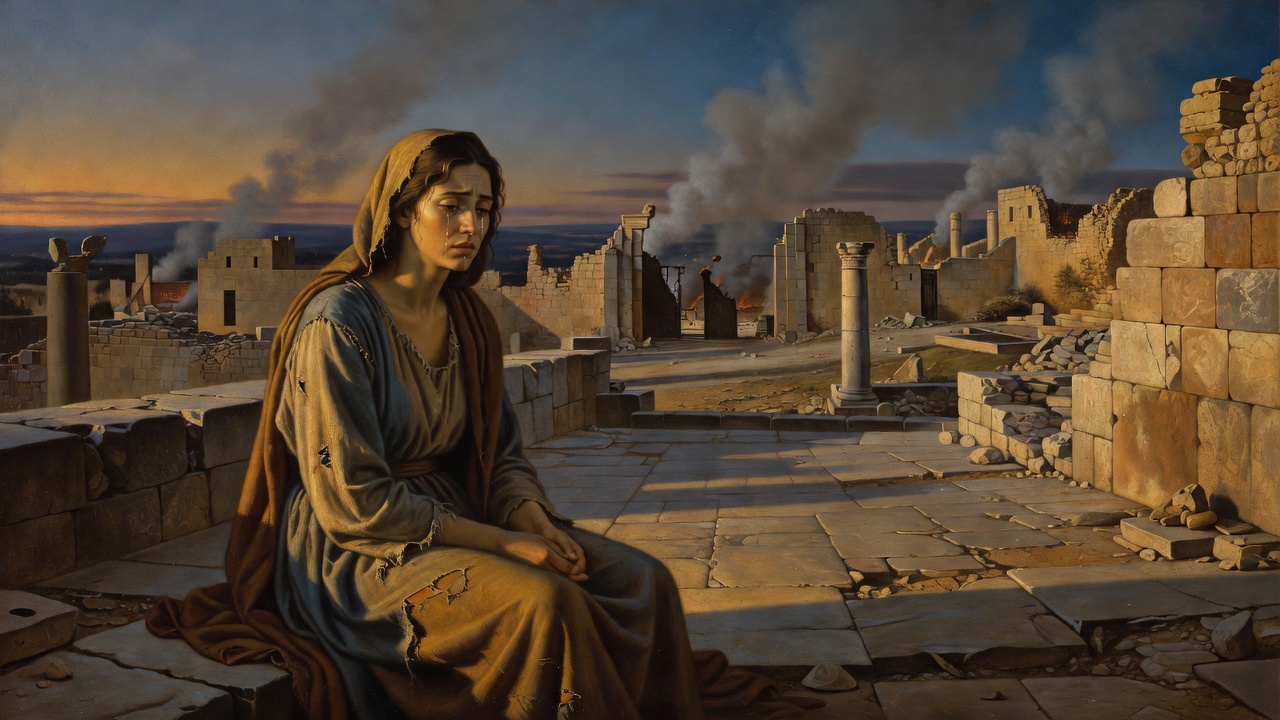
- Lamentations portrays Jerusalem—also called Zion after the historic hill fortified by King David—as a grieving widow stripped of her majesty, abandoned by former allies, and forced into harsh servitude following the city's destruction.Sources: the Bible text itself · Jerusalem · Zion
- The poem highlights the cessation of religious life, noting that the roads leading to Zion lie empty because pilgrims no longer journey there for appointed festival feasts, while foreign invaders have entered and seized the sacred sanctuary.Sources: the Bible text itself · Zion
- During and after the siege, the surviving population experienced severe famine, with priests, elders, and common citizens trading their remaining family treasures just to obtain enough bread to survive.Sources: the Bible text itself
Notes written with AI assistance from open sources (Theographic Bible Metadata, CC BY-SA 4.0; Easton’s Bible Dictionary, public domain) and reviewed before publishing.
Places in this chapter
- Jerusalem · 31.777, 35.234 · verses 1, 5, 7, 8, 17, 18
- Zion · Today: Jerusalem · 31.777, 35.234 · verses 4, 6, 17
Only places identified with high confidence are shown (90% or more according to the scholarly sources compiled by OpenBible). Period map: DARE (Digital Atlas of the Roman Empire), CC BY 4.0; modern map: © OpenStreetMap contributors; places: OpenBible.info (CC BY 4.0).
Credits and license for this translation
Biblica® Open Nova Bíblia Viva 2007
Portuguese: Biblica® Open Nova Bíblia Viva 2007 (Bible)
copyright © 2007, 2010 Biblica, Inc.
Language: Português
Dialect: Brazil
Contributor: Biblica, Inc.
Biblica® Open Nova Bíblia Viva™
Copyright © 2007, 2010 by Biblica, Inc.
“Biblica” é uma marca registrada na Oficina de Patentes e Marcas dos Estados Unidos por Biblica, Inc. Usado com permissão.
“Biblica” is a trademark registered in the United States Patent and Trademark Office by Biblica, Inc. Used with permission.
――――――
Creative Commons license
This work is made available under the Creative Commons Attribution-ShareAlike 4.0 International License (CC BY-SA). To view a copy of this license, visit https://creativecommons.org/licenses/by-sa/4.0 or send a letter to Creative Commons, PO Box 1866, Mountain View, CA 94042, USA.
You have permission to copy and distribute this Work, as long as you do not change it and you keep the title as it is. Changing or translating this Work will create a derivative work. When you publish this derivative work, you must list what changes you have made where people can see them, such as on a website. You must also show where the original Work is from: “The original Work by its copyright holders is available for free at www.biblica.com and open.bible .”
Notice of copyright must appear on the title or copyright page of the work as follows:
Biblica® Open Nova Bíblia Viva™
Copyright © 2007, 2010 by Biblica, Inc.
“Biblica” é uma marca registrada na Oficina de Patentes e Marcas dos Estados Unidos por Biblica, Inc. Usado com permissão.
“Biblica” is a trademark registered in the United States Patent and Trademark Office by Biblica, Inc. Used with permission.
You must also make your derivative work available under the same license (CC BY-SA).
If you would like to notify Biblica, Inc. regarding your translation of this work, please contact us at https://open.bible/#feedback .
This translation is made available to you under the terms of the
Creative Commons Attribution Share-Alike license 4.0.
You have permission to share and redistribute this Bible translation in any format and to make reasonable revisions and adaptations of this translation, provided that:
You include the above copyright and source information.
If you make any changes to the text, you must indicate that you did so in a way that makes it clear that the original licensor is not necessarily endorsing your changes.
If you redistribute this text, you must distribute your contributions under the same license as the original.
Pictures included with Scriptures and other documents on this site are licensed just for use with those Scriptures and documents.
For other uses, please contact the respective copyright owners.
Note that in addition to the rules above, revising and adapting God's Word involves a great responsibility to be true to God's Word. See Revelation 22:18-19.
2025-05-20
Section headings adapted from the Berean Standard Bible (public domain); they are not part of this translation’s text.
Source: http://ebible.org/poronbv/ · eBible.org