John 2
Biblica® Open Nova Bíblia Viva 2007 · Tap a verse to see its cross-references.
As Bodas de Caná
1No terceiro dia foi realizado um casamento no povoado em Caná da Galileia. A mãe de Jesus estava ali. 2Jesus e seus discípulos também foram convidados para o casamento. 3Durante a festa o vinho acabou, e a mãe de Jesus veio a ele e disse: “Eles não têm mais vinho”.
4“Mulher, que tenho eu com você?”, disse ele. “Ainda não chegou a minha hora”.
5Todavia, a mãe disse aos empregados: “Façam tudo o que ele disser a vocês”.
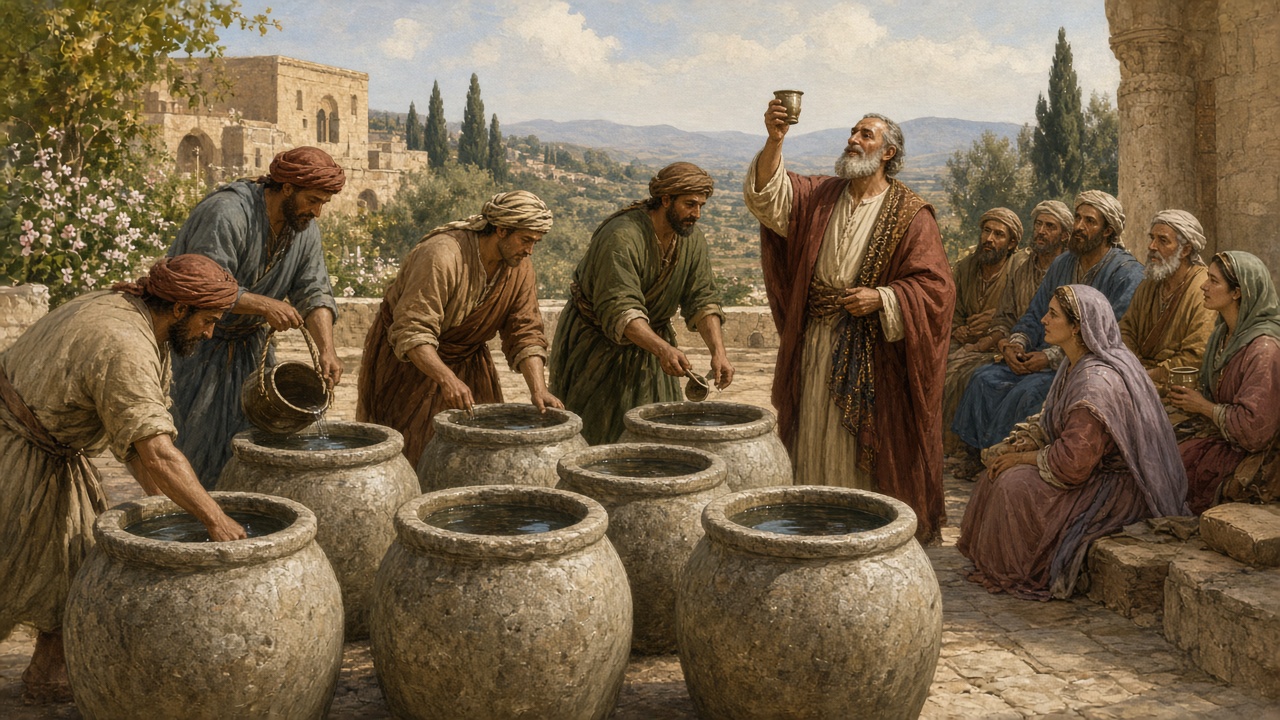
6Havia ali seis talhas de pedra; elas eram utilizadas nas cerimônias de purificação, e em cada uma cabiam entre 80 e 120 litros.
7Então Jesus disse aos empregados: “Encham as talhas de água”. Quando isso foi feito, 8ele disse: “Tirem um pouco e levem ao mestre de cerimônias”.
E eles levaram. 9Quando o mestre de cerimônias experimentou a água, que já tinha sido transformada em vinho, não sabendo de onde vinha (embora os empregados soubessem), chamou o noivo 10e disse: “O senhor é diferente de todos os outros! Geralmente o dono da festa serve primeiro o vinho melhor, e depois, quando todo mundo está satisfeito e não se importa mais, o vinho inferior é servido. Mas o senhor guardou o melhor para o fim!”
11Este milagre em Caná da Galileia foi o primeiro que Jesus realizou. Ele revelou a sua glória, e os seus discípulos creram nele.
Jesus Purifica o Templo
12Depois desse casamento, ele foi com sua mãe, seus irmãos e seus discípulos passar alguns dias em Cafarnaum.
13Quando chegou a época da comemoração anual da Páscoa dos judeus, Jesus foi para Jerusalém. 14No pátio do templo, ele achou os comerciantes vendendo bois, ovelhas e pombos para sacrifícios; e os homens de negócios nas suas mesas, trocando dinheiro. 15Jesus fez um chicote com umas cordas e expulsou todos do templo, bem como as ovelhas e os bois, espalhando no chão as moedas dos negociantes, virando as mesas deles! 16Depois ele chegou aos homens que vendiam pombos, e disse: “Tirem essas coisas daqui! Não transformem a casa do meu Pai em um mercado!”
17Então seus discípulos se lembraram desta profecia das Escrituras: “O grande zelo que tenho pela sua casa me consome”.
18“Que direito o Senhor tem de mandar todos saírem?”, perguntaram os judeus. “Se recebeu essa autoridade de Deus, mostre-nos um milagre que prove isso”.
19“Pois bem”, respondeu Jesus. “Destruam este santuário, e em três dias eu o levantarei!”
20“Como?”, exclamaram eles. “Levou 46 anos para construir-se este templo, e o Senhor vai levantá-lo em três dias?” 21Acontece que o templo do qual ele falava era o seu corpo. 22Mais tarde, quando Jesus ressuscitou, os seus discípulos se lembraram que ele havia dito isso. Então creram na Escritura e na palavra que Jesus dissera.
23Por causa dos milagres que Jesus fez em Jerusalém durante a comemoração da Páscoa, muitos creram em seu nome. 24Mas Jesus não confiava neles, porque os conhecia muito bem. 25Ninguém precisava dar testemunho acerca do homem, pois ele bem conhecia a natureza humana!
Did you know?
From a wedding in Cana to the temple in Jerusalem
- Cana, a town of Galilee near Capernaum, is not mentioned in the Old Testament. Some identify it with Kana el-Jelil, also called Khurbet Kana, eight or nine miles north of Nazareth; others with Kefr Kenna, about five miles northeast of Nazareth and twelve miles in a direct line from Tiberias, on the road toward the Sea of Galilee. There Jesus performed the first of his signs, turning water into wine at a wedding.Sources: Cana · the Bible text itself
- After the wedding, Jesus went down to Capernaum with his mother, his brothers, and his disciples, and they stayed a few days. Capernaum, “Nahum’s town,” was a Galilean city not mentioned in the Old Testament. After he was expelled from Nazareth, it became his own city.Sources: the Bible text itself · Capernaum
- When the Jewish Passover was near, Jesus went up to Jerusalem, a mountain city. Its name, in a dual form, means “possession of peace” or “foundation of peace,” probably referring to the mountains Zion and Moriah or, as some suppose, to the upper and lower city; modern Arabs call it el-Khuds, “the holy.” Those who demanded a sign said the temple had taken forty-six years to build, and a chronology dates this Passover and the temple incident to AD 27.Sources: the Bible text itself · Jerusalem · First Passover and Temple Cleansing
Notes written with AI assistance from open sources (Theographic Bible Metadata, CC BY-SA 4.0; Easton’s Bible Dictionary, public domain) and reviewed before publishing.
Places in this chapter
Only places identified with high confidence are shown (90% or more according to the scholarly sources compiled by OpenBible). Period map: DARE (Digital Atlas of the Roman Empire), CC BY 4.0; modern map: © OpenStreetMap contributors; places: OpenBible.info (CC BY 4.0).
Credits and license for this translation
Biblica® Open Nova Bíblia Viva 2007
Portuguese: Biblica® Open Nova Bíblia Viva 2007 (Bible)
copyright © 2007, 2010 Biblica, Inc.
Language: Português
Dialect: Brazil
Contributor: Biblica, Inc.
Biblica® Open Nova Bíblia Viva™
Copyright © 2007, 2010 by Biblica, Inc.
“Biblica” é uma marca registrada na Oficina de Patentes e Marcas dos Estados Unidos por Biblica, Inc. Usado com permissão.
“Biblica” is a trademark registered in the United States Patent and Trademark Office by Biblica, Inc. Used with permission.
――――――
Creative Commons license
This work is made available under the Creative Commons Attribution-ShareAlike 4.0 International License (CC BY-SA). To view a copy of this license, visit https://creativecommons.org/licenses/by-sa/4.0 or send a letter to Creative Commons, PO Box 1866, Mountain View, CA 94042, USA.
You have permission to copy and distribute this Work, as long as you do not change it and you keep the title as it is. Changing or translating this Work will create a derivative work. When you publish this derivative work, you must list what changes you have made where people can see them, such as on a website. You must also show where the original Work is from: “The original Work by its copyright holders is available for free at www.biblica.com and open.bible .”
Notice of copyright must appear on the title or copyright page of the work as follows:
Biblica® Open Nova Bíblia Viva™
Copyright © 2007, 2010 by Biblica, Inc.
“Biblica” é uma marca registrada na Oficina de Patentes e Marcas dos Estados Unidos por Biblica, Inc. Usado com permissão.
“Biblica” is a trademark registered in the United States Patent and Trademark Office by Biblica, Inc. Used with permission.
You must also make your derivative work available under the same license (CC BY-SA).
If you would like to notify Biblica, Inc. regarding your translation of this work, please contact us at https://open.bible/#feedback .
This translation is made available to you under the terms of the
Creative Commons Attribution Share-Alike license 4.0.
You have permission to share and redistribute this Bible translation in any format and to make reasonable revisions and adaptations of this translation, provided that:
You include the above copyright and source information.
If you make any changes to the text, you must indicate that you did so in a way that makes it clear that the original licensor is not necessarily endorsing your changes.
If you redistribute this text, you must distribute your contributions under the same license as the original.
Pictures included with Scriptures and other documents on this site are licensed just for use with those Scriptures and documents.
For other uses, please contact the respective copyright owners.
Note that in addition to the rules above, revising and adapting God's Word involves a great responsibility to be true to God's Word. See Revelation 22:18-19.
2025-05-20
Section headings adapted from the Berean Standard Bible (public domain); they are not part of this translation’s text.
Source: http://ebible.org/poronbv/ · eBible.org