Genesis 46
Biblica® Open Nova Bíblia Viva 2007 · Tap a verse to see its cross-references.
A Viagem de Jacó para o Egito
1Israel partiu com tudo o que possuía. Ele parou em Berseba e ofereceu sacrifícios ao Deus de seu pai Isaque. 2Ainda em Berseba, Deus falou de noite com Israel por meio de visões. Deus disse: “Jacó! Jacó!”
Ele respondeu: “Eis-me aqui!”
3“Eu sou Deus, o Deus do seu pai”, disse ele. “Não tema em descer para o Egito, porque lá eu farei de você uma grande nação. 4Estarei com você na viagem para o Egito e certamente o trarei de volta. E a mão de José fechará os seus olhos”.
5Então Jacó deixou Berseba. E os filhos de Israel levaram o seu pai, seus filhos e suas mulheres nas carruagens mandadas pelo faraó. 6Levaram os seus rebanhos e os bens que tinham conseguido em Canaã, e Jacó e toda a sua família foram para o Egito.
Os que Foram para o Egito
7Levou para aquela terra seus filhos, seus netos, suas filhas e suas netas, ou seja, toda a sua descendência.
Os Filhos de Lia
8Estes são os nomes dos israelitas, Jacó e os seus filhos, que foram para o Egito:
Rúben, o filho mais velho de Jacó. 9Os filhos de Rúben: Enoque, Palu, Hezrom e Carmi. 10Simeão e seus filhos Jemueel, Jamim, Oade, Jaquim, Zoar e Saul, que era filho de uma cananeia. 11Levi e seus filhos Gérson, Coate e Merari. 12Judá e seus filhos Er, Onã, Selá, Perez e Zerá. Er e Onã morreram na terra de Canaã. Perez e seus filhos Hezrom e Hamul. 13Issacar e seus filhos Tolá, Puva, Jó e Sinrom. 14Zebulom e seus filhos Serede, Elom e Jaleel. 15Foram esses os filhos de Jacó e de Lia nascidos em Padã-Arã. Diná também era filha dela. No total, entre filhos e filhas, netos e netas, eram trinta e três pessoas.
Os Filhos de Zilpa
16Gade e seus filhos: Zifiom, Hagi, Suni, Esbom, Eri, Arodi e Areli. 17Aser e seus filhos: Imna, Isvá, Isvi, Berias e a irmã deles, Sera. Os filhos de Berias foram Héber e Malquiel. 18Foram esses os filhos que Jacó teve com Zilpa, serva que Labão deu a sua filha Lia. Ao todo, os filhos e filhas, netos e netas de Zilpa eram dezesseis pessoas.
Os Filhos de Raquel
19Os filhos de Raquel, a mulher de Jacó, José e Benjamim. 20No Egito nasceram estes filhos de José e de Azenate, filha de Potífera, sacerdote de Om: Manassés e Efraim. 21Os filhos de Benjamim: Bela, Bequer, Asbel, Gera, Naamã, Eí, Rôs, Mupim, Hupim e Arde. 22Foram esses os filhos de Jacó e de Raquel. Ao todo, eram catorze pessoas.
Os Filhos de Bila
23Dã e seu filho Husim. 24Naftali e seus filhos Jazeel, Guni, Jezer e Silém. 25Foram esses os filhos de Bila, que Labão deu à sua filha Raquel. Bila deu à luz sete filhos.
26Todos os que foram com Jacó para o Egito, todos os seus descendentes, sem contar as mulheres e seus filhos, somavam sessenta e seis pessoas. 27Com mais os dois filhos que nasceram de José no Egito, somando os membros da família de Jacó que foram para o Egito, eram setenta pessoas.
Jacó Chega ao Egito
28Jacó mandou Judá à frente até José, para saber o caminho para Gósen. Quando eles chegaram, 29José mandou preparar uma carruagem, e foi encontrar-se com seu pai em Gósen. Ao vê-lo, José o abraçou e chorou. E ficou muito tempo abraçado ao pai, chorando.
30Israel disse a José: “Agora já posso morrer, pois já vi o seu rosto. Encontrei o meu filho vivo!”
31E José disse aos irmãos e a toda a família de seu pai: “Vou falar com o faraó e lhe direi: ‘Meus irmãos e toda a família de meu pai, que estavam na terra de Canaã, vieram para cá. 32Os homens são pastores e criadores de gado. Eles trouxeram consigo os rebanhos, o seu gado e tudo o que têm’. 33Quando, pois, o faraó perguntar qual é a profissão de vocês, 34respondam assim: ‘Estes seus servos criam rebanhos desde pequenos. Esse também era o trabalho dos nossos antepassados’. Assim, vocês poderão ficar morando na terra de Gósen, porque os pastores são desprezados pelos egípcios”.
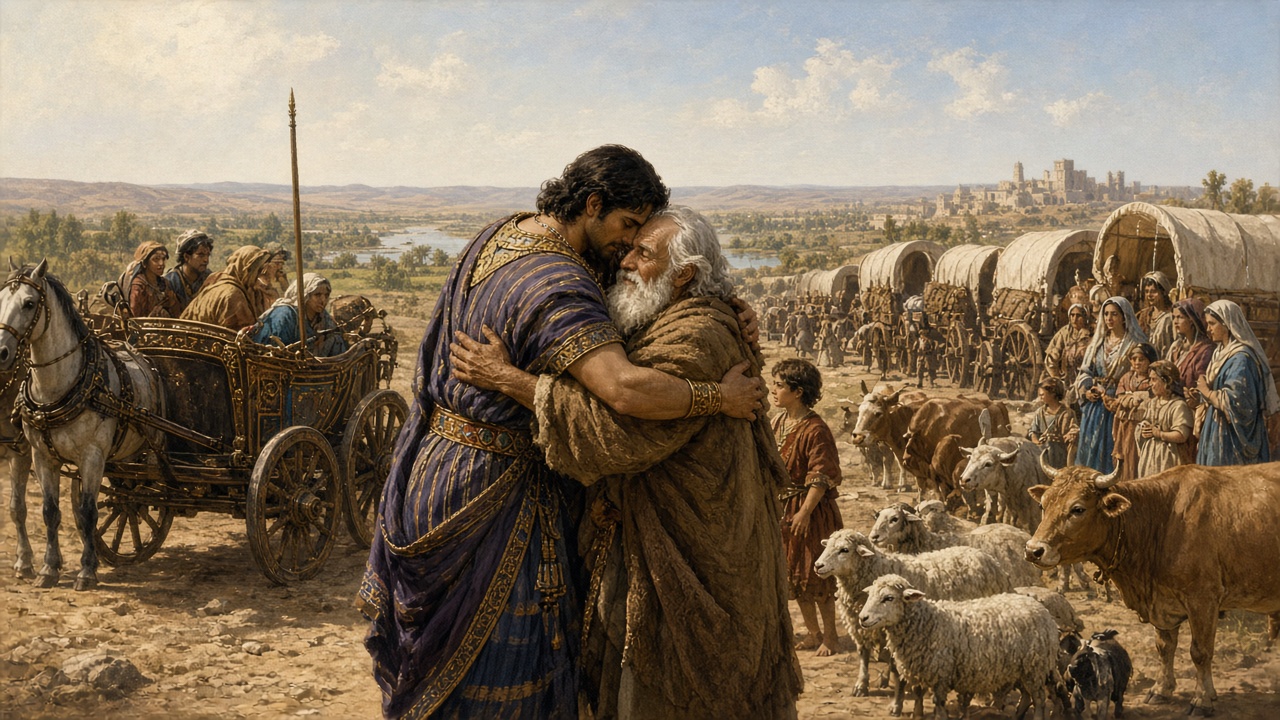
Did you know?
Israel Goes Down to Egypt
- As Israel set out for Egypt with all that he had, he stopped at Beersheba and offered sacrifices to the God of his father Isaac. Beersheba, meaning well of the oath or well of seven, was a well Abraham dug and named after a compact with Abimelech; when Isaac reopened it, he gave it the same name. It was a favorite dwelling of both patriarchs, and there that night God spoke to Jacob in a vision, telling him not to fear going down to Egypt, for he would make him a great nation there.Sources: the Bible text itself · Beersheba
- Jacob sent Judah ahead to Joseph for directions to Goshen, an Egyptian district east of the Nile, apparently near the royal residence, where the family remained until the Exodus. Easton's Bible Dictionary (1897) calls it the best of the land, now a desert, and also the land of Rameses. Joseph told his brothers to say they had raised livestock from youth, so they might settle there, because shepherds were detestable to the Egyptians; that dictionary suggests Pharaoh was probably Apopi, last of the Hyksos, who welcomed these Asiatic shepherds, while native Egyptians abhorred them, though some argue Joseph arrived later, under Thothmes III, after the Hyksos were expelled.Sources: the Bible text itself · Goshen · Pharaoh (of Joseph)
- The chapter counts sixty-six of Jacob's direct descendants who came to Egypt, not counting the wives of his sons, and seventy when Joseph's two sons already born in Egypt are included. Leah's sons and her daughter Dinah are named in that tally, although Easton's Bible Dictionary (1897) says Leah herself had died in Canaan before the journey and was buried in the cave of Machpelah; Rachel had died earlier giving birth to Benjamin and was buried on the way to Ephrath, that is, Bethlehem. Manasseh and Ephraim were born to Joseph in Egypt by Asenath, daughter of Potiphera, priest of On, a center of sun-worship that the Septuagint and Vulgate call Heliopolis.Sources: the Bible text itself · Leah · Rachel · On
Notes written with AI assistance from open sources (Theographic Bible Metadata, CC BY-SA 4.0; Easton’s Bible Dictionary, public domain) and reviewed before publishing.
Places in this chapter
- Egypt · 30.129, 31.308 · verses 1, 3, 4, 5, 6, 7, 8, 20, 26, 27
- Canaan · 32.767, 35.333 · verses 6, 12, 31
- Heliopolis · Today: Ain Shams · 30.129, 31.308 · verse 20
- Goshen · Today: Goshen 1 · 30.799, 31.834 · verses 28, 29, 34
Only places identified with high confidence are shown (90% or more according to the scholarly sources compiled by OpenBible). Period map: DARE (Digital Atlas of the Roman Empire), CC BY 4.0; modern map: © OpenStreetMap contributors; places: OpenBible.info (CC BY 4.0).
Credits and license for this translation
Biblica® Open Nova Bíblia Viva 2007
Portuguese: Biblica® Open Nova Bíblia Viva 2007 (Bible)
copyright © 2007, 2010 Biblica, Inc.
Language: Português
Dialect: Brazil
Contributor: Biblica, Inc.
Biblica® Open Nova Bíblia Viva™
Copyright © 2007, 2010 by Biblica, Inc.
“Biblica” é uma marca registrada na Oficina de Patentes e Marcas dos Estados Unidos por Biblica, Inc. Usado com permissão.
“Biblica” is a trademark registered in the United States Patent and Trademark Office by Biblica, Inc. Used with permission.
――――――
Creative Commons license
This work is made available under the Creative Commons Attribution-ShareAlike 4.0 International License (CC BY-SA). To view a copy of this license, visit https://creativecommons.org/licenses/by-sa/4.0 or send a letter to Creative Commons, PO Box 1866, Mountain View, CA 94042, USA.
You have permission to copy and distribute this Work, as long as you do not change it and you keep the title as it is. Changing or translating this Work will create a derivative work. When you publish this derivative work, you must list what changes you have made where people can see them, such as on a website. You must also show where the original Work is from: “The original Work by its copyright holders is available for free at www.biblica.com and open.bible .”
Notice of copyright must appear on the title or copyright page of the work as follows:
Biblica® Open Nova Bíblia Viva™
Copyright © 2007, 2010 by Biblica, Inc.
“Biblica” é uma marca registrada na Oficina de Patentes e Marcas dos Estados Unidos por Biblica, Inc. Usado com permissão.
“Biblica” is a trademark registered in the United States Patent and Trademark Office by Biblica, Inc. Used with permission.
You must also make your derivative work available under the same license (CC BY-SA).
If you would like to notify Biblica, Inc. regarding your translation of this work, please contact us at https://open.bible/#feedback .
This translation is made available to you under the terms of the
Creative Commons Attribution Share-Alike license 4.0.
You have permission to share and redistribute this Bible translation in any format and to make reasonable revisions and adaptations of this translation, provided that:
You include the above copyright and source information.
If you make any changes to the text, you must indicate that you did so in a way that makes it clear that the original licensor is not necessarily endorsing your changes.
If you redistribute this text, you must distribute your contributions under the same license as the original.
Pictures included with Scriptures and other documents on this site are licensed just for use with those Scriptures and documents.
For other uses, please contact the respective copyright owners.
Note that in addition to the rules above, revising and adapting God's Word involves a great responsibility to be true to God's Word. See Revelation 22:18-19.
2025-05-20
Section headings adapted from the Berean Standard Bible (public domain); they are not part of this translation’s text.
Source: http://ebible.org/poronbv/ · eBible.org