Genesis 4
Waratau Siaga Tatuei mo Vilegi · Tap a verse to see its cross-references.
Ken mo wehi Ebol.
1I Tevue mo maturugi gahorana Wesue mo tinogi na maresu mo bamba Ken, Wesue mo veve vena, “I Huqe u bului eu, neu nau bulusi na tangaloi a mwera.” 2Taligu mo bamba netune tuegi a henana i Ebol, Ebol a tangaloi leogoro sibsib i Ken nge a tangaloi ririvue. 3Lolo taro matue i Ken mo wali na bulana mwasi rivurivu mo voragi na nona hogogo lawe na Huqe. 4I Ebol vage mo wali na totogai bulana sibsib rau damoe. Siu Huqe mo havuhevugi Ebol mena nona hure bonboni. 5Nge i Huqe Mauri vi hevuhevu te mei Ken mena nona hure bonboni. Mo vai i Ken mero mo romasi. 6I Huqe mo veve lawe Ken, “?Huri havagi gom mero siu gom romasi huri na havagi? 7Tareve a doridori mu garea nain rongarea i niko nge tareve doridori mu hi garea tea, me a landomu mo eno lo gineu esi, a asiana mo raraigo lo turegimu, mo rarai ve na laigo nge niko hogosie goin qaragi nie.” 8I Ken mo veve lawe tuana Ebol, “Doro vano lolo talu.” Lo taro ngere lolo talu i Ken mo maraga mo ue vagamate Ebol. 9I Huqe mo veve lawe Ken, “?Tuem Ebol nge logo?” Ken mo duvie move, “?Nahi iloe tea? ?Huri ve neu nam leogoro tuegu?” 10Huqe mo veve move, “?Gu vei na havagi? A diloi dai tuemu mo ngara lolo tano. 11Siserigi ngaha gom toga lo vavai arahiana dena tano hilogo nge mo wawanga huri ve na lai na dai tuemu dena limemu. 12Tavohe goin tabana lo tano vin he bete na mwasi ririvue garea tea lawego niko, goin toga te surigi siu goin vuragi na tangaloi dige radu lo ure.” 13Ken mo veve lawe na Huqe, “Noku vevegiana u lawualawuagi huri ve nain weli leie. 14Bagataha gom lai vohogi eu dena vanue siu goin lehi eu tea siu neu nain tuduviduvi lo ure siu a hava tangaloi vin haqe au vin ue vagamateau.” 15A Huqe mo veve lawe Ken move, “Tareve mwere hi hine vin wehi Ken, vin toga lo vevegiana vin liue vagabitu.” I Huqe mo tau na gigilegi lui Ken, mo veve sere huri ve hava tangaloi vin haqea vin wehe tea. 16Siu i Ken mo beragi dena nagoi Huqe mo toga lolo vanue Nod lo matai naho mo kalo Iden.
Rehavai Ken
17I Ken mo maturu mei gaihorana mo tinogi na maresu mo bamba Enok, Ken mo tavuigi na vanue rege mo suri na henai netune Enok ta lune. 18Enok mo bamba Irad. Irad mo bamba Mehusael. Mehusael mo bamba Metusael ko i Metusael mo bamba Lamek. 19Lamek mo lai gaihorana gairue. Tuegi henana Eda tuegi Sila. 20I Eda mo bamba Jabal nge meire rau toga lolo siusiu tomuegi redu huri ram leohuri na gangarue mwaomwao. 21Jabal tuana i Jubal. Ngeie meire a tangaloi tomuegi redu rau uvi na bue warue me ram geri buegerigeri. 22Sila vage mo bamba netune Tubal Ken mo vai me mo vanga na aean mena a brons. Haqei Tubal Ken Nama. 23Lamek mo veve lawe tubui lo valena gairue, “Eda tona Sila, nero rorongtagi nero ronghuri na noku leo; nau wehi na tangaloi huri u vagasaburugi eu me nau wehi na mwalakelo huri u vei eu nau gagarugi na daigu. 24Tareve tangaloi vi wehi Ken tangaloi gaibitu rain mate, nge Lamek tareve tangaloi vi wehe a tangaloi ngavulu geibitu domwagi gaibitu rain mate hurie.”
Set mei Enos
25Tevue mo maturu mei gahorana Wesue mo bamba na me maresu mo suri na henana Set siu mo veve, “I Huqe Mauri u hogogi na maresu taligu gaisesei Ebol, lo tagugi i Ken uwehi vagamatea.” 26A maresu mwera vage mo vora lawe Set me mo suri na henana i Enos. Lo taro hi tangaloi ram tavuigi ram ware gareagi na henai Huqe.
Did you know?
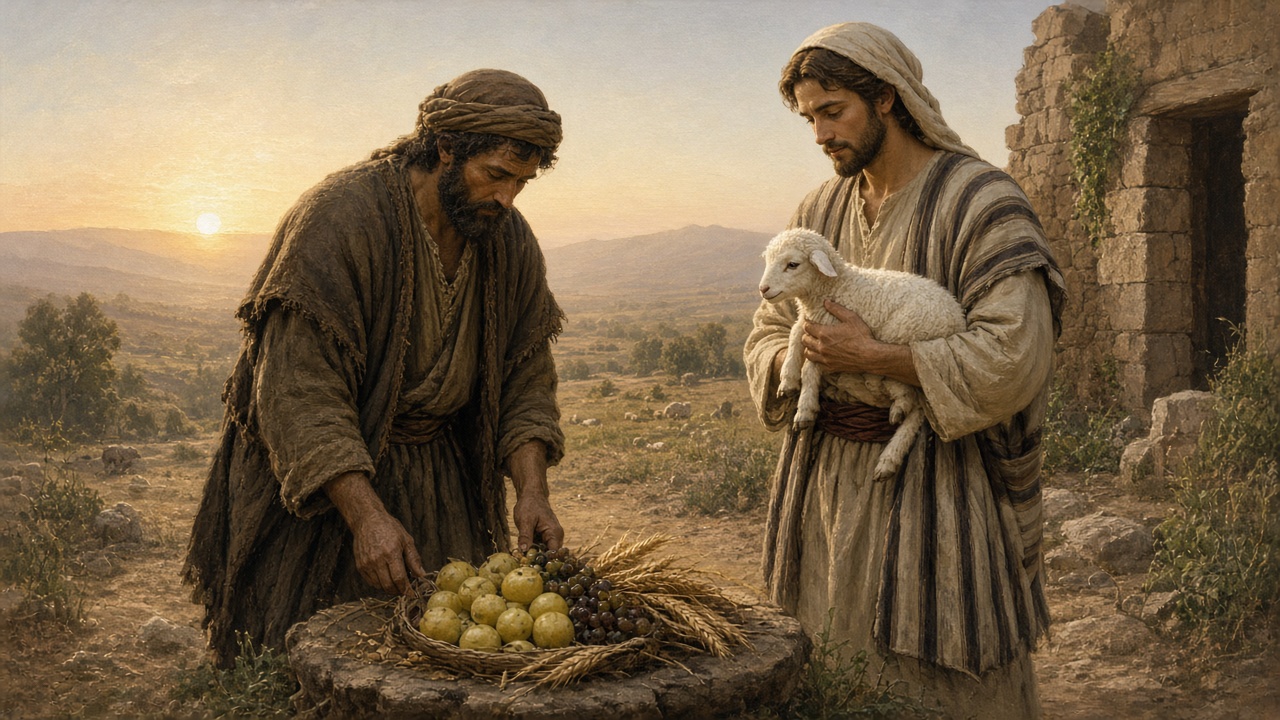
Cain, Abel, and Life East of Eden
- Abel’s Hebrew name means “breath” or “vanity.” He kept sheep, while his brother Cain tilled the soil: Abel brought the best portions of the firstborn of his flock, and Cain brought fruit of the ground. Easton's Bible Dictionary (1897) reads the phrase “in process of time” (margin, “at the end of days”) as probably referring to the Sabbath.Sources: Abel · Cain · the Bible text itself
- After Abel’s death, Cain settled in the land of Nod, east of Eden, a name meaning exile, wandering, or unrest. There he built a city and named it after his son Enoch. Easton's Bible Dictionary notes that this is the first city mentioned in Scripture.Sources: Nod · Enoch (son of Cain) · the Bible text itself
- Lamech, fifth in descent from Cain, married two women, Adah and Zillah. Easton's Bible Dictionary calls his address to them the only extant example of antediluvian poetry, sometimes known as “Lamech’s sword-song.” Their children are tied to early ways of life: Jabal with tents and livestock, Jubal with the harp and flute, and Tubal-cain with forging bronze and iron.Sources: Lamech (descendant of Cain) · Adah (wife of Lamech) · Zillah · the Bible text itself
Notes written with AI assistance from open sources (Theographic Bible Metadata, CC BY-SA 4.0; Easton’s Bible Dictionary, public domain) and reviewed before publishing.
Credits and license for this translation
Waratau Siaga Tatuei mo Vilegi
Ambae, East: Waratau Siaga Tatuei mo Vilegi (Old Testament)
copyright © 2022 Pioneer Bible Translators
Language: Havai (Ambae, East)
Contributor: The Seed Company
© Pioneer Bible Translators of Dallas, Texas, USA.
This translation is made available to you under the terms of the
Creative Commons Attribution Share-Alike license 4.0.
You have permission to share and redistribute this Bible translation in any format and to make reasonable revisions and adaptations of this translation, provided that:
You include the above copyright and source information.
If you make any changes to the text, you must indicate that you did so in a way that makes it clear that the original licensor is not necessarily endorsing your changes.
If you redistribute this text, you must distribute your contributions under the same license as the original.
Pictures included with Scriptures and other documents on this site are licensed just for use with those Scriptures and documents.
For other uses, please contact the respective copyright owners.
Note that in addition to the rules above, revising and adapting God's Word involves a great responsibility to be true to God's Word. See Revelation 22:18-19.
2025-05-20
Source: http://ebible.org/omb/ · eBible.org