1 Kings 12
Waratau Siaga Tatuei mo Vilegi · Tap a verse to see its cross-references.

About this book
About 1 Kings
- Easton's Bible Dictionary (1897) treats the authorship of the books of Kings as uncertain. A tradition that Jeremiah wrote them is, in Easton's view, supported by passages almost identical with parts of Jeremiah and by events Jeremiah knew personally, yet Easton thinks it more probable that Ezra, after the Captivity, compiled the books from earlier documents, perhaps written by David, Solomon, Nathan, Gad, and Iddo. Easton dates the composition between 561 B.C., when Jehoiachin was released from captivity by Evil-merodach, and 538 B.C., the decree of Cyrus.Sources: Easton: Kings, The Books of
- Easton says these books contain the annals of the kingdom from Solomon's accession until Nebuchadnezzar and the Babylonians subdued it, a period he estimates at about 453 years. 1 Kings opens while David is dying: Adonijah, his fourth son, who had become heir-apparent to the throne after the deaths of Amnon and Absalom, has himself proclaimed king, but Nathan and Bathsheba persuade David to enthrone Solomon at once. Solomon, David's son by Bathsheba, whose history is recorded in 1 Kings 1-11, came to the throne, Easton suggests, at about sixteen or eighteen.Sources: Easton: Kings, The Books of · Adonijah · Solomon
- In the Hebrew Scriptures the two books of Kings originally formed one book; the Septuagint first divided them and, with the Vulgate, numbers them as the third and fourth books of Kings, the books of Samuel being the first and second. Easton notes that Chronicles gives greater prominence to the priestly or Levitical office, while Kings gives greater prominence to the royal office, and that in the threefold division of the Scriptures by the Jews these books are ranked among the Prophets. The narrative points to earlier sources: the book of the acts of Solomon and the chronicles of the kings of Judah and of Israel.Sources: Easton: Kings, The Books of
- After Solomon's death the ten tribes revolted and invited Jeroboam, son of Nebat, to be their king; Easton calls him the first king of those tribes and dates his reign from 976 to 945 B.C. He had fled to Egypt under the protection of Shishak I, and later moved his residence from Shechem, his first capital, to Tirzah, which remained the chief residence of Israel's kings until Omri bought the hill of Shomeron from Shemer for two talents of silver and built Samaria. The later narrative includes Ahab, Omri's son and the seventh king of Israel, whose wife was Jezebel: to the calf worship introduced by Jeroboam he added the worship of Baal, and he was severely admonished by the prophet Elijah.Sources: Jeroboam · Tirzah · Samaria · Ahab
Notes written with AI assistance from open sources (Theographic Bible Metadata, CC BY-SA 4.0; Easton’s Bible Dictionary, public domain) and reviewed before publishing.
Ngere tau Israel ram Mawahe Huri na Ratahigi Gairue
1Rehobom u vano Sekem, huri ngere Israel doluegi rau vano taie vena ran taue na vuragi ratahigi. 2Tavohe Jerobom mo rongoe ngeie tau mosigei Ijib huri u toa dei ratahigi Solomon dena vanue Israel. Mo siregi Ijib mo tudori mo vano lo vanue Israel. 3Ngere tau Israel ram hora hurie ram vomai doluegi bubugi ram veve lawe Rehobom vena: 4“I tamamu Solomon u teu na tabana mava lumei, nge siserigi hi nigo go vaie na tabana siaga hi na mamarae. Siu gamai gain tabana nomu.” 5Rehobom mo duvi, “Nen vano a rani gai gaitolu vin liliu nemo vomai taligu lombegu.” Me a tangaloi ram mule taligu. 6Siu ratahigi Rehobom meire sesea ngerehi rau tamba mei tamana Solomon tavohe mo toga mwaso. Mo hui vena, “?Gimiu nei veve vena nai duvi na tangaloi ngere ngaha wuraha?” 7Ramo duvie, “Tareve bagataha goin vuragi nora tangaloi tabanagi me goin gato garea meire, me gom duvi vurugegi nire, rain vuragi nom tangaloi tabanagi tuqaravu.” 8Nge i Rehobom u rahagi na tovotovo nora sesea me mo hingehinge dena mwalagelo mwera ngere rau sesea bubugi, ram vuragi na nona tangaloi tovotovo. 9Mo huire vena, “?Nomiu tovotovo a havai? ?Dai duvi na tangaloi ngerelehe wuraha? Huri rau veve laweau vena, ‘Gon vai na tabana mava tamamu u teue lumei na mamarae.’” 10Ngere mwalagelo mwera hi rau sesea bubugi meie ram duvi, “Goi veve lawe na tangaloi ngerehi rau veve lawego vena, ‘Tamamu teu na tabana mava lumei, nge go vai na nomai tabana na mamarae,’ veve lawera vena, ‘A bisungu bisu biti u matolu dena tanoi wesi tamangu. 11Tamangu u teu lumiu tabana mava; Neu nain veie vin mava liue. Tamangu u gavogo gena gaiteli tangaloi; Neu, nain gavogo gena ginei garo volae.’” 12Lo rani gai toligi, Jerobom mena tangaloi doluegi rau tudori lobei Rehobom mwerei ratahigi u veve, “Nein vumai taligu lombegu lo rani gaitoligi.” 13I ratahigi u duvi gagarasigi na leogi lawera tangaloi. U rahagi na tovotovo mo beteana lawea dena sesea. 14Me mo huri na tovotovo nora mwalagelo me move, “Tamangu u vei na nomiu tabana u mava; Neu nain veie vin mava liue. Tamangu u gavo gimiu gena gaiteli tangaloi; Neu nain gavo gimiu gena kinei garo volae.” 15I ratahigi he rorontagi nire tangaloi tea, huri a taroi kineu lehe mo vai u vumai deni Huqe, huri ve a leoi Huqe na woro mwere hi Huqe u veve lawe Ahisa tau Silo me i Ahisa mo veve lawe Jerobom netui Nebat. 16Tavohe ngere Israel doluegi ram leo ve i ratahigi he rorontagi nire tea, ram duvi na ratahigi, “I Devet gamai gai taranie tea. Netui Jesi gamai gai iloe tea. Vagabui Devet go leohuri na nom babagi lui tubumu! Ginde tau Israel da mule lolo noda siusiu!” Siu ngere tau Israel ram mawahe ram mule vano lo nora siusiu. 17Nge i ngere tau Israel hi ram toga lolo vanue renge sao noi Juda, lo taro hi ram toga lo tanoi leogoro noi Rehobom mosigei.
18Ratahigi Rehobom u hora Adoram, a tangaloi hi mo vai na tangaloi ve ran tabana siaga, nge i ngere Israel doluegi rau buguri vagamatea. Ratahigi Rehobom, mo galo lo bulana sariot mo toa vano mo toga Jerusalem. 19Siu ngere tau Israel ramo qalo vohivohi na babagi lui Devet mo vumai mo dadari bagataha. 20Tavohe ngere Israel doluegi ram rongo huri ve i Jerobom u mule, ram hora warea vumai lo nora kalo bubugi, me ram taue mo ratahigi goro na Israel doluegi. A lulugi hogosie lui Juda rau huri rorongogi na babagi lui ratahigi Devet. 21Tavohe Rehobom u dadari Jerusalem, mo ware bubugi nire doluegi lo babagi lui Juda me a babagi lui Benseman. Ngere u teri vaga vudolue vagategale avigi ngavulu gaiwelu hogo tangaloi vuro huri ve ngere rain vai na vuro mei retuara tau Israel. Siu ngere rain lai tuguhi na tanoi ratahigi Rehobom i netui Solomon. 22Nge a leo lehe noi Huqe Mauri u vumai lawe Semaia a tangaloi ligoligogi noi Huqe Mauri: 23“Go veve lawe Rehobom netui Solomon, ratahigi tau Juda, lo babagi lui Juda doluegi, mei Benseman, me lawe na sinobu lavasigi vage, vena, 24‘Nge lehe a havai i Huqe u veve: Mese hage ve go vai vuro vohivohi retuemiu, tau Israel. Gimiu doluegi ne mule lo tano miu, huri ngaha a nogu dedegi.’” Siu ram tabe na leo noi Huqe ram mule taligu, mwerehi i Huqe u veve.
25Siu i Jerobom mo hagovi na ute Sekem lolo vusi vanuei Evrem me mo toga taie. U maraga taie mo vano mo hangovi na ute Benuel vage. 26Jerobom mo ladolado gahea move, “Siserigi lehe a tanoi leogoro vi tudori taligu lo bambagi lui ratahigi Devet. 27Tareve tangaloi ngerelehe rai hage tamwere ve ran vai na nora hure bonboni lo sara gogona noi Huqe lolo Jerusalem taligu, a domire vin huri na nora huqegi, Rehobom ratahigi tau Juda. Rain ue vagamate au me rain tudori lobei ratahigi Rehobom.” 28Lo tagui nona hingehinge lo leogi, i ratahigi u vei na nunui bulugi mwalagelo gairue gena vatu homu. Mo veve lawera tangaloi, “Gimiu neu hage Jerusalem u tatarise beno, O Israel, a nomiu huqe ngere, ru lei gimiu dena vanue Ijib.” 29U teue tuegi lo ute hi Betel, me u teue tuegi lo ute hi Dan. 30Siu a gineu lehe u vuragi na asiana; a tangaloi rau vumai ram galohagi nie hi Betel, me ram vano Dan ram galohagi nie hi tuegi.
Did you know?
The Division of the Kingdom
- When the northern tribes gathered at Shechem requesting lighter taxes and labor burdens, Rehoboam rejected the counsel of Solomon's elders and threatened harsher measures. This triggered the division of the united monarchy, fulfilling the prophecy previously spoken by Ahijah the Shilonite.Sources: the Bible text itself · Rehoboam · Ahijah · Shechem
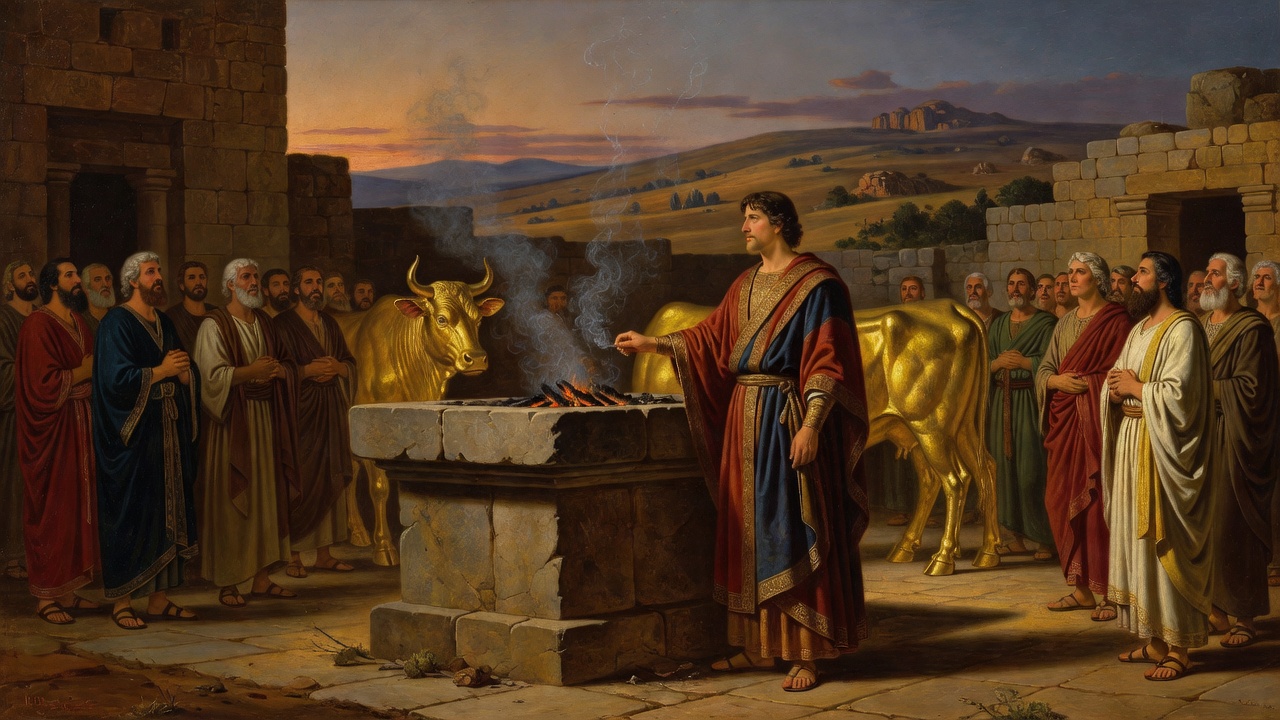
- To prevent his subjects from traveling to the temple in Jerusalem, King Jeroboam set up two golden calves for worship at opposite ends of the northern kingdom, placing one in Bethel and the other in Dan. He also established shrines on high places and appointed priests who were not from the tribe of Levi.Sources: the Bible text itself · Jeroboam · Bethel (of Palestine) · Dan
Notes written with AI assistance from open sources (Theographic Bible Metadata, CC BY-SA 4.0; Easton’s Bible Dictionary, public domain) and reviewed before publishing.
Places in this chapter
- Shechem · Today: Tell Balatah · 32.214, 35.282 · verses 1, 25
- Egypt · 30.129, 31.308 · verses 2, 20, 28
- Shiloh · Today: Khirbet Seilun · 32.056, 35.290 · verse 15
- Jerusalem · 31.777, 35.234 · verses 18, 21, 27, 28
- Dan · Today: Tel Dan · 33.249, 35.652 · verses 29, 30
Only places identified with high confidence are shown (90% or more according to the scholarly sources compiled by OpenBible). Period map: DARE (Digital Atlas of the Roman Empire), CC BY 4.0; modern map: © OpenStreetMap contributors; places: OpenBible.info (CC BY 4.0).
Credits and license for this translation
Waratau Siaga Tatuei mo Vilegi
Ambae, East: Waratau Siaga Tatuei mo Vilegi (Old Testament)
copyright © 2022 Pioneer Bible Translators
Language: Havai (Ambae, East)
Contributor: The Seed Company
© Pioneer Bible Translators of Dallas, Texas, USA.
This translation is made available to you under the terms of the
Creative Commons Attribution Share-Alike license 4.0.
You have permission to share and redistribute this Bible translation in any format and to make reasonable revisions and adaptations of this translation, provided that:
You include the above copyright and source information.
If you make any changes to the text, you must indicate that you did so in a way that makes it clear that the original licensor is not necessarily endorsing your changes.
If you redistribute this text, you must distribute your contributions under the same license as the original.
Pictures included with Scriptures and other documents on this site are licensed just for use with those Scriptures and documents.
For other uses, please contact the respective copyright owners.
Note that in addition to the rules above, revising and adapting God's Word involves a great responsibility to be true to God's Word. See Revelation 22:18-19.
2025-05-20
Source: http://ebible.org/omb/ · eBible.org