Genesis 46
Hset Hadròeh · Tap a verse to see its cross-references.
Boc Plình mahnu dađeh ka Jacôp…
1Isorali loh lam wê tiaq deh ƀài kùng hang. Trùh ta Bê-e sêba, haq padon dèh ƀài ramènh dèch ka Boc Plình da Ysac, baq haq. 2Ta kan hnoq jò damang, Boc Plình i doe ka Jacôp: Jacôp Jacôp! Isorali padreo bàu: I au kô 3Boc Plình doe: Au kô raq Boc Plình, Boc Plình da baq ìh. Drah loh ta Êdip, apaq yùq cleq, majaih qmang aih ta aih èh au broq ka ìh wìa moeq diac kàn. 4Cla au kô èh hadai loh ta Êdip ti ìh, èh hadai cla au kô èh raq ma ahlài ìh, wop qmang aih raq. Jôsep èh ma hi apot da ìh mat.
5Enh Bê-e sêba Jacôp loh lam; ƀài kon calô da Isorali dèch Jacôp, baq wì haq, xam ƀài cadrì kon wì haq tŏc ta xê da Phara-ôn ma khoe thê lam đìh yŏc ƀài wì aih. 6Wì haq wê dŏng ƀài ngè ma aban xam kùng hang đeh ma khoe achap jah ta Cana-an, đòeq lam trùh ta Êdip. 7Qmang aih Jacôp xam dìq ka hnim haq, ƀài kon calô, ƀài xau calô, ƀài kon cadrì, ƀài xau cadrì, dìq loh ta Êdip.
Arèn ƀài mangai ta cadraq Jacôp …
8Hacô! yiniq ƀài kon calô da Isorali aih la Jacôp, ma loh ta Êdip: Kon ramua da Jacôp aih la Ruƀên. 9Ƀài kon calô da Ruƀên aih Hênoc, Phalu, Hèt-rôn, xam Cacmi. 10Ƀài kon calô da Simê-ôn aih la Jêmu-ên, Jamin, Ôhat, Jakin, Xôha xam Saulo, aih la kon da mai mangai gùng Cana-an. 11Ƀài kon da Lêwi aih la Getsôn, Kêhat, xam Mêrari. 12Ƀài kon da Juđa aih la Êro, Onan, Sêla, Phêrêt xam Xêrat. Mahaq Êro xam Onan khoe cachìt tagùng Cana-an; kon da Phêrêt aih la Hèt-rôn xam Hamun. 13Ƀài kon calô da Ysaca aih la Thôla, Phuwa, Jop xam Simrôn. 14Ƀài kon calô da Saƀu-lôn aih la Sêrêt, Êlon xam Jali-ên. 15Ƀài kon calô xam mòeq toq kon cadrì yiniq haq la Đina, Lê-a ma khoe ha-uang ka Jacôp jò ma oe tagùng Phađan- Aram, xam ƀài xau aih dìq dŏng jah piq jàt piq ngai.
16Ƀài kon calô da Gat aih la Xiphi-ôn, Hagi, Suni, Ecbôn, Êri, Arôđi xam Arêli. 17Ƀài kon calô da Ase aih la Jimna, Jic xam Jicwi, Bêria, xam Sêrat, oh cadrì da wì aih. Kon da Bêria aih la Hêbe xam Manki-an. 18Aih, ƀài kon da Sinƀa ma ha-uang ka Jacôp xam ƀài xau, dìq dŏng aih jah mòeq jàt tadràu ngai. Sinƀa aih la mangai hapŏng da Laƀan ma khoe am tiaq patìh dèh ka kon cadrì aih la Lê-a. 19Ƀài kon da Rachên mai Jacôp aih la Jôsep xam Bênjamin, 20Jôsep khoe i kon tagùng Êdip, aih la Manase, xam Epra-im, Anat kon cadrì da Phôti-phêra, mangai pajàu kàn tagùng Ôn, khoe ha-uang ka haq. 21Ƀài kon calô da Ƀênjamin aih la Bêla, Bêke, Acbên, Jêra, Na-aman, Êhi, Rôso, Môpbim, Hôpbim xam Aret. 22Qmang aih, ƀài kon calô da Rachên ha-uang ka Jôsep xam ƀài xau dìq dŏng jah mòeq jàt pôn ngai. 23Kon calô da Đan aih la Husim. 24Ƀài kon calô da Neptali aih la Jatsi-ên, Guni, Jicse xam Silem. 25Ƀài kon calô da Bila ma ha-uang ka Jôsep xam ƀài xau aih dìq dŏng jah tapèh ngai. Ƀila aih la hapŏng Laƀan ma khoe am đòeq patìh ka kon cadrì haq la Rachên.
26Wì aih lam tiaq Jacôp trùh ta Êdip, aih la ƀài mangai ha-uang loh enh Jacôp – tàng joq ùh rèn xam ƀài kon mai – dìq dŏng aih jah tadràu jàt tadràu ngai. 27Xam kon da Jôsep ha-uang ta Êdip jah baiq ngai. Qmang aih ƀài mangai da hnim Jacôp lam trùh ta Êdip, rèn dìq dŏng jah tapèh jàt ngai.
28Jacôp thê Juđa lam adroe đòeq hu bòch Jôsep aràng haq mùt tagùng Gôsen. 29Jôsep tŏc xê axêh haq khoe padon đòeq lam tŏc ta Gôsen đìh Isorali, baq rađeh. Haq loh deh enh ngèa baq, haq cwat deh baq rai hmoe ka dùnh. 30Isorali doe ka Jôsep: Manòeq kô yac ka au cachìt xôq ùh dèh. Majah qmang aih baq khoe hnoq hadrò kon, èh loq kon oe raq rìh.
31Khoe aih Jôsep anoe dèh ka oh daq xam dìq ka mangai hnim baq haq rameh: Au chônh lam adroe hu anoe ka Phara-ôn loq: Oh daq xam dìq ka hnim baq au, enh gùng Cana-an khoe trùh ta au. 32Wì haq mangai rìh ka aban trìu, ban ƀài calùh, i qnung dŏng deh calùh trìu, ƀo xam dèh ƀài kùng hang wì haq. 33Èh jò Phara-ôn loq thê creo ka pì hu boch: Pì rìh ka abroq đeh cleq? 34Aih pì doe rameh: Mangai hapŏng wì craq rìh dèh ka ngè aban enh qyoh trùh manòeq qmang ka baq nhèn khoe broq. Qmang aih dôq oh daq jah oe tagùng Gôsen, majah qmang aih mangai Êdip loq cadròt haraya ka mangai ban trìu.
Did you know?
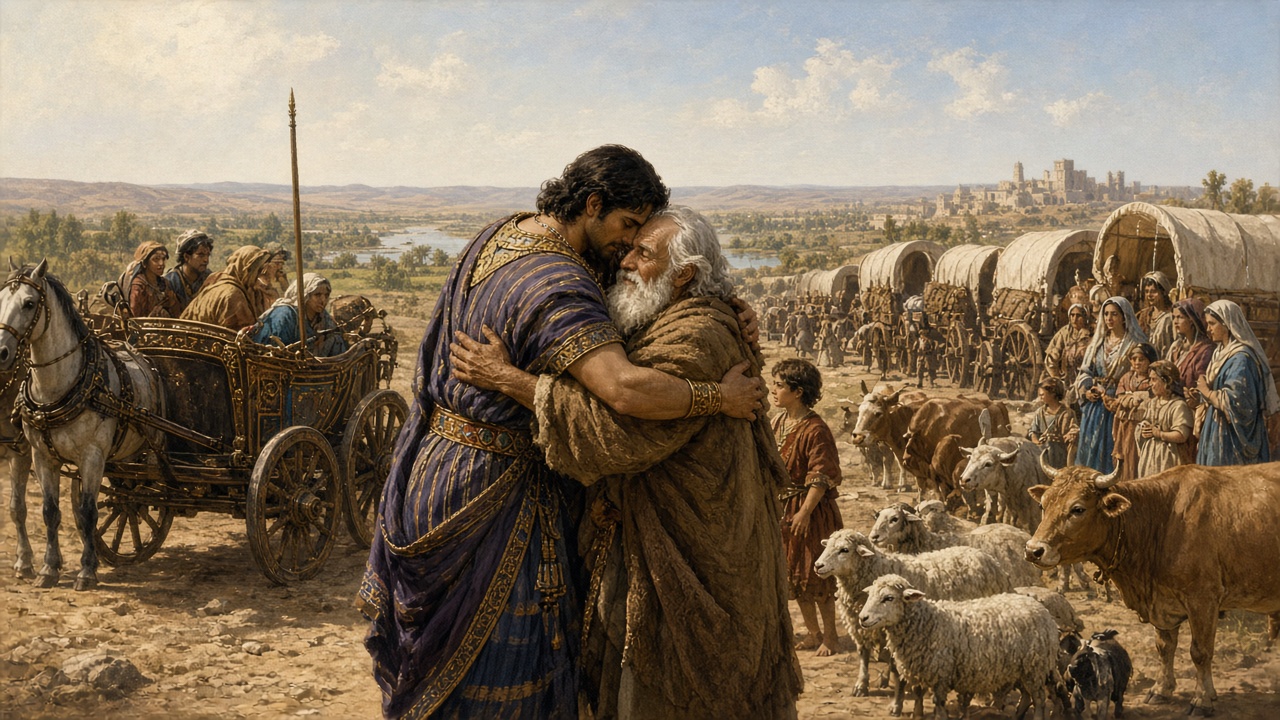
Israel Goes Down to Egypt
- As Israel set out for Egypt with all that he had, he stopped at Beersheba and offered sacrifices to the God of his father Isaac. Beersheba, meaning well of the oath or well of seven, was a well Abraham dug and named after a compact with Abimelech; when Isaac reopened it, he gave it the same name. It was a favorite dwelling of both patriarchs, and there that night God spoke to Jacob in a vision, telling him not to fear going down to Egypt, for he would make him a great nation there.Sources: the Bible text itself · Beersheba
- Jacob sent Judah ahead to Joseph for directions to Goshen, an Egyptian district east of the Nile, apparently near the royal residence, where the family remained until the Exodus. Easton's Bible Dictionary (1897) calls it the best of the land, now a desert, and also the land of Rameses. Joseph told his brothers to say they had raised livestock from youth, so they might settle there, because shepherds were detestable to the Egyptians; that dictionary suggests Pharaoh was probably Apopi, last of the Hyksos, who welcomed these Asiatic shepherds, while native Egyptians abhorred them, though some argue Joseph arrived later, under Thothmes III, after the Hyksos were expelled.Sources: the Bible text itself · Goshen · Pharaoh (of Joseph)
- The chapter counts sixty-six of Jacob's direct descendants who came to Egypt, not counting the wives of his sons, and seventy when Joseph's two sons already born in Egypt are included. Leah's sons and her daughter Dinah are named in that tally, although Easton's Bible Dictionary (1897) says Leah herself had died in Canaan before the journey and was buried in the cave of Machpelah; Rachel had died earlier giving birth to Benjamin and was buried on the way to Ephrath, that is, Bethlehem. Manasseh and Ephraim were born to Joseph in Egypt by Asenath, daughter of Potiphera, priest of On, a center of sun-worship that the Septuagint and Vulgate call Heliopolis.Sources: the Bible text itself · Leah · Rachel · On
Notes written with AI assistance from open sources (Theographic Bible Metadata, CC BY-SA 4.0; Easton’s Bible Dictionary, public domain) and reviewed before publishing.
Places in this chapter
- Egypt · 30.129, 31.308 · verses 1, 3, 4, 5, 6, 7, 8, 20, 26, 27
- Canaan · 32.767, 35.333 · verses 6, 12, 31
- Heliopolis · Today: Ain Shams · 30.129, 31.308 · verse 20
- Goshen · Today: Goshen 1 · 30.799, 31.834 · verses 28, 29, 34
Only places identified with high confidence are shown (90% or more according to the scholarly sources compiled by OpenBible). Period map: DARE (Digital Atlas of the Roman Empire), CC BY 4.0; modern map: © OpenStreetMap contributors; places: OpenBible.info (CC BY 4.0).
Credits and license for this translation
Hset Hadròeh
The New Testament in the Hre language of Vietnam, translated by Baq Thi
Copyright © 2024 Baq Thi
Language: (Hre)
This translation is made available to you under the terms of the
Creative Commons Attribution Share-Alike license 4.0.
You have permission to share and redistribute this Bible translation in any format and to make reasonable revisions and adaptations of this translation, provided that:
You include the above copyright and source information.
If you make any changes to the text, you must indicate that you did so in a way that makes it clear that the original licensor is not necessarily endorsing your changes.
If you redistribute this text, you must distribute your contributions under the same license as the original.
Pictures included with Scriptures and other documents on this site are licensed just for use with those Scriptures and documents.
For other uses, please contact the respective copyright owners.
Note that in addition to the rules above, revising and adapting God's Word involves a great responsibility to be true to God's Word. See Revelation 22:18-19.
2026-07-18
Source: http://ebible.org/hrebt/ · eBible.org