Luke 6
God Lavayiyat Aṅ Puhuvasiwni · Tap a verse to see its cross-references.
The Question about the Sabbath
1Noqw nasuṅwintalöṅnit aw pituqw, Jesus put aw nánatuwnayaqamuy amumum söhövos’uyit aṅ nö́ṅakwisa. Noqw put aw nánatuwnayaqam söhövosit talayat mawtiwisk̇ahk̇aṅw, put mapqölpeq murik̇ahk̇aṅw nōnoptiwisa. 2Noqw hakim Pharisee‐sinom pumuy amumi paṅqawu: Ya uma hinoqw nasuṅwintöṅnit ep hihta mewniwtaqat hintsatsk̇a? 3Noqw Jesus lavayhtiqe pumuy amumi paṅqawu: Ya ura hisat David suṅwámuy amumum tsöṅmokqe hinhtiqat uma put pantaqat pas aṅ qa ṅas’ew tuṅwáya? 4Ura pam God kīyat aw pákihqe, pölavikit God aw noiwhqat ömahtat, aṅqw nöst, pu ámumyaqamuy put huyta; pas ura God awwat momṅwit‐sa put aṅqw nȫnösaṅwuqat put’a. 5Pu Jesus pumuy amumi paṅqawu: Pay nu’ Sinot Tiat piw nasuṅwintalöṅnit aw móṅw’iwta.
The Man with a Crippled Hand
6Pu hisat pam nasuṅwintalöṅnit ep tsotsvalkimi pákihqe ep tūtutuqayna. Noqw hak tāqa putvaqw mālakiwtaqa pep nuhtuma. 7Noqw tutavot tutuqaynayaqam Pharisee‐sinmuy amumum Jesus aw tunatyawyuṅwa, mātaq pi kurs pam nasuṅwintalöṅnit ep put qalaptsinaniqw ōviy’o; nen puma hihta ep put nēveltoynayani. 8Noqw pay pam pumuy tunatyayamuy amumi mātsi’taqe, lākiwtaqat may’taqat aw paṅqawu: Wunuptut, sinsonve wunuwtaa. Noqw pam panhti. 9Pahsat pu Jesus pumuy amumi paṅqawu: Kurs nu umuy hihta tūviṅtani. Ya hak nasuṅwintalöṅvaqat ep hihta lolmat, sen qalolmat hinhtiniqw pam súanta? Sen qatsit ayo táviniqö’, sen hovalaniqö’? 10Pu pam pumuy sohsokmuy amuhpa’ yorikt, tāqat aw paṅqawu: Uhmay tsihkwaa. Noqw pam panhti; noqw māat put ayaṅqwat māyat an pās powalti. 11Noqw puma itsívuhonaqtotiqe, hin as Jesus hintsatsnaniqey nānami yuaatota.
Jesus Chooses the Twelve Apostles
12Noqw pay ephaqam piw pam nāwaknaniqe haqami tsomomiq’a; nihqe tōk̇ep God aw nāwakna. 13Noqw tālawvaqw, pam put aw nánatuwnayaqamuy wáṅwayhqe, pumuy amuṅaqw pakwt lȫq sihk̇ay’taqamuy namorsta; nihqe pam pumuy Ayaiwyuṅqamuy yan tuṅwa, 14Imuyu: Simon, ura pam put Peter yan túṅwa, pu tupkoyat Andrewt, pu James‐nit pu John, pu Philip‐nit pu Bartholomewt, 15Pu Matthewt‐nit pu Thomas, pu Alpheus tiyat James‐nit pu Simon, Zelotes yan túṅwantiwhqata, 16Pu James tupkoyat Judas‐nit pu Judas Iscariot Jesus momṅwituy amumi kurs mātapniqata.
Jesus Teaches and Heals
17Pu pam pumuy tsamk̇aṅw, paṅqw hawhqe, haqam suntutskway’taqat ep wunu, k̇aysiwhqamuy put aw nánatuwnayaqamuy amumuma. Noqw qaan’ewakw hintaqam sinom put aw tūqayyuṅwniqe, pu hīhihta tūyay aṅqw qalaptuyaniqe öki, Judeat aṅqw‐nik̇aṅw, pu Jerusalem aṅqw sohsokivaq’ö, pu pātuwaqatsit qalaveq Tyre aṅqw‐nīk̇aṅw pu Sidon aṅq’ö. 18Pu ima tuyoy’ewakw hīhikwsimuy akw okiwhinyuṅqam piw ö́kihqe powaltoti. 19Noqw sinom sohsoyam as put aw tóṅokyaniqey nānawakna, pas pi put aṅqw suyan öqala yámakiwtaqe sohsokmuy qalaptsintaqw ōviy’o.
Happiness and Sorrow
20Noqw pam put aw nánatuwnayaqamuy amuhpa’ yorikt, amumi paṅqawu: Pas uma aṅ ōokiwyaqam hahlayhpit epya, pi uma God moṅwtunatyayat himuy’yuṅwa. 21Uma aṅ pu’ tsöṅsoiwtaqam hahlayhit epya, pi uma nāt ȫöyyani; pas uma aṅ pu’ tsaykitaqam hahlayhpit epya, pi uma nāt tsutsúyni. 22Ason sinom nuy Sinot Tiyat atsviy umumi qa suhtaq’ewye’, nahpiy umuy lālayye’, umumiq hīhiṅqaqwe’, umuhnatṅwaniy himu itséheetnihqat pan ayo tūvayaqw, uma hahlayhpit epyani. 23Hisat panhtotiqw, uha hahlayhtote’, pas hahlaytso’tinumyani, ispi meh, uma ōveqatsit ep qaan’ewakw ahsatit makiwyaniqee; pi pay pan pumuy namat hapi God lavay’aymuyatuy hintsatsna. 24Nīk̇aṅw is ókiwa, uma aṅ k̇ahaksinomu, pi uma umuhhahlayhpiy pay ömahtota. 25Is ókiwa, uma aṅ ȫyiwyuṅqamu, pi uma nāt tsöṅso’ni; is ókiwa, uma aṅ pu’ tsutsúyyaqamu, pi uma nāt qahahlayk̇ahk̇aṅw tsaykitani. 26Pas sinom sohsoyam umuy lomayuaatotaqw, umuṅem is óhini; pi pay pan hapi pumuy namat hakimuy nawip’ew God lavay’aymuyatuy yuaatota.
Love for Enemies
27Nīk̇aṅw nu umuy inumi tūqayyuṅqamuy umumi paṅqawni: Uma umuhtuwqamuy amumi unaṅway’yuṅwni; sinom umumi qa suhtaq’ewyaqamuy uma lolmat amuṅem hintsatsk̇ani. 28Sinom umuy qalomáyuaatotaqw, uma pumuy amumi lomayuaatotani; pu umuy qaanhintsahtsanyaqw, amuṅem uma nāwakinwisni. 29Ason hak uhtayway sutsvaqw wuvahtaqw, um ayaṅqwat piw aw ītamantani; pu hak uh’usimniy uṅ nawhk̇e’, uhnapnay enaṅ nāwaknaqw, um qa aw rohomnumni. 30Hakiy ūmi hihta tūviṅtaqw, um put máqamantani, pu hihta uhhimuy kímahqat um aw ahoy qa tūviṅtamantani. 31Pu sinom umuy pāsyaniqat uma nānawakne’, pay uma piw pan pumuy pāsyani. 32Ispi kurs pay uma umumi unaṅway’yuṅqamuy‐sa amumi unaṅway’yuṅqw, hak sen put ep umuy hahlayhtini? Pay pi qaanhinwisqam pumuy amumi unaṅway’yuṅqamuy amumi tuwat unaṅway’yuṅwa. 33Pu kurs hak umuṅem hihta lolmat hintsakq, uma tuwat put eṅem lolmat hintsatsk̇aqw ya sen hak put ep umuy hahlayhtini? Pay pi aṅ qaanhinwisqam piw pan hintsatsk̇a. 34Pu kurs pay um hakiy aṅqw hihta ömahtaniqey wūwank̇aṅw, hakiy sīvat nasimokmaqaqw hak put ep ūmi hahlayhtini? Pay pi aṅ qaanhinwisqam piw qaanhinwisqamuy nasimokhuylalwa, piw aw ahsatit ömahtotaniqey tuṅlay’k̇ahkaṅwo. 35Tis pi uma umuhtuwqamuy amumi unaṅway’yuṅwni; nen lolmat hintsatsk̇ani; pu tūnasimokhuylalwani, qa hihta put ep tuṅlay’k̇ahk̇aṅwo. Nen uma qaan’ewakw ahsatit makiwyani; piw Sus’oveqnihqat tímatni. Pi pam aṅ qa tsúyakyaṅwuqamuy, qalōlolmatuy enaṅ pās’i. 36Paniqw ōviy uma nun’okwatni, Umunay hin núokwaniqw pan’i.
Judging Others
37Uma qa tūovelantotani; nen uma qa pantsaniwyani. Uma hakiy qa paysoqtotani, nen qa pantsaniwyani. Ason hak umuhpe qaanhtiqw, uma put pantaqat ep aw pöhikyamantani, noqw sinom tuwat umumi pö́hikyani. 38Uma hihta kuwahtotimantani, noqw pu tuwat umumi himu kuwahtiwni. Sinom wukotuwanit aṅqw móo’taqat hihta kuytotat, put hūrs aqw ṅúṅuyvut, pu wīlaniwhput, pu pas aṅ wahohotaqat umumi o’yamantani. Pi uma hakiy eṅem hin tuwantotaqw, pay piw pan umuṅem tuwantiwmantani. 39Noqw pam tūwutsit hihta tuawi’taqat lavayhtiqe, amumi paṅqawu: Ya sen hak qapostalqa hakiy qapostalqat haqami wikni? Ya puma qa nāma haqami pövamiq posni? 40Pay hakiy aw tutuqayhqa put tutuqaynaqat epnihqe qa pavan pasniṅwu. Nīk̇aṅw ason pam pās tutuqaye’, pep pu’ pam put tutuqaynaqat pay antani. 41Noqw ya um hinoqw uhtupkoy posmiq hihta hihsaq tuway’k̇aṅw, uhposveq lestavit pakiwtaqat qa aw unaṅwtavi’ta. 42Noqw pantaqw um hin uhtupkoy aw paṅqawni: Itupko, nu as uhposkiy uṅem hóroknani, kítani, susmataqpi uhposveq lestavi pakiwtaqö’? Um nawip’ew hinmaqa, um mohti uhposṅaqw lestavit hórokne’, pahsat pu um suyan tālat tayk̇aṅw, uhtupkoy poskiyat hóroknani.
A Tree and its Fruit
43Pi lomasipaltsoki soon hin’ewakw sipalat himuy’vaṅwu; piw qalomásipaltsoki soon nukṅwat sipalat himuy’vaṅwu. 44Sinom himutsokit hímunihqat aniwniyat akw tuwi’yuṅwa. Soon hihta kūtay’taqat aṅqw nönvospalat hak mawni; soon hak yöṅötskit aṅqw ōvat tsovalani. 45Sino lolma lomatunatyawtaqa unaṅṅaqw hihta lolmat nȫṅantoynaṅwu; noqw pam piw hak qalolma qalomátunatyawtaqa unaṅṅaqw hihta qalolmat nȫṅantoynaṅwu. Pi hak hin tunatyay’te’, pan hapi yuaataṅwu.
The Two House Builders
46Uma nuy Tutuyqawhqa, Tutuyqawhqa, yan túṅwantota. Nīk̇aṅw uma hinoqw ilavayiy qa aṅ hinwisa? 47Inuminihqa ilavayiy aw tūqayk̇aṅw put aṅ hinmaqa hakiy antaqat nu umuy āawnani. 48Pam hakiy tāqat anta. Pam hak a’nö háṅwahqe owat ep kīhut yayhna. Noqw a’nö wukomunvaqw, pāhu kīhut aqw a’nö yēvantak̇aṅw, soon put wayáyaykinani, pam owat ep wunuqw ōviy’o. 49Pu i’ hak navotk̇aṅw put qa aṅ hinmaqa hakiy tāqat anta. Pam hak qa qaqatspitaqat, pisave kīta. Noqw mūnaṅw put kīhut aqw a’nö yēvantaqw, pam āpiy sahpu; noqw pam kīhu qaan’ewakw kīqöti.
Did you know?
The Sabbath, the Twelve, and the Plain
- On a Sabbath, as Jesus passed through the grainfields, his disciples picked heads of grain, rubbed them in their hands, and ate them, and some Pharisees called this unlawful. Jesus recalled that David and his hungry companions ate consecrated bread from the house of God, bread lawful only for the priests, and said that the Son of Man is Lord of the Sabbath. On another Sabbath he restored a man’s withered right hand in the synagogue while scribes and Pharisees watched for a reason to accuse him; a chronology dates both episodes to AD 28.Sources: the Bible text itself · Corn on the Sabbath · Healing a Withered Hand
- After spending the night in prayer on the mountain, Jesus called his disciples and chose twelve, whom he designated apostles. Among them were Simon, whom he named Peter, and Peter’s brother Andrew, fishermen from Bethsaida on the western coast of the Sea of Galilee, and Matthew, a tax collector at Capernaum who had formerly been known as Levi.Sources: the Bible text itself · Simon Peter · Andrew · Matthew
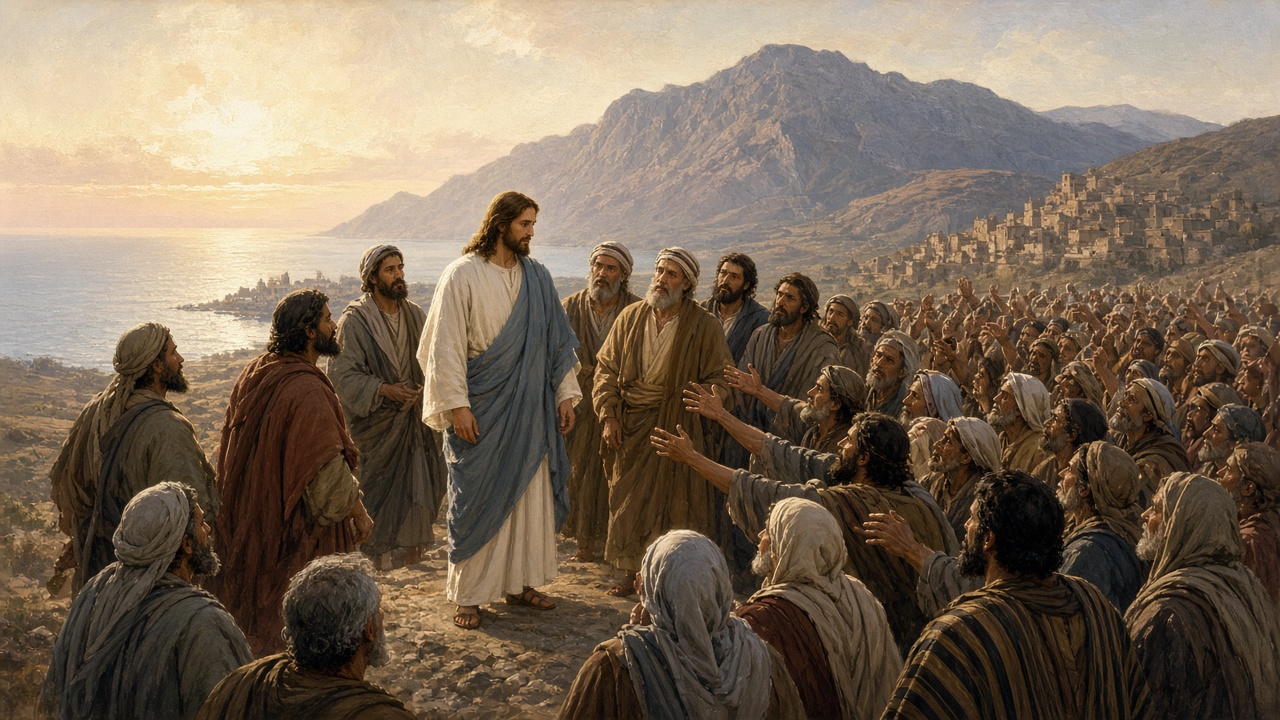
- Jesus came down with them and stood on a level place, where people from Judea, Jerusalem, and the sea coast of Tyre and Sidon had gathered to hear him and to be healed. Tyre and Sidon were ancient Phoenician cities on the Mediterranean; Sidon, the older city, lay about twenty-five miles north of Tyre. A chronology dates this teaching to AD 28 and titles it the Sermon on the Mount, though the narrative places Jesus on level ground after he came down from the mountain.Sources: the Bible text itself · Tyre · Sidon · Sermon on the Mount
Notes written with AI assistance from open sources (Theographic Bible Metadata, CC BY-SA 4.0; Easton’s Bible Dictionary, public domain) and reviewed before publishing.
Places in this chapter
- Jerusalem · 31.777, 35.234 · verse 17
- Judea · Today: Judea 1 · 31.777, 35.234 · verse 17
- Sidon · Today: Sandikli archaeological site in Sidon · 33.561, 35.372 · verse 17
- Tyre · 33.271, 35.196 · verse 17
Only places identified with high confidence are shown (90% or more according to the scholarly sources compiled by OpenBible). Period map: DARE (Digital Atlas of the Roman Empire), CC BY 4.0; modern map: © OpenStreetMap contributors; places: OpenBible.info (CC BY 4.0).
Credits and license for this translation
God Lavayiyat Aṅ Puhuvasiwni
New Testament in Hopi (US:hop:Hopi)
copyright © 2012 Wycliffe Bible Translators, Inc.
Language: Hopi
Translation by: Wycliffe Bible Translators, Inc.
Hopi [hop], USA
Copyright Information
© 2012, Wycliffe Bible Translators, Inc. All rights reserved.
This translation text is made available to you under the
terms of the Creative Commons License: Attribution-Noncommercial-No Derivative Works.
( http://creativecommons.org/licenses/by-nc-nd/3.0/ )
In addition, you have permission to port the text to different file formats, as long as you
do not change any of the text or punctuation of the Bible.
You may share, copy, distribute, transmit, and extract portions
or quotations from this work, provided that you include the above copyright
information:
You must give Attribution to the work.
You do not sell this work for a profit.
You do not make any derivative works that change any of the actual words or punctuation of the Scriptures.
Permissions beyond the scope of this license may be
available if you contact
us with your request.
The New Testament
in Hopi
© 2012, Wycliffe Bible Translators, Inc. All rights reserved.
This translation is made available to you under the terms of the
Creative Commons Attribution-Noncommercial-No Derivatives license 4.0.
You may share and redistribute this Bible translation or extracts from it in any format, provided that:
You include the above copyright and source information.
You do not sell this work for a profit.
You do not change any of the words or punctuation of the Scriptures.
Pictures included with Scriptures and other documents on this site are licensed just for use with those Scriptures and documents.
For other uses, please contact the respective copyright owners.
2014-04-25
Source: http://ebible.org/hopNT/ · eBible.org