John 8
Bib Sen An · Tap a verse to see its cross-references.
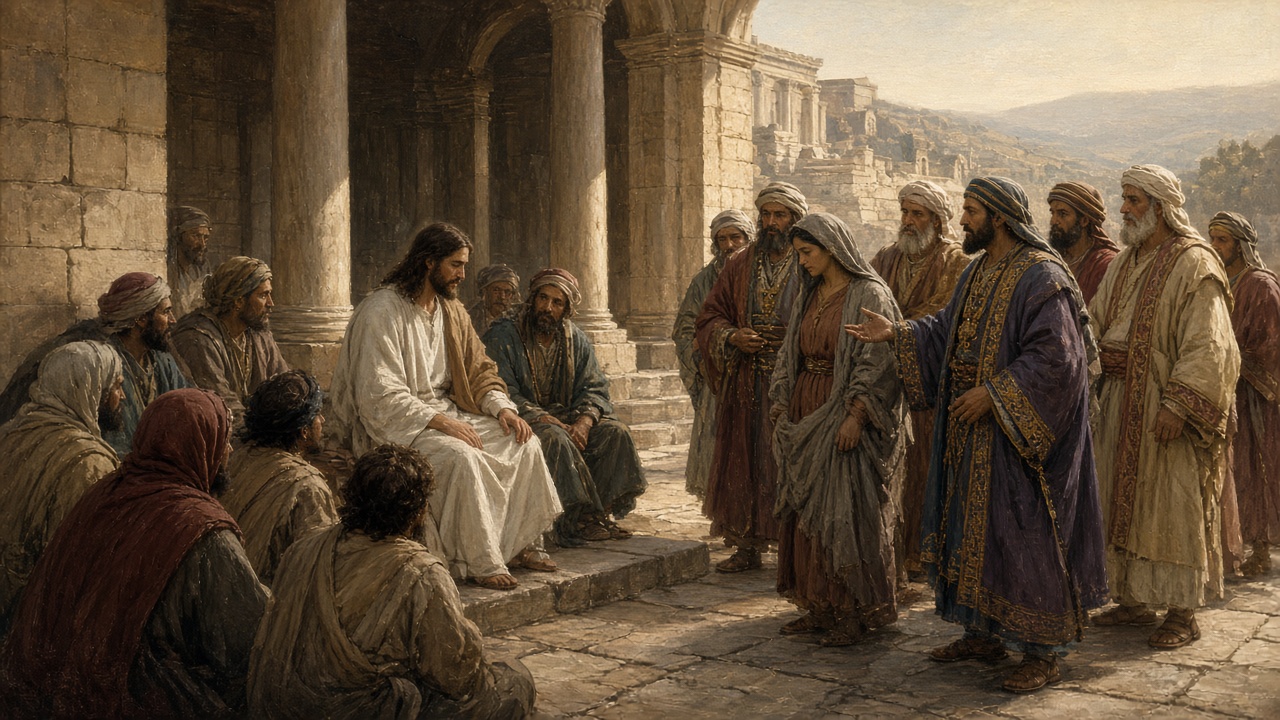
1Men Jésus te ale nan Mòn Oliv la. 2Gran maten a Li te vini ankò nan tanp lan, e tout pèp la t ap vin kote Li. E Li te chita, pou kòmanse enstwi yo. 3Skrib yo ak Farizyen yo te mennen yon fanm ki te kenbe nan adiltè e te fè l chita nan mitan yo.
4Yo te di Li: “Mèt, fanm sa te kenbe nan adiltè, nan zak la menm. 5Epi nan Lalwa Moïse la, li te kòmande nou pou nou te lapide yon fanm konsa ak wòch. Kisa ou menm di?” 6Yo t ap di sa pou yo ta kapab sonde l pou yo ta twouve mwayen pou akize Li. Men Jésus te bese, e te ekri atè a avèk dwat Li.
7Men lè yo te pèsiste avèk demann sa a, Li te leve dwat epi te reponn yo: “Sila a ki pa gen peche pami nou, kite l se premye moun pou voye yon wòch sou li.” 8Ankò Li te bese e te kòmanse ekri atè a.
9Lè yo tande sa, yo te kòmanse kite kote a youn pa youn. Sa te kòmanse avèk pi granmoun pami yo. Konsa, yo te kite Li la pou kont Li avèk fanm nan ki te rete menm kote li te ye a nan mitan lakou a. 10Jésus te leve, e te di li: “Fanm, kote yo ye? Nanpwen youn ki kondane ou?” 11Li te di: “Pa youn, Senyè.” Jésus te di “Ni Mwen menm, mwen pa kondane ou nonplis. Ale, epi depi koulye a, pa peche ankò.”
12Ankò Jésus te pale avèk yo e te di: “Mwen se limyè a lemonn. Sila a ki swiv Mwen p ap mache nan tenèb, men l ap gen limyè lavi a.”
13Pou sa, Farizyen yo te di Li: “Ou fè temwayaj pwòp tèt ou. Konsa temwayaj Ou pa vrè.”
14Jésus te reponn e te di yo: “Menmsi Mwen pote pwòp temwayaj pa M, temwayaj Mwen vrè, paske Mwen konnen kote Mwen sòti, e kote M ap prale, men nou pa konnen kote Mwen sòti, ni kote M ap prale.
15“Nou menm nou jije pa lachè, men Mwen p ap jije pèsòn. 16Men menmsi Mwen jije, jijman Mwen vrè, paske Mwen pa sèl, men Mwen avèk Li menm ki te voye M nan.
17“Menm nan lalwa pa w la Li te ekri ke temwayaj a de moun vrè. 18Mwen se Sila ki pote temwayaj pou pwòp tèt Mwen menm, e anplis, Papa a ki te voye M nan pote temwayaj sou Mwen.”
19Pou sa yo te di Li: “Kote Papa ou?” Jésus te reponn yo: “Nou pa konnen ni Mwen, ni Papa M. Si nou te konnen Mwen, nou ta konnen Papa M tou.”
20Pawòl sa yo Li te pale nan trezò a, pandan Li t ap enstwi nan tanp lan. Men pèsòn pa t sezi Li, paske lè Li poko te rive.
21Li te di yo ankò: “M ap prale, e nou va chache M, e va mouri nan peche nou. Kote M ap prale, nou p ap kab vini.”
22Pou sa, Jwif yo t ap di: “Asireman Li p ap vin touye tèt Li. Konsi l ap di ‘Kote m ap prale, nou p ap kab vini?’”
23Li t ap di yo: “Nou sòti pa anba, men Mwen sòti pa anwo. Nou a mond sila a; Mwen pa a mond sila a. 24Pou sa, Mwen te di nou ke nou tout va mouri nan peche nou yo. Paske anmwenske nou kwè ke Mwen menm se Sila a, nou va mouri nan peche nou yo.”
25Epi yo t ap di Li: “Ki moun Ou ye?” Epi Jésus te di yo “Menm sa a Mwen t ap di nou depi nan kòmansman. 26Mwen gen anpil bagay pou pale e pou jije konsènan nou. Sinon, Li menm ki te voye M nan vrè. E bagay ke M te tande de Li yo, sa yo Mwen pale a lemonn.”
27Yo pa t konprann ke Li t ap pale avèk yo konsènan Papa a.
28Pou sa, Jésus te di yo: “Lè nou leve Fis a Lòm nan, nou va konnen ke Mwen menm se Li menm, e ke M pa fè anyen pou kont Mwen, men Mwen pale bagay sa yo tankou Papa a te enstwi Mwen. 29E Li ki te voye M nan avèk Mwen. Li pa t kite M pou kont Mwen, paske Mwen toujou fè bagay ki fè L kontan.” 30Pandan Li t ap pale, anpil moun te vin kwè nan Li.
31Konsa, Jésus t ap pale avèk Jwif yo ki te kwè nan Li, “Si nou kontinye nan Pawòl Mwen, anverite, nou se disip Mwen. 32E nou va konnen laverite a, e verite a va fè nou lib.”
33Yo te reponn Li: “Nou se pitit Abraham. Nou pa t janm esklav a pèsòn. Kijan ou kapab di ‘nou va vin lib?’”
34Jésus te reponn yo “Anverite, anverite, Mwen di nou, tout moun ki fè peche se esklav a peche a.
35“Epi esklav la p ap toujou rete nan kay la, men Fis la ap toujou la. 36Se pou sa, si Fis la fè nou lib, nou ap vrèman lib.
37“Mwen konnen ke nou se pitit Abraham, men nou ap chache touye M, paske pawòl Mwen pa gen plas nan nou. 38Mwen pale bagay ke M gen tan wè avèk Papa M. E nou menm tou fè bagay ke nou te tande de papa pa nou.”
39Yo te reponn Li e te di: “Abraham se Papa nou”.
Jésus te di yo: “Si nou se pitit Abraham, fè zèv Abraham yo. 40Men jan li ye a, nou ap chache pou touye M, yon nonm ki di nou laverite ke M te tande depi nan Bondye.
“Sila a, Abraham pa t janm fè. 41Nou ap fè pwòp zèv papa nou.”
Yo te di Li: “Nou pa t fèt kon pitit deyò. Nou gen yon sèl papa, Bondye.”
42Jésus te di yo: “Si Bondye te Papa nou, nou ta renmen M, paske Mwen sòti nan Li, e se nan Li ke M vini. Mwen pa vini pou kont Mwen, men se Li ki voye M.
43“Poukisa nou pa konprann sa ke M ap di a? Se paske nou pa kapab tande pawòl Mwen.
44“Nou se pitit a papa nou, dyab la. Epi nou vle fè volonte a papa nou. Li te yon asasen depi nan kòmansman, e li pa kanpe nan verite a, paske nanpwen verite nan li. Lè li manti, li manti pou kont li, paske se yon mantè li ye, epi papa a tout manti.
45“Men akoz ke Mwen pale laverite, nou pa kwè M. 46Kilès nan nou ki gen prèv ke M peche? Si Mwen pale laverite, poukisa nou pa kwè M?
47“Sila ki se pou Bondye, tande pawòl a Bondye. Men nou pa tande, paske nou pa pou Bondye.”
48Jwif yo te reponn e te di Li: “Èske nou pa di vrèman ke Ou se yon Samariten epi ke Ou gen yon move lespri?”
49Jésus te reponn: “Mwen pa gen yon move lespri. Men Mwen onore Papa M, e nou dezonore M. 50Men Mwen pa chache glwa pa M. Men gen youn ki chache, epi ki jije.
51“Anverite, anverite Mwen di nou, si nenpòt moun kenbe pawòl Mwen, li p ap janm wè lanmò.”
52Jwif yo te di Li: “Koulye a nou konnen ke Ou gen yon move lespri. Abraham te mouri, e pwofèt yo osi. Men Ou di: ‘Si nenpòt moun kenbe pawòl Mwen, li p ap janm wè lanmò.’ 53Anverite Ou pa pi gran pase Papa zansèt nou, Abraham ki te mouri an? Pwofèt yo te mouri tou. Ki moun menm Ou fè pretansyon ke Ou ye?”
54Jésus te reponn yo: “Si Mwen bay glwa a Mwen menm, glwa sa a pa anyen. Se Papa M ki fè M resevwa glwa. De kilès ke ou di M: ‘Li se Bondye Nou.’
55“Nou poko vin rekonèt Li, men Mwen menm, mwen konnen Li. Si Mwen di ke M pa konnen L, Mwen ta yon mantè tankou nou menm, men Mwen vrèman konnen Li, e kenbe pawòl Li.
56“Papa zansèt nou, Abraham te rejwi pou wè jou sa a, e Li te wè l, e te ranpli avèk jwa.”
57Pou sa, Jwif yo te di L: “Ou poko gen senkant ane, e Ou te gen tan wè Abraham?”
58Jésus te di yo “Anverite, avan Abraham te la, Mwen se.”
59Konsa, yo pran wòch pou lapide Li, men Li te kache kò Li, e te kite tanp lan.
Did you know?
Light, Law, and Abraham
- John 8 opens as Jesus goes to the Mount of Olives and returns early in the morning to the temple courts, where he sits and teaches the people who gather. The Mount of Olives is a ridge east of Jerusalem, separated from the city by the Kidron valley and named for the olive trees that cover its sides.Sources: the Bible text itself · Mount of Olives
- Scribes and Pharisees bring in a woman caught in adultery and ask Jesus what he says about Moses' command in the Law to stone such a woman, seeking to test him and to gain a basis for accusing him. Still in the temple courts, near the treasury, Jesus later says, "I am the light of the world." A dated event list places both episodes in AD 29, each lasting one day.Sources: the Bible text itself · Woman Caught in Adultery · Light of the World/I am discourse
- When Jesus says that the truth will set them free, his hearers answer that they are Abraham's descendants and have never been slaves to anyone. Abraham is called "father of a multitude"; he was the son of Terah and the heir of the promises. After Jesus declares, "before Abraham was born, I am," they pick up stones to throw at him.Sources: the Bible text itself · Abraham
Notes written with AI assistance from open sources (Theographic Bible Metadata, CC BY-SA 4.0; Easton’s Bible Dictionary, public domain) and reviewed before publishing.
Places in this chapter
- Mount of Olives · 31.778, 35.246 · verse 1
Only places identified with high confidence are shown (90% or more according to the scholarly sources compiled by OpenBible). Period map: DARE (Digital Atlas of the Roman Empire), CC BY 4.0; modern map: © OpenStreetMap contributors; places: OpenBible.info (CC BY 4.0).
Credits and license for this translation
Bib Sen An
The Holy Bible in Haitian Creole, 2023 update
copyright © 2017-2023 Ron Smith
Language: Kreyòl Ayisyen (Haitian)
Translation by: Ron Smith
Contributor: Felix Nixon
This translation is made available to you under the terms of the
Creative Commons Attribution Share-Alike license 4.0.
You have permission to share and redistribute this Bible translation in any format and to make reasonable revisions and adaptations of this translation, provided that:
You include the above copyright and source information.
If you make any changes to the text, you must indicate that you did so in a way that makes it clear that the original licensor is not necessarily endorsing your changes.
If you redistribute this text, you must distribute your contributions under the same license as the original.
Pictures included with Scriptures and other documents on this site are licensed just for use with those Scriptures and documents.
For other uses, please contact the respective copyright owners.
Note that in addition to the rules above, revising and adapting God's Word involves a great responsibility to be true to God's Word. See Revelation 22:18-19.
2026-06-11
Source: http://ebible.org/hatbsa/ · eBible.org