Isaiah 60
Bib Sen An · Tap a verse to see its cross-references.
1“Leve, briye; paske limyè ou fin parèt
e glwa a SENYÈ a fin leve sou ou.
2Paske gade byen, tenèb va kouvri latè
e pwofon tenèb tout pèp yo.
Men SENYÈ a va vin leve sou ou,
e glwa li va parèt sou ou.
3Nasyon yo va vin kote limyè ou a,
e wa yo nan klète lè ou leve a.
4“Leve zye ou toupatou e gade;
yo tout rasanble ansanm;
yo vin kote ou.
Fis ou yo va vini soti lwen,
e fi ou yo va pote nan bra yo.
5Epi ou va wè, ou va plen ak limyè;
kè ou va kontan e ou va rejwi.
Paske abondans lanmè a va vire vè ou;
gran richès a nasyon yo va rive kote ou.
6Anpil chamo va kouvri ou,
jenn chamo a Madian ak Épha yo.
Tout sila soti Séba yo va vini.
Yo va pote lò ak lansan,
e yo va pote bòn nouvèl a, lwanj a SENYÈ a.
7Tout bann mouton Kédar yo va rasanble kote ou.
Belye a Nebajoth yo va sèvi ou;
yo va vin aksepte pou monte sou lotèl Mwen an,
e Mwen va glorifye kay Mwen an
ki plen lonè ak mayifisans.
8“Se kilès sa yo ki vole tankou yon nwaj
ak tankou toutrèl vè fenèt pa yo?
9Anverite, peyi kot yo va tann Mwen;
gwo bato Tarsis yo va vini premyèman
pou mennen fis ou yo soti lwen;
ajan ak lò yo avèk yo, pou non SENYÈ Bondye ou a
e pou Sila Ki Sen an Israël la,
akoz Li te bay ou glwa.
10“Etranje yo va bati, fòtifye miray ou yo,
epi wa pa yo va fè sèvis pa yo.
Paske nan kòlè Mwen, Mwen te frape ou
e nan gras Mwen, Mwen te fè ou mizerikòd.
11Pòtay ou yo va vin louvri nèt tout tan;
yo p ap fèmen ni lajounen, ni lannwit,
pou yo kapab pote bay ou richès a tout nasyon yo,
ak wa yo kon kaptif.
12Paske nasyon ak wayòm ki p ap sèvi ou a va peri;
wi, nasyon sa yo va fin detwi nèt.
13“Glwa a Liban an va rive kote ou,
bwa pichpen an, bwa sèd ak bwa blan
pou anbeli plas sanktyè Mwen an.
Mwen va fè plas pye Mwen yo vin plen glwa.
14Fis a sila ki te aflije ou yo va vin bese devan ou
e tout sila ki te meprize ou yo
va bese yo menm devan pla pye ou.
Yo va rele ou vil SENYÈ a,
Sion a Sila Ki Sen an Israël la.
15“Konsi, ou te abandone e rayi, pou pèsòn pa pase ladann,
Mwen va fè ou vin plen ak majeste,
yon objè lajwa de jenerasyon an jenerasyon.
16Anplis, ou va souse lèt a nasyon yo,
e ou va souse tete a wa yo.
Konsa, ou va konnen ke Mwen, SENYÈ a,
se Sovè ou e Redanmtè ou,
Sila Ki Pwisan a Jacob la.
17Olye bwonz, Mwen va pote lò;
olye fè, Mwen va pote ajan;
olye bwa, Mwen va pote bwonz
e olye wòch, Mwen va pote fè.
Anplis, Mwen va fè lapè vin chèf ou
e ladwati kon konseye ou.
18Vyolans p ap tande ankò nan peyi ou,
ni devastasyon oswa destriksyon anndan lizyè ou;
men ou va rele miray ou yo: “Sali” e pòtay ou yo: “Lwanj”.
19Ou p ap sèvi solèy la pou limyè lajounen ankò,
ni klate lalin nan pou ba ou limyè;
men ou va gen SENYÈ a kon yon limyè etènèl
e Bondye ou kon glwa ou.
20Solèy ou p ap bese ankò,
ni lalin nan p ap febli;
paske ou va gen SENYÈ a kon limyè etènèl
e jou ke ou kriye ak gwo doulè yo va fini.
21Epi tout moun ou yo va dwat,
Yo va posede peyi a jis pou tout tan;
branch ke M te plante a, zèv a men M yo,
pou M kapab resevwa glwa.
22Pi piti a va devni yon gran pèp
e pi piti menm nan, yon nasyon pwisan.
Mwen, SENYÈ a va fè l prese rive nan lè l.”
Did you know?
The Glorious Restoration of Zion
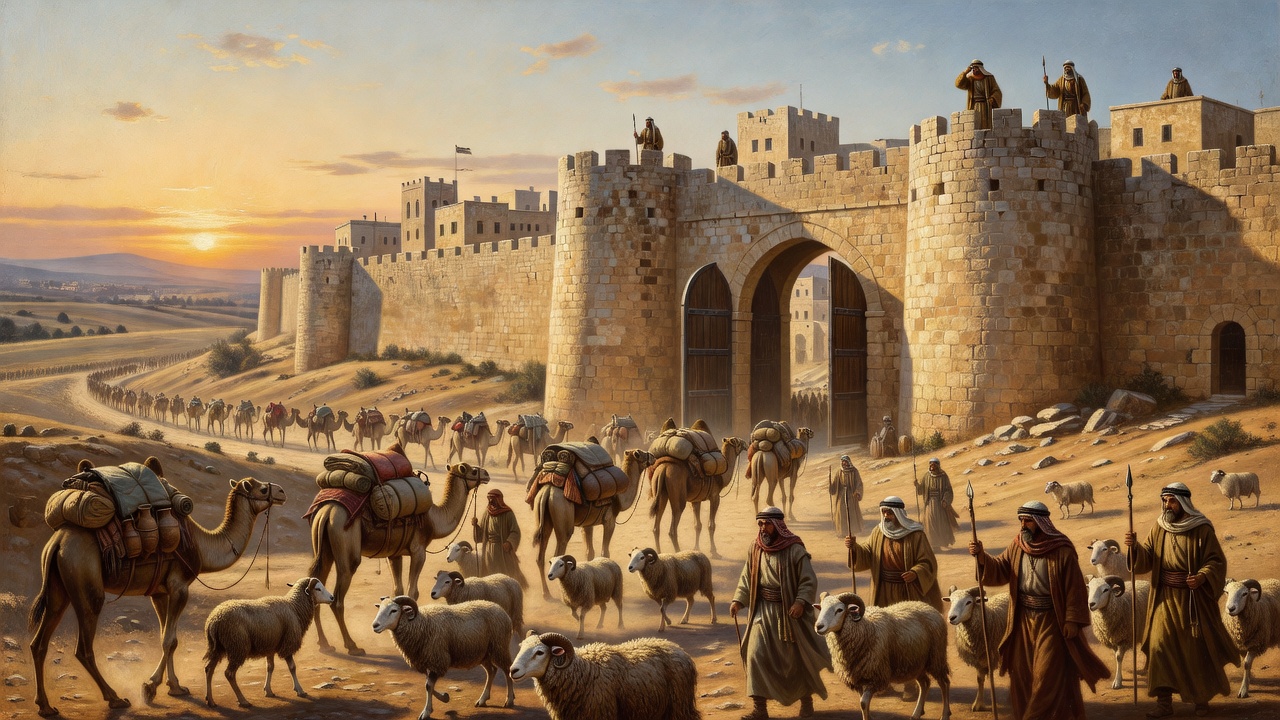
- Sheba was a kingdom in southern Arabia renowned for its ancient trade in gold and spices, while Midian was a nomadic Arabian tribe long engaged in desert commerce. Isaiah 60 envisions these distant peoples arriving on vast camel caravans, bearing gold and frankincense to praise the Lord.Sources: Sheba · Midian · the Bible text itself
- Kedar and Nebaioth trace back in biblical genealogies to the sons of Ishmael, with Kedar designating pastoral nomadic tribes of northwestern Arabia known for their large flocks and black tents. In this prophetic vision, their sheep and rams are brought to Jerusalem to be accepted as offerings upon the altar.Sources: Kedar · Nebajoth · Kedar · the Bible text itself
Notes written with AI assistance from open sources (Theographic Bible Metadata, CC BY-SA 4.0; Easton’s Bible Dictionary, public domain) and reviewed before publishing.
Places in this chapter
- Jerusalem · 31.777, 35.234 · verses 1, 14
- Ephah · Today: Midian · 28.495, 35.012 · verse 6
- Midian · 28.495, 35.012 · verse 6
- Sheba · 15.348, 44.206 · verse 6
- Kedar · 29.811, 39.868 · verse 7
- Lebanon · 33.540, 35.584 · verse 13
- Zion · Today: Jerusalem · 31.777, 35.234 · verse 14
Only places identified with high confidence are shown (90% or more according to the scholarly sources compiled by OpenBible). Period map: DARE (Digital Atlas of the Roman Empire), CC BY 4.0; modern map: © OpenStreetMap contributors; places: OpenBible.info (CC BY 4.0).
Credits and license for this translation
Bib Sen An
The Holy Bible in Haitian Creole, 2023 update
copyright © 2017-2023 Ron Smith
Language: Kreyòl Ayisyen (Haitian)
Translation by: Ron Smith
Contributor: Felix Nixon
This translation is made available to you under the terms of the
Creative Commons Attribution Share-Alike license 4.0.
You have permission to share and redistribute this Bible translation in any format and to make reasonable revisions and adaptations of this translation, provided that:
You include the above copyright and source information.
If you make any changes to the text, you must indicate that you did so in a way that makes it clear that the original licensor is not necessarily endorsing your changes.
If you redistribute this text, you must distribute your contributions under the same license as the original.
Pictures included with Scriptures and other documents on this site are licensed just for use with those Scriptures and documents.
For other uses, please contact the respective copyright owners.
Note that in addition to the rules above, revising and adapting God's Word involves a great responsibility to be true to God's Word. See Revelation 22:18-19.
2026-06-11
Source: http://ebible.org/hatbsa/ · eBible.org