Ezekiel 17
Bib Sen An · Tap a verse to see its cross-references.
1Alò, pawòl SENYÈ a te vin kote mwen. Li te di: 2“Fis a lòm, pwopoze yon devinèt e pale yon parabòl a lakay Israël. 3Di yo: ‘Konsa pale Senyè BONDYE a: “Yon gwo èg ak gwo zèl, gwo zèl louvri ak anpil bèl plim de anpil koulè te vini Liban, e te rache pran tèt pye sèd la. 4Li te rache tout ti branch nan pi wo tèt li, e te pote li nan peyi komèsan yo. Li te plase li nan yon vil machann yo.
5“‘“Anplis, li te pran semans peyi a pou te plante li nan yon tè fètil. Li te mete li akote gwo dlo. Li te plase li tankou yon pye sikren. 6Konsa, li te boujonnen e te vin yon lyann ba ki t ap kouvri toupatou ak branch li yo ki te tounen vè li menm, men rasin li yo te rete anba l. Konsa, li te vin yon plant, li te bay boujon e li te pwodwi anpil ti branch.
7“‘“Men te gen yon lòt gwo èg ak gwo zèl ak anpil plim. Epi gade byen, lyann sa a te koube rasin li yo vè li menm e te voye branch yo deyò vè li menm soti nan tè kote li te plante a, pou l te ka wouze li. 8Li te plante nan bon tè, akote anpil dlo, pou l te ka fè anpil branch ak bay fwi, e vin yon pye rezen byen bèl.”
9“Pale, ‘Konsa di Senyè BONDYE a: “Èske li va grandi byen? Èske li p ap rache rasin li yo, e koupe fwi li, pou li fennen nèt—pou tout fèy k ap pete yo ta fennen? Epi kit se pa gwo fòs, kit se pa anpil moun, li p ap ka leve sòti nan rasin li ankò. 10Gade byen, akoz li te plante, èske l ap grandi byen? Èske li p ap fennen nèt toutotan ke van lès ap frape li yo? Li va fennen sou tè a kote li te plante a?”’”
11Anplis, pawòl SENYÈ a te rive kote mwen e te di: 12“Di koulye a a kay rebèl la, ‘Èske ou pa konnen sa bagay sa yo vle di?’ Di yo: ‘Gade byen, wa Babylone nan te rive Jérusalem, te pran wa ak prens li yo e te mennen yo kote li Babylone. 13Li te pran youn nan fanmi wa a pou te fè yon akò avè l e te fè l sèmante. Anplis, li te retire pwisan yo nan peyi a, 14pou wayòm nan ta vin ba, pou l pa egzalte tèt li, men nan swiv akò L pou li ka kanpe ankò. 15Men li te fè rebèl kont li lè l te voye reprezantan li yo kote Égypte pou yo ta ka ba li cheval ak anpil sòlda. Èske li va reyisi? Èske sila ki fè kalite bagay sa yo va chape? Èske li, anverite, kapab kraze akò a e chape?
16“‘Jan Mwen viv la’, deklare Senyè BONDYE a, ‘Anverite, nan peyi wa ki te fè l wa, sèman a sila li te meprize a, e akò a sila li te kraze a; alò, avèk li menm,nan mitan Babylone, li va mouri. 17Farawon ak lame pwisan li an, ak gran fòs pèp li a, p ap ede li nan lagè a, lè yo fè monte ran syèj e bati miray syèj pou koupe lavi anpil moun. 18‘Konsa, li te meprize sèman an lè l te kraze akò a e gade byen, li te fè sèman li an, men gade tout bagay li te fè. Li p ap chape.’”
19“Akoz sa, pale Senyè BONDYE a: ‘Jan Mwen viv la, anverite, sèman Mwen an ke li te meprize a, ak akò Mwen an ke li te kraze a, Mwen va koze malè sou tèt li. 20Filè Mwen an va kouvri li nèt e li va kenbe nan pèlen an. Epi Mwen va mennen li Babylone e antre nan jijman avèk li selon zak enfidèl ke li te komèt kont Mwen an. 21Tout mesye byen chwazi pami sòlda li yo va tonbe pa nepe, e sila ki chape yo va gaye nan tout van. Konsa nou va konnen ke Mwen menm, SENYÈ a te pale.’
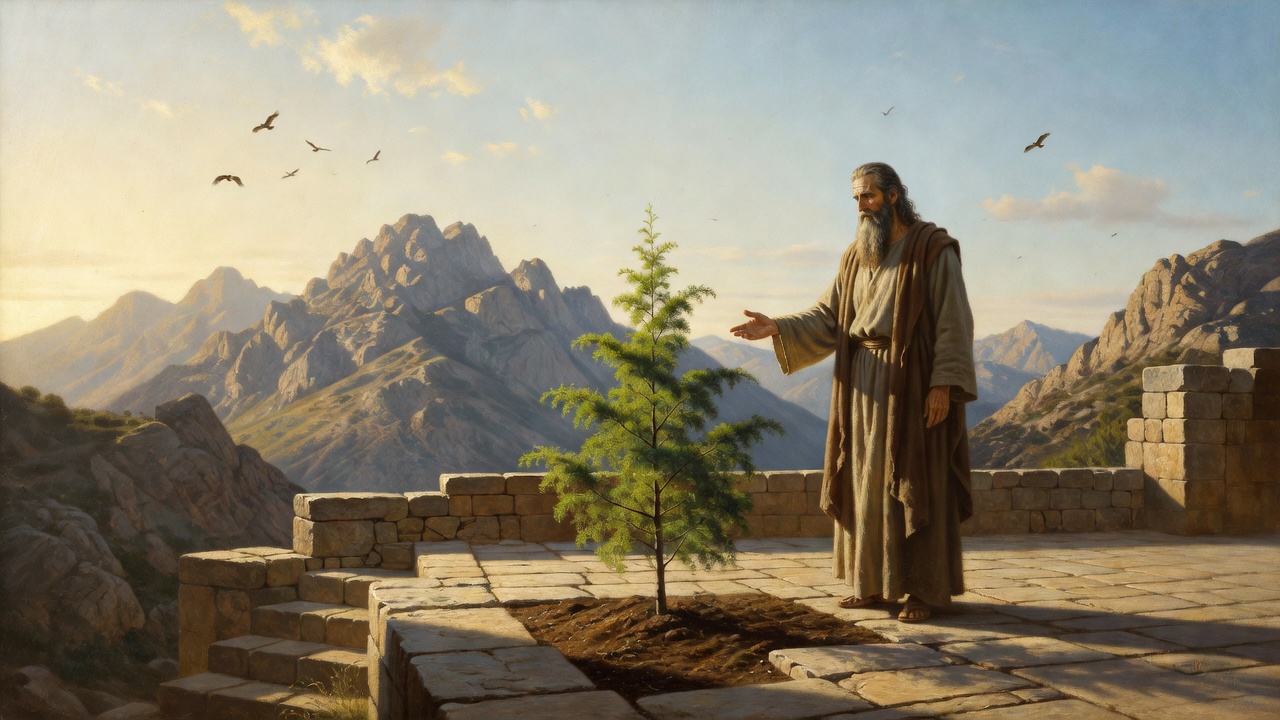
22“Senyè BONDYE a di: ‘Anplis, Mwen va pran yon ti branch piti soti anlè pye sèd la e Mwen va plante li. Mwen va rache nan pi wo pwent a jenn ti boujon li yo, youn ki piti e ki mou e Mwen va plante li sou yon mòn ki byen wo. 23Sou mòn byen wo Israël la, Mwen va plante li, pou li kapab pwodwi gwo branch, bay fwi e devni yon gwo pye sèd byen bèl. Epi zwazo de tout kalite yo va fè nich yo anba li. Yo va pran repo nan lonbraj branch li yo. 24Tout pyebwa nan chan yo va konnen ke Mwen se SENYÈ a. Mwen desann pyebwa ki byen wo a, egzalte pyebwa ki ba a, seche pyebwa ki vèt la e fè pyebwa ki sèch la fleri.
“‘Mwen, SENYÈ a, te pale e Mwen te akonpli sa.’”
Did you know?
The Parable of the Eagles and the Cedar
- Ezekiel presents a political allegory where the first great eagle represents the king of Babylon, who captured Jerusalem's royal leadership and established a vassal king under a solemn covenant. The second eagle represents Egypt and its Pharaoh, to whom the Judean ruler turned for cavalry and military assistance in defiance of his sworn allegiance.Sources: the Bible text itself · Babylon · Egypt · Pharaoh
- In the prophetic message, breaking a political vassal oath made under Babylon was treated not merely as diplomatic rebellion, but as spiritual treason against God, who regarded the sworn pledge as His own oath.Sources: the Bible text itself
- The chapter concludes with a reversal of human political schemes: God Himself promises to take a tender shoot from the top of the cedar and plant it upon the mountain heights of Israel, where it will grow into a majestic tree offering shelter to birds of every kind.Sources: the Bible text itself
Notes written with AI assistance from open sources (Theographic Bible Metadata, CC BY-SA 4.0; Easton’s Bible Dictionary, public domain) and reviewed before publishing.
Places in this chapter
- Lebanon · 33.540, 35.584 · verse 3
- Canaan · 32.767, 35.333 · verse 4
- Babylon · 32.543, 44.422 · verses 12, 14, 15, 16, 17, 20
- Jerusalem · 31.777, 35.234 · verses 12, 17
- Egypt · 30.129, 31.308 · verse 15
Only places identified with high confidence are shown (90% or more according to the scholarly sources compiled by OpenBible). Period map: DARE (Digital Atlas of the Roman Empire), CC BY 4.0; modern map: © OpenStreetMap contributors; places: OpenBible.info (CC BY 4.0).
Credits and license for this translation
Bib Sen An
The Holy Bible in Haitian Creole, 2023 update
copyright © 2017-2023 Ron Smith
Language: Kreyòl Ayisyen (Haitian)
Translation by: Ron Smith
Contributor: Felix Nixon
This translation is made available to you under the terms of the
Creative Commons Attribution Share-Alike license 4.0.
You have permission to share and redistribute this Bible translation in any format and to make reasonable revisions and adaptations of this translation, provided that:
You include the above copyright and source information.
If you make any changes to the text, you must indicate that you did so in a way that makes it clear that the original licensor is not necessarily endorsing your changes.
If you redistribute this text, you must distribute your contributions under the same license as the original.
Pictures included with Scriptures and other documents on this site are licensed just for use with those Scriptures and documents.
For other uses, please contact the respective copyright owners.
Note that in addition to the rules above, revising and adapting God's Word involves a great responsibility to be true to God's Word. See Revelation 22:18-19.
2026-06-11
Source: http://ebible.org/hatbsa/ · eBible.org