Deuteronomy 3
Bib Sen An · Tap a verse to see its cross-references.
1“Alò, nou te vire monte nan wout la vè Basan. Konsa, Og, wa a Basan an avèk tout pèp li a te sòti pou rankontre nou nan batay nan Édréï. 2Men SENYÈ a te di mwen: ‘Pa pè li, paske Mwen te livre li avèk tout pèp li a, ak peyi li a nan men ou; epi ou va fè li menm jan ke ou te fè Sihon, wa Amoreyen yo, ki te rete Hesbon an.’
3“Konsa SENYÈ a, Bondye nou an, te livre osi Og, wa Basan an, avèk tout pèp li a nan men nou e nou te frape yo jis nanpwen ki te rete vivan. 4Nou te pran an kaptif tout vil li yo nan tan sa a; nanpwen vil ke nou pa t pran sou yo: swasant vil, tout rejyon Argob la, wayòm a Og la, nan Basan. 5Tout vil sa yo te fòtifye avèk miray ki wo, avèk pòtay byen bare; epi osi, anpil vil ki te san miray. 6Nou te konplètman detwi yo, jis jan ke nou te fè a Sihon, wa Hesbon an, e nou te konplètman detwi gason, fanm ak pitit a chak vil yo. 7Men nou te piyaje tout bèt ak byen a vil yo.
8“Konsa, nou te pran peyi a nan tan sa a nan men wa Amoreyen yo ki te lòtbò Jourdain an, soti nan vale Arnon an jis rive nan Mòn Hermon an. 9(Sidonyen yo rele Hermon Sirion e Armoreyen yo rele li, Senir.) 10Nou te pran tout vil nan platon yo, tout Galaad ak tout Basan jis rive nan Salca ak Édréï, vil a wayòm Og yo, nan Basan. 11(Paske se sèl Og, wa Basan an ki te rete kòm retay a Rephaïm yo. Gade byen, kabann li te fèt an fè. Èske li pa nan Rabbath, vil a fis Ammon yo? Longè li se te nèf koude e lajè li se te kat koude nan koude a yon moun.)”
12“Konsa, nou te vin pran posesyon a peyi sila nan tan sa a. Soti nan Aroër, ki bò kote vale Arnon an, ak mwatye peyi ti mòn a Galaad yo, avèk vil pa li yo, mwen te bay yo a Ribenit yo e a Gadit yo. 13Rès pati a Galaad la ak tout Basan an, wayòm Og la, mwen te bay a mwatye tribi Manassé a, tout rejyon a Argob la (pa tout Basan, se li yo rele peyi a Rephaïm yo. 14Jaïr, fis a Manassé a te pran tout rejyon Argob la jis rive nan lizyè Gechiyen yo ak Maakatyen yo, e yo te rele li Basan, selon pwòp non pa li, Havvoth-Jaïr, e se konsa li rele jis jodi a.) 15A Makir, mwen te bay Galaad. 16A Ribenit yo avèk Gadit yo, mwen te bay soti Galaad pou rive jis nan vale Arnon, mitan vale a sèvi kòm yon lizyè e jis nan rivyè Jabbok la, ki se fwontyè a fis Ammon yo; 17Araba a osi, avèk rivyè Jourdain an kòm yon lizyè soti Kinnéreth jis rive nan lanmè Araba a, Lamè Sale a, nan pye a mòn Pisga nan lès.
18“Epi mwen te kòmande nou nan tan sa a e te di: ‘SENYÈ a, Bondye nou an, te bannou peyi sa a pou posede li. Nou tout, mesye vanyan yo, nou va travèse avèk zam devan frè nou yo, fis Israël yo. 19Men madanm nou yo avèk pitit nou yo ak bèt nou yo (mwen konnen ke nou genyen anpil bèt) va rete nan vil ke mwen te bannou yo,’ 20jis SENYÈ a bay repo a sitwayen parèy a nou an, jis tankou nou; epi yo, osi, vin posede peyi ke SENYÈ a, Bondye nou an, va bay yo lòtbò Jourdain an. Nan moman sa a, nou tout kapab retounen nan pwòp posesyon pa l ke mwen te bannou an’.
21“Mwen te kòmande Josué e te di: ‘Zye ou gen tan fin wè tout sa ke SENYÈ a, Bondye nou an, te fè a dè wa sa yo. Konsa, SENYÈ a va fè nan tout wayòm kote ou prèt pou travèse yo. 22Pa pè yo; paske SENYÈ a, Bondye nou an, se Li menm k ap goumen pou nou.’
23“Nan tan sa a, osi, mwen te sipliye SENYÈ a, Bondye nou an. Mwen te di: 24‘O SENYÈ BONDYE, Ou te kòmanse montre sèvitè ou a jan Ou gran ak men pwisan Ou. Paske ki dye ki genyen nan syèl la oswa sou tè a, ki kapab fè kalite zèv sa yo, zèv pwisan tankou pa Ou yo? 25Kite mwen pase, mwen priye Ou, travèse wè bèl peyi ki lòtbò Jourdain an, bèl peyi mòn sa a, avèk Liban.’
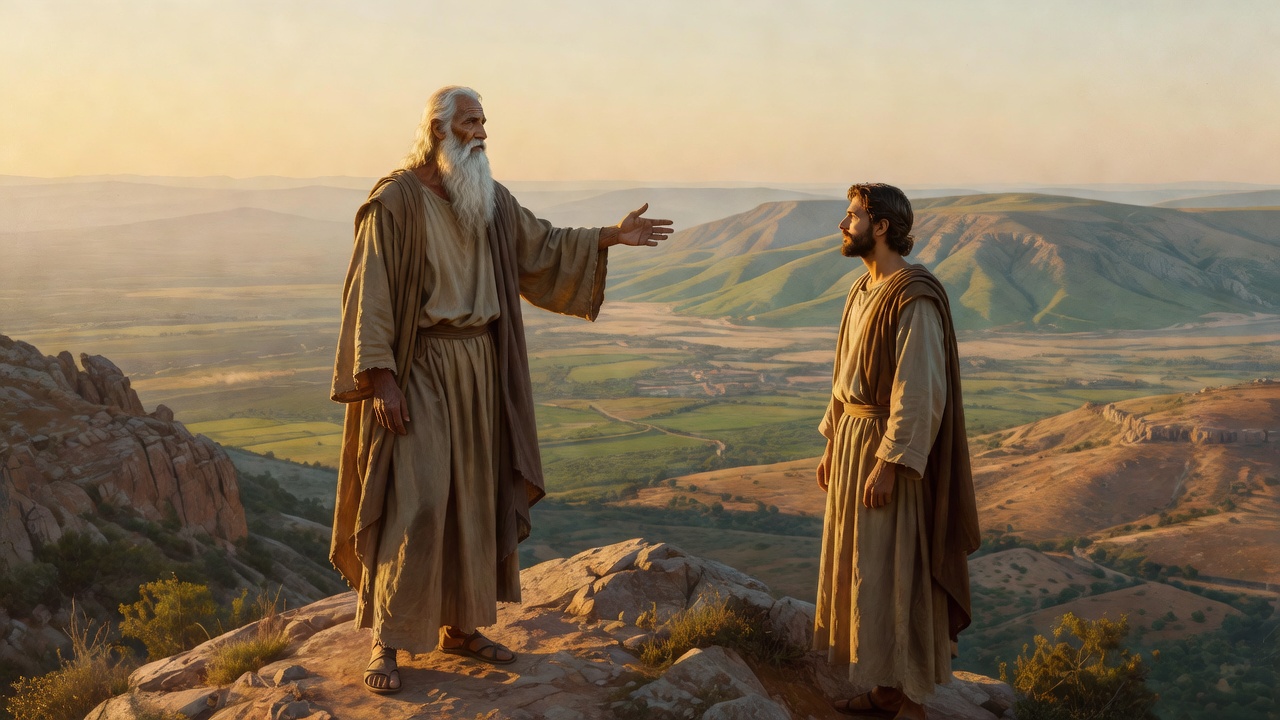
26“Men SENYÈ a te fache avèk mwen akoz nou menm, e Li pa t koute mwen. SENYÈ a te di mwen: ‘Sa sifi! Pa pale M ankò de zafè sa a. 27Monte sou tèt Pisga, leve zye ou vè lwès, nan nò, sid avèk lès, e gade li avèk zye ou, paske ou p ap travèse Jourdain an. 28Men pale Josué, ankouraje li e ba li fòs, paske li va ale lòtbò a nan tèt a pèp sa a, e li va bay yo li kòm eritaj pa yo peyi ke ou va wè a.’
29“Konsa, nou te rete nan vale a anfas Beth-Peor a.”
Did you know?
Victory in Bashan and Joshua's Succession
- Og, the king of Bashan defeated by the Israelites at Edrei, is described as the last survivor of the Rephaim. Deuteronomy mentions that his iron bedstead or sarcophagus, measuring nine cubits long and four cubits wide, was preserved in Rabbah of the Ammonites.Sources: Og · the Bible text itself
- The region of Argob in Bashan was renowned for its sixty strongly fortified cities with high walls and barred gates. Following Israel's victory, this rugged territory was allocated to the half-tribe of Manasseh and taken by Jair, one of its descendants.Sources: Argob · the Bible text itself
- Although Moses was permitted to view the Promised Land in every direction from the summit of Pisgah, he was forbidden from crossing the Jordan River. Moses was directed to commission and strengthen Joshua, who would lead the people across to inherit the land.Sources: Joshua · the Bible text itself
Notes written with AI assistance from open sources (Theographic Bible Metadata, CC BY-SA 4.0; Easton’s Bible Dictionary, public domain) and reviewed before publishing.
Places in this chapter
- Bashan · 32.781, 35.935 · verses 1, 3, 4, 6, 10, 11, 13, 14
- Argob · 32.969, 36.455 · verses 4, 13, 14
- Jordan · Today: Jordan River · 31.761, 35.558 · verses 8, 17, 18, 20, 21, 25, 27, 28
- Mount Hermon · 33.400, 35.850 · verses 8, 9
- Valley of the Arnon · Today: Wadi Mujib · 31.466, 35.573 · verses 8, 12, 16
- Senir · Today: Mount Hermon · 33.400, 35.850 · verse 9
- Gilead · Today: Gilead 1 · 32.187, 35.692 · verses 10, 12, 13, 15, 16
- Ammon · 31.955, 35.934 · verses 11, 16
- Rabbah · Today: Amman · 31.955, 35.934 · verse 11
- Havvoth-jair · 32.588, 35.726 · verse 14
- Jabbok · Today: Zarqa River · 32.115, 35.543 · verse 16
- Arabah · 30.417, 35.151 · verse 17
- Salt Sea · Today: Dead Sea · 31.500, 35.500 · verse 17
- Lebanon · 33.540, 35.584 · verse 25
Only places identified with high confidence are shown (90% or more according to the scholarly sources compiled by OpenBible). Period map: DARE (Digital Atlas of the Roman Empire), CC BY 4.0; modern map: © OpenStreetMap contributors; places: OpenBible.info (CC BY 4.0).
Credits and license for this translation
Bib Sen An
The Holy Bible in Haitian Creole, 2023 update
copyright © 2017-2023 Ron Smith
Language: Kreyòl Ayisyen (Haitian)
Translation by: Ron Smith
Contributor: Felix Nixon
This translation is made available to you under the terms of the
Creative Commons Attribution Share-Alike license 4.0.
You have permission to share and redistribute this Bible translation in any format and to make reasonable revisions and adaptations of this translation, provided that:
You include the above copyright and source information.
If you make any changes to the text, you must indicate that you did so in a way that makes it clear that the original licensor is not necessarily endorsing your changes.
If you redistribute this text, you must distribute your contributions under the same license as the original.
Pictures included with Scriptures and other documents on this site are licensed just for use with those Scriptures and documents.
For other uses, please contact the respective copyright owners.
Note that in addition to the rules above, revising and adapting God's Word involves a great responsibility to be true to God's Word. See Revelation 22:18-19.
2026-06-11
Source: http://ebible.org/hatbsa/ · eBible.org