Ezekiel 17
Bib La · Tap a verse to see its cross-references.
1Seyè a pale avè m' ankò, li di m' konsa: 2-Nonm o! Bay moun pèp Izrayèl yo yon pawoli. Rakonte yo yon parabòl. 3Di yo men mesaj Seyè sèl Mèt la voye ba yo: Vwala, se te yon gwo gwo malfini ak zèl li yo byen laj. Plim li yo te long epi yo te tout kalite koulè. Li vole li ale nan peyi Liban, li kase tèt yon pye sèd. 4Li pran l', li pote l' ale nan yon peyi kote moun se trafik ase y'ap fè la. Li mete l' nan yon lavil kote se kòmèsan ase ki rete la. 5Lèfini, li pran yon ti plan nan peyi Izrayèl la, li plante l' nan yon bon venn tè, toupre yon larivyè ki toujou plen dlo, pou l' ka grandi tankou yon pye sikren. 6Ti plan an pran, li fè yon bèl pye rezen ki pa twò wo. Branch li yo grandi, yo moute nan direksyon malfini an, men rasin li yo menm desann fon anba tè. Li bay yon bèl pye rezen ak anpil branch plen fèy. 7Te vin gen yon lòt gwo malfini ak gwo zèl byen laj ak anpil plim sou li. Lè sa a, pye rezen an pouse rasin nan direksyon malfini sa a. Li vire tout branch li yo nan direksyon l' tou. Li te konprann malfini sa a tapral wouze l' pi byen pase jaden kote l' te plante a. 8Men, pye rezen an te deja plante nan yon bon venn tè, kote yon kannal ki toujou gen dlo, pou l' te ka fè fèy, pou l' te ka donnen, pou li te ka rive fè yon bèl pye rezen. 9Di yo men mesaj Seyè sèl Mèt la voye ba yo: Eske pye rezen an ap grandi vre? Eske premye malfini an p'ap dechouke l', rache tout grap rezen l' yo, kase tout branch li yo pou yo mouri? Li p'ap bezwen anpil fòs ni yon lame moun pou l' dechouke l'. 10Wi, yo te plante l'. Men, èske l'ap grandi? Eske li p'ap mouri lè van lès la va soufle sou li? Eske li p'ap mouri lamenm kote li t'ap pouse a? 11Seyè a pale avè m', li di m' konsa: 12-Pale ak bann moun tèt di sa yo. Mande yo si yo konprann sans parabòl la. Di yo konsa: Wa lavil Babilòn lan te vini lavil Jerizalèm, li pran wa a ansanm ak tout chèf li yo, li mennen yo ansanm avè l' lavil Babilòn. 13Li pran yon moun nan fanmi wa a, li pase kontra avè l', li fè l' sèmante pou l' toujou soumèt devan li. Li pran tout grannèg ki nan peyi a, li fè yo prizonye, li depòte yo. 14Konsa, li sèten peyi a va rete tou piti anba men l', yo p'ap ka leve tèt devan li, y'a toujou kenbe kontra li te pase ak yo a. 15Men, wa peyi Jida a revòlte. Li voye mesaje nan peyi Lejip al chache chwal ak anpil sòlda. Eske l'ap rive fè sa li vle fè a? Eske li ka soti nan sitiyasyon kote l' ye a? Depi li kase kontra a, fòk li peye l'. 16Se mwen menm, Seyè sèl Mèt la, k'ap pale: Jan nou konnen mwen vivan vre a, wa a pral lavil Babilòn, paske li te kase kontra a, li pa t' respekte kondisyon li te pase ak wa lavil Babilòn lan ki te mete l' la pou gouvènen peyi a. 17Farawon an te mèt vini ak yon gwo lame ansanm ak anpil sòlda, li p'ap ka ede l' goumen nan lagè a, lè moun Babilòn yo va vin moute ranblè ak fouye gwo kannal pou yo touye moun san gad dèyè. 18Wa peyi Izrayèl la pa respekte pawòl li, li kase kontra a. Malgre angajman li te pran yo, li fè tout bagay sa yo. Sa p'ap pase konsa pou li. 19Se poutèt sa, men sa Seyè Sèl Mèt la di: Jan nou konnen mwen vivan vre a, ou pa respekte pawòl ou avè m'. Ou pa kenbe kontra mwen te pase avè ou la. Mwen gen pou m' pini ou pou sa. 20M'ap voye privye m' sou ou, w'ap pran nan may yo, m'ap trennen ou lavil Babilòn. Se la m'ap pini ou pou kenbe ou pa te kenbe pawòl ou avè m'. 21Tout pi bon sòlda li yo pral mouri nan lagè. Sa ki chape yo, yo pral gaye yo toupatou sou latè. Lè sa a, n'a konnen se mwen menm, Seyè a, ki pale. 22Men sa Seyè sèl Mèt la di: -M'ap koupe boujon tèt yon pye sèd ki byen wo. M'ap kase yon jenn ti boujon nan branch ki pi wo yo. M'ap plante l' sou tèt yon mòn byen wo, 23sou tèt mòn ki pi wo nan peyi Izrayèl la. L'ap fè branch, l'ap donnen. L'ap vin fè yon bèl bèl pye sèd. Tout kalite zwezo pral rete ladan l'. Y'ap pare solèy nan lonbraj branch li yo. 24Tout pyebwa nan peyi a va konnen se mwen menm ki Seyè a. Mwen koupe gwo pyebwa yo mete atè. Ti pyebwa piti yo, m'ap fè yo grandi. Mwen cheche pyebwa ki vèt yo. Pyebwa ki fin mouri yo, mwen fè yo boujonnen ankò. Se mwen menm Seyè a ki pale. Sa mwen di m'ap fè a, m'ap fè l'.
Did you know?
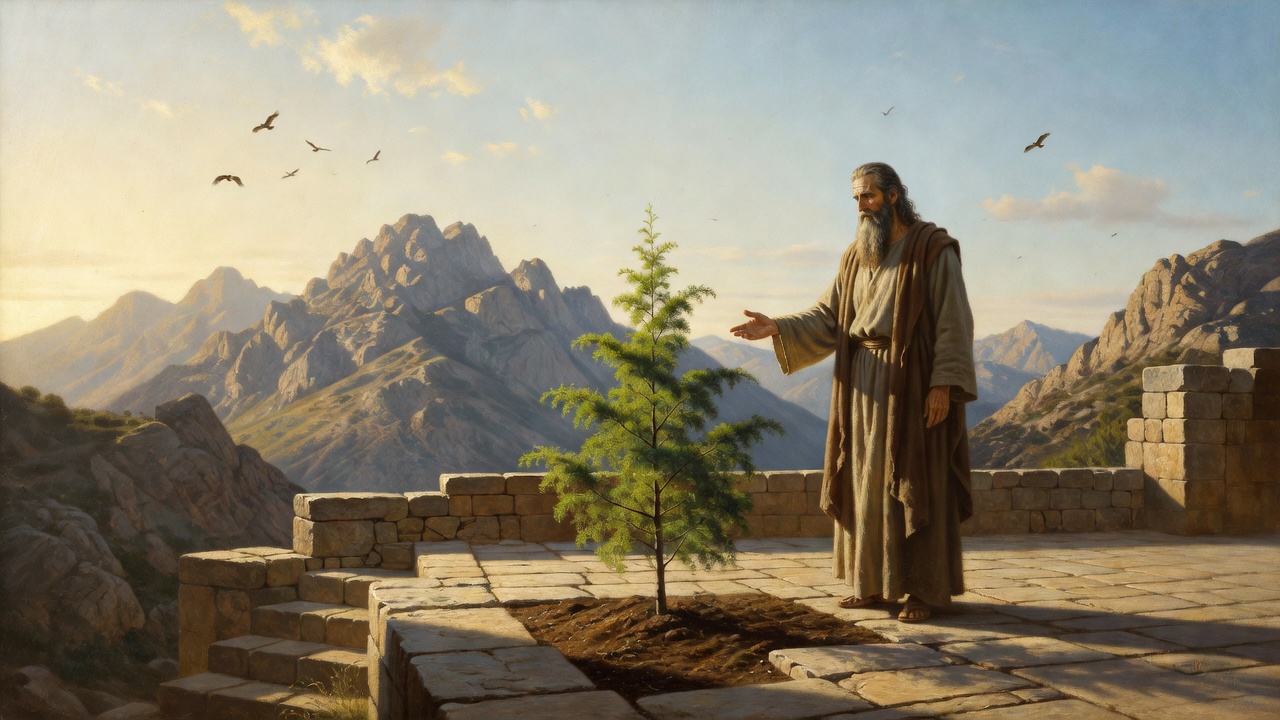
The Parable of the Eagles and the Cedar
- Ezekiel presents a political allegory where the first great eagle represents the king of Babylon, who captured Jerusalem's royal leadership and established a vassal king under a solemn covenant. The second eagle represents Egypt and its Pharaoh, to whom the Judean ruler turned for cavalry and military assistance in defiance of his sworn allegiance.Sources: the Bible text itself · Babylon · Egypt · Pharaoh
- In the prophetic message, breaking a political vassal oath made under Babylon was treated not merely as diplomatic rebellion, but as spiritual treason against God, who regarded the sworn pledge as His own oath.Sources: the Bible text itself
- The chapter concludes with a reversal of human political schemes: God Himself promises to take a tender shoot from the top of the cedar and plant it upon the mountain heights of Israel, where it will grow into a majestic tree offering shelter to birds of every kind.Sources: the Bible text itself
Notes written with AI assistance from open sources (Theographic Bible Metadata, CC BY-SA 4.0; Easton’s Bible Dictionary, public domain) and reviewed before publishing.
Places in this chapter
- Lebanon · 33.540, 35.584 · verse 3
- Canaan · 32.767, 35.333 · verse 4
- Babylon · 32.543, 44.422 · verses 12, 14, 15, 16, 17, 20
- Jerusalem · 31.777, 35.234 · verses 12, 17
- Egypt · 30.129, 31.308 · verse 15
Only places identified with high confidence are shown (90% or more according to the scholarly sources compiled by OpenBible). Period map: DARE (Digital Atlas of the Roman Empire), CC BY 4.0; modern map: © OpenStreetMap contributors; places: OpenBible.info (CC BY 4.0).
Credits and license for this translation
Bib La
The Holy Bible in Haitian Creole
Public Domain
Language: Kreyòl Ayisyen (Haitian)
In the Public Domain due to publication without copyright notice in 1985, and without subsequent registration within 5 years.
2020-03-10
Source: http://ebible.org/hat/ · eBible.org