Job 3
Tupàn ze'eg · Tap a verse to see its cross-references.
ZEMUGETA HAW PITÀI HAW
Izo omono ze'egaiw uzexak kar awer 'ar rehe
1Iahykaw rehe Izo uze'eg kury. Omono uze'egaiw 'ar uzexak kar awer rehe. Na'aw Izo ize'eg awer xe.
3Tuwe Tupàn omono ze'egaiw hezexak kar awer 'ar rehe nehe.
Tuwe Tupàn omono ze'egaiw a'e ipytunaw rehe nehe.
— Uzexak kar a'e, i'i a'e 'ar mehe wà. — Awa a'e, i'i wà.
4Tuwe a'e 'ar uzeapo ipytunahy haw romo nehe.
Tuwe Tupàn ywate har nuzekaiw kwaw a'e 'ar rehe nehe.
Tuwe tatainy nuhyape pixik kwaw a'e 'ar rehe nehe.
5Tuwe ipytunahy haw wiko izar romo nehe.
Tuwe ywàkun upyk nehe. Tuwe ywàkun umuwew kwarahy heny haw a'e 'ar rehe har nehe.
6Tuwe a'e ipytunaw ipytunahy tuweharupi nehe.
Tuwe ukàzym 'ar ipapar haw wi nehe.
7Tuwe a'e ipytunaw upyta umyrypar 'ym romo nehe, uzemumikahy ma'e romo nehe.
Tuwe ni amo nuenu kwaw amo urywete haw rehe wanehapukaz mehe wà nehe.
8Amo paze ma'e ikàg wera'u àzàg Erewiàtà her ma'e wi wà.
Tuwe a'e paze ma'e omono uze'egaiw a'e ipytunaw rehe wà nehe.
9Tuwe zahytata izi'itahy har a'e ipytunaw rehe har uwew wà nehe.
Tuwe uwàro tatainy nehe. Tuwe tatainy nur kwaw izupe nehe.
Tuwe na'iku'em pixik kwaw nehe.
10Ta'e hemuzexak kar hehy pe a'e xe.
Nahemunyryk kwaw ko ma'erahy wi.
Màràzàwe tuwe nazexak kar kwaw umàno ma'e kwer ài ihe
11Màràzàwe tuwe nazexak kar kwaw umàno ma'e kwer romo.
Màràzàwe tuwe namàno kwaw hezexak kar mehe.
12Màràzàwe tuwe hehy hepyhyk u'uwaromo a'e.
Màràzàwe tuwe umur ukàm ihewe hemukamu kar pà ipupe.
13Aze mo àmàno a'e 'ar mehe we,
Aker mo ko 'ar rehe.
Apytu'u mo ma'erahy ipuraraw 'ym pà.
14Aiko mo tuwihawete wanehe we. Aiko mo tuwihaw upuner ma'e wanehe we.
A'e tuwihaw uzapo wi wàpuzuhu kwehe arer wà.
15Aiko mo tuwihaw wanehe we.
A'e tuwihaw umynehem wàpuz or pupe wà, parat pupe wà no.
16Aze mo hehy hezuka zemim hezexak kar 'ym mehe we a'e.
Naikuwe iwer mo ihe. Aiko mo kwarer 'ar hexak 'ymar ài.
17Tywypaw pe upaw ikatu 'ym ma'e wanemimutar.
Ikene'o ma'e upytu'u a'e pe wà.
18Imunehew pyrer upytu'u a'e pe uzeinuinuromo wà.
Nuenu kwaw uwihaw hehapukaz haw a'e pe wà.
19Upuner ma'e wiko a'e pe wà. Upuner 'ym ma'e wiko a'e pe wà no.
Uma'ereko e ma'e kwer utyryk uzarer wanuwi wà no.
Màràzàwe tuwe hurywete 'ym ma'e wiko we wà no
20Màràzàwe tuwe uzemumikahy ma'e wexak wiwi tatainy wà.
Màràzàwe tuwe teko nuzuka kwaw upy'a pupe uzemumikahy ma'e wà.
21Uwàro umàno àwàm waiko wà. Nur kwaw a'e.
Uputar umàno àwàm temetarer tetea'u wi wà. Nezewe rehe we nur kwaw wanupe.
22Uzetymaw pupe uwezyw mehe hurywete wà.
Hurywete azeharomoete wà.
23Tupàn umuata kar hehàpyhà 'ym ma'e zàwe wà.
Umàmàn waiwyr paw rupi wà.
24Namai'u kwaw ihe. Azai'o. Hekuhemaw uzeakook 'y ài.
25Akyze amo ma'e uzeapo ma'e ràm wi ihe. Uzeapo tuwe a'e ma'e.
Akyze tuwe amo ma'e wi. A'e ma'e nuzawy kwaw tuwe hemugaz taw a'e.
26Naiko kwaw zeàmàtyry'ymaw rehe. Naheta kwaw hepytu'u haw ihewe.
Naheawoawotahy kwaw zote ihe.
Did you know?
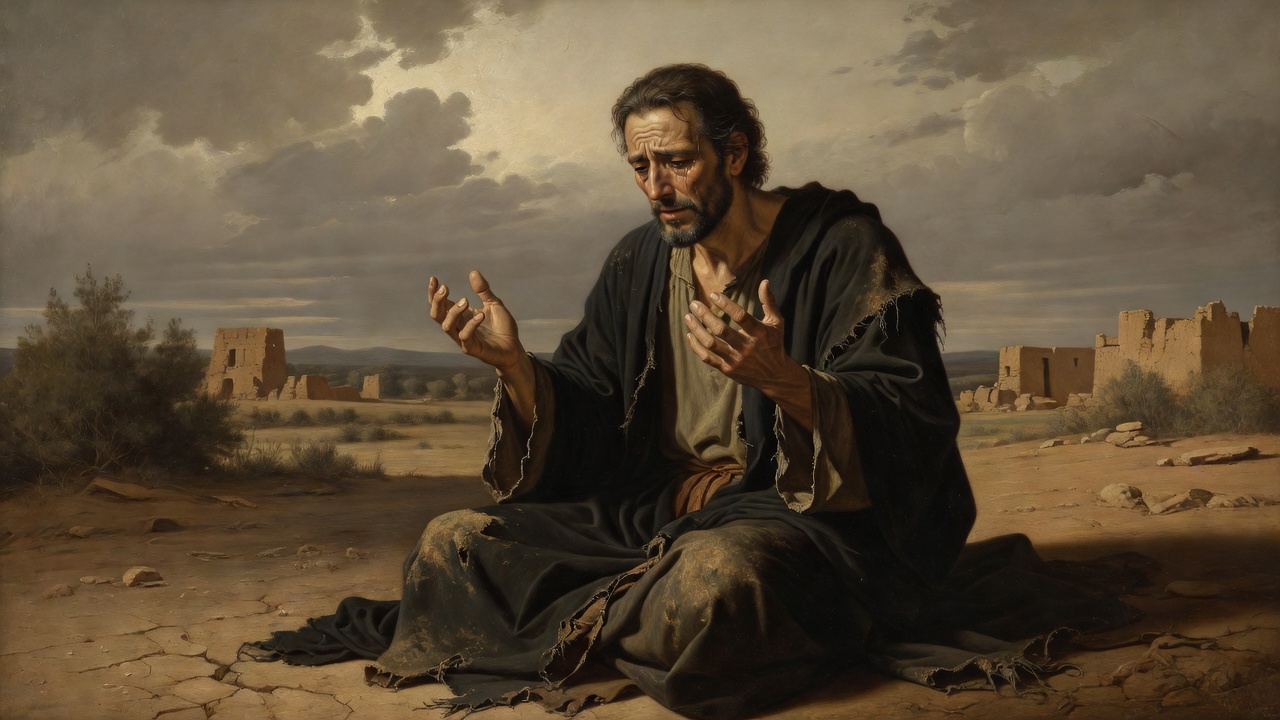
Job Curses the Day of His Birth
- After enduring intense suffering, Job breaks his silence not by cursing God, but by cursing the day of his birth and the night he was conceived, wishing that day had been swallowed by absolute darkness.Sources: the Bible text itself · Job
- In his poetic lament, Job calls upon those who curse the day and are prepared to rouse Leviathan, using ancient imagery of cosmic chaos to emphasize his longing for the erasure of his existence.Sources: the Bible text itself
- Job describes the realm of the dead as an equalizer where kings, counselors, slaves, and prisoners find rest together, free from the exhaustion, oppression, and turmoil that plague the living.Sources: the Bible text itself
Notes written with AI assistance from open sources (Theographic Bible Metadata, CC BY-SA 4.0; Easton’s Bible Dictionary, public domain) and reviewed before publishing.
Credits and license for this translation
Tupàn ze'eg
Bible without Deuterocanon in Guajajára (BR:gub:Guajajára)
copyright © 2007 Wycliffe Bible Translators, Inc.
Language: Guajajára
Translation by: Wycliffe Bible Translators, Inc.
Guajajára [gub], Brazil
Copyright Information
© 2007, Wycliffe Bible Translators, Inc. All rights reserved.
This translation text is made available to you under the
terms of the Creative Commons License: Attribution-Noncommercial-No Derivative Works.
( http://creativecommons.org/licenses/by-nc-nd/3.0/ )
In addition, you have permission to port the text to different file formats, as long as you
do not change any of the text or punctuation of the Bible.
You may share, copy, distribute, transmit, and extract portions
or quotations from this work, provided that you include the above copyright
information:
You must give Attribution to the work.
You do not sell this work for a profit.
You do not make any derivative works that change any of the actual words or punctuation of the Scriptures.
Permissions beyond the scope of this license may be
available if you contact
us with your request.
Printed book ISBN 9788531109713
The Bible without Deuterocanon
in Guajajára
© 2007, Wycliffe Bible Translators, Inc. All rights reserved.
This translation is made available to you under the terms of the
Creative Commons Attribution-Noncommercial-No Derivatives license 4.0.
You may share and redistribute this Bible translation or extracts from it in any format, provided that:
You include the above copyright and source information.
You do not sell this work for a profit.
You do not change any of the words or punctuation of the Scriptures.
Pictures included with Scriptures and other documents on this site are licensed just for use with those Scriptures and documents.
For other uses, please contact the respective copyright owners.
2020-03-30
Source: http://ebible.org/gubBl/ · eBible.org