John 11
Alkawal Kesal · Tap a verse to see its cross-references.
Maayde Lasar
1Gorko gom, bi'eteeɗo Lasar e tawano Baytaniya, o nyawi. Oo woodi sakikiraaɓe ɗiɗo, Mariyama e Marta. 2Mariyama on nun woni moomunooɗo wardi e Joomiraawo, go o moytiri gaasa makko koyɗe Yeesu. Sakiike makko, Lasar nyawunoo. 3Sakikiraaɓe makko lili e Yeesu wi'a mo: «Moodibbo, beldiijo maa yanɗaa.»
4No Yeesu nanunoo ka, wi'i: «Nyaw ɗum ɗon nyaw maayde bane. Ɗum waru nun gam tedduŋal Alla, gam Ɓiɗɗo Alla teddiniree e majjum.»
5Yeesu e yiɗi Marta, e miiraawo mum, e Lasar. 6Baa no o nani Lasar yanɗaa, haɗay mo jooɗaago balɗe ɗiɗi to o wonunoo. 7Ɓaawo majjum o wi'i aahiiɓe makko: «En bittee leydi Yahudiya!» 8Aahiiɓe wi'i: «Moodibbo, baa ɓooyay Yahuduuɓe e daartano warirgo maa kaaƴe, go ton nun bittataa?» 9Yeesu toontii: «Hinaa wakkatiiji sappo e ɗiɗi woni der nyaalooma? Jahoowo nyaalooma fergataako gam oo yi'a jayŋol duuniyaaru nu. 10Amma jahoowo jemma fergoto gam jayŋol walaa e makko.»
11Ɓaawo o bati haalaaji ɗii, o wi'i: «Giɗo meeɗen Lasar ɗaanike, mi yahan, mi finnina mo.» 12Aahiiɓe wi'i: «Moodibbo, to o ɗaani nun, o yoofoto.» 13Maayde Lasar nun o batannoo. Kamɓe ɓe miili haala ɗoyŋol nun o batani. 14Yeesu laaɓinani ɓe: «Lasar maayii! 15Ɓerne am welii gam mooɗon ko mi tawaaka ton. Ɗum laatanto on daliila goonɗinon. To non en jahu, to makko.» 16Den Toma bi'eteeɗo Ciwto wi'i aahiiɓe horiiɓe: «En jahu enen bo gam maayden e makko.»
Yeesu nun woni ummital e gurnam
17No Yeesu yottinoo, tawi waɗii balɗe naay Lasar e tawaa der saabeere. 18Hakkune Baytaniya e Urusaliima ɓuraa kilooji tati, 19Yahuduuɓe ɗuuɓɓe wari to Marta e Mariyama gam eytugo ɓe e maayde sakiike maɓɓe.
20No Marta nani Yeesu warii, yahi taɓɓitoyii mo, tawi Mariyama e jooɗii der suudu. 21Marta wi'i Yeesu: «Moodibbo, to aa wonunoo ɗo, sakiike am maayataano. 22Amma baa jooni mii anni huune fu ko ƴamuɗaa Alla, o waɗante.» 23Yeesu wi'i mo: «Sakiike maa fintan.» 24Marta wi'i: «Mii anni o fintan nyalaane ummital.»
25Yeesu wi'i mo: «Min woni pintinoowo, min woni kokkoowo yonki. Neɗɗo fu goonɗinɗo am, baa to maayii, o wuuran. 26Buurɗo fu, goonɗinɗo am, maayataa abada. Aa goonɗini ɗum na?» 27O toontii: «Ee, moodibbo! Mii goonɗini an woni Cuɓaaɗo, Ɓiɗɗo Alla, garoowo e duuniyaaru.»
Yeesu wullii
28E dow ɗum Marta yahi noddoygo miiraawo mum Mariyama, o sownii ɗum: «Moodibbo warii, oo noddee.»
29No Mariyama nanuno kaa ɗon, ummii ɗon maa ɗon, yahi to makko. 30Yeesu naatayno siire nen taw. Oo tawaa to Marta fottunoo e makko. 31Yahuduuɓe e wondunoo e Mariyama der suudu. Ɓee eyta mo. Ɓe ji'i o faɗɗitii, o wurtii. Ɓe tokki mo, ɓe miili o yahan nun e saabeere o wulla.
32No Mariyama yotti to Yeesu, no o yi'i mo, o diccii yeeso makko, o wi'i: «Moodibbo, to aa wonunoo ɗo, sakiike am maayataano.»
33No Yeesu yi'i Mariyama e Yahuduuɓe wondunooɓe e mum e wulla, hakkillo makko ummii, o wemmaa. 34O ƴami: «Toy gattuɗon mo?» ɓe toontii: «Moodibbo, war, daaru!» 35Yeesu wulli. 36Yahuduuɓe wi'i: «Daaree no o yiɗiri mo.» 37Woɓɓe e maɓɓe wi'i: «Bumtinɗo bunɗo waawataano ko haɗi gorko on maayugo na?»
Lasar fintinaama
38Hakkillo Yeesu ummii kade, o yahi to saabeere woni. Saabeere nen laati nun gayka maaɓɓiraaka hayre. 39Yeesu wi'i: «Ikkinee hayre nen!» Marta, sakiike maayɗo, wi'i mo: «Moodibbo, o luuɓii ko, gam hanne waɗi balɗe naay oo woni der saabeere.» 40Yeesu wi'i mo: «Mi wi'ay maa baa, to a goonɗinii, a yi'an baawɗe Alla?»
41Ɓe ikkini hayre nen. Yeesu tiggitii, wi'i: «Baaba, mii yettee gam aa nananammi. 42Min kan, mii anni baadey fu aa nananammi. Amma mi baddu maa nun gam himɓe dariiɓe ɓee ɗo, gam ɓe goonɗina an nun lilimmi.» 43Ɓaawo haalaaji ɗii, o bati e semme: «Lasar wurta!» 44Maayunooɗo on wurtii, juuɗe mum e koyɗe mum e fiilaa leppi, yeeso mum e soomii. Yeesu wi'i ɓe: «Piilitee mo, accon mo o yaha.»
45Ɗuuggal e Yahuduuɓe warunooɓe to Mariyama, yi'uɓe ko Yeesu waɗi, goonɗini mo. 46Amma woɓɓe maɓɓe yahi to Farisaaɓe, bati ɓe ko Yeesu waɗi. 47Farisaaɓe ɓen e hooreeɓe Limaamiiɓe waɗi dawriine, wi'i: «Gorko oo e waɗa kaayeefiiji ɗuuɗɗi. Noy gaɗeten? 48To en accirii mo nunnun, ɓe fu, ɓe goonɗinan mo. Romankeeɓe waran, halka en enen e nokkuure meeɗen ceniine e leydi meeɗen.»
49Gooto maɓɓe, bi'eteeɗo Kayafas, laatinooɗo hooreejo Limaamiiɓe duuɓol mum, wi'i ɓe: «Onon, on annaa goɗɗum. 50On annaa gomma neɗɗo gooto maayana leydi men e ɓuri leydi nin fu halka.» 51Nani e hoore makko bane o bati haalaaji ɗii, amma gam o laatinoo hooreejo Limaamiiɓe duuɓol mum, o waɗay maa annabaaku e haani Yeesu maayana leydi nin. 52Leydi nin tan bane haani o maayana, amma gam o hawrita ɓiɓɓe Alla sankitiiɓe fu laatoo jama'aare woore.
53Diga nyaanne den, hooreeɓe Yahuduuɓe dawri warugo mo. 54Jon kan Yeesu acci yahugo e warta hakkune Yahuduuɓe. O yawti diga ɗon, o yahi siire wi'eteene Efrayim gonune ley haro. O jooɗodii ton e aahiiɓe makko.
55Juulɗe Yahuduuɓe bi'eteeɗe Paska ɓadike. Ɗuuggal e himɓe leydi nii yahi Urusaliima gam laaɓina ko'e mum diga juulɗe ɗen yottaaki. 56Ɓee gonii e fageere suudu Alla, ɓee daarta Yeesu, ɓee ƴamontira: «O warataa e juulɗe ɗen? Naa no miiluɗon?»
57Tawi hooreeɓe Limaamiiɓe e Farisaaɓe batiino annuɗo to o woni fu, bata, heɓa o nanŋee.
Did you know?
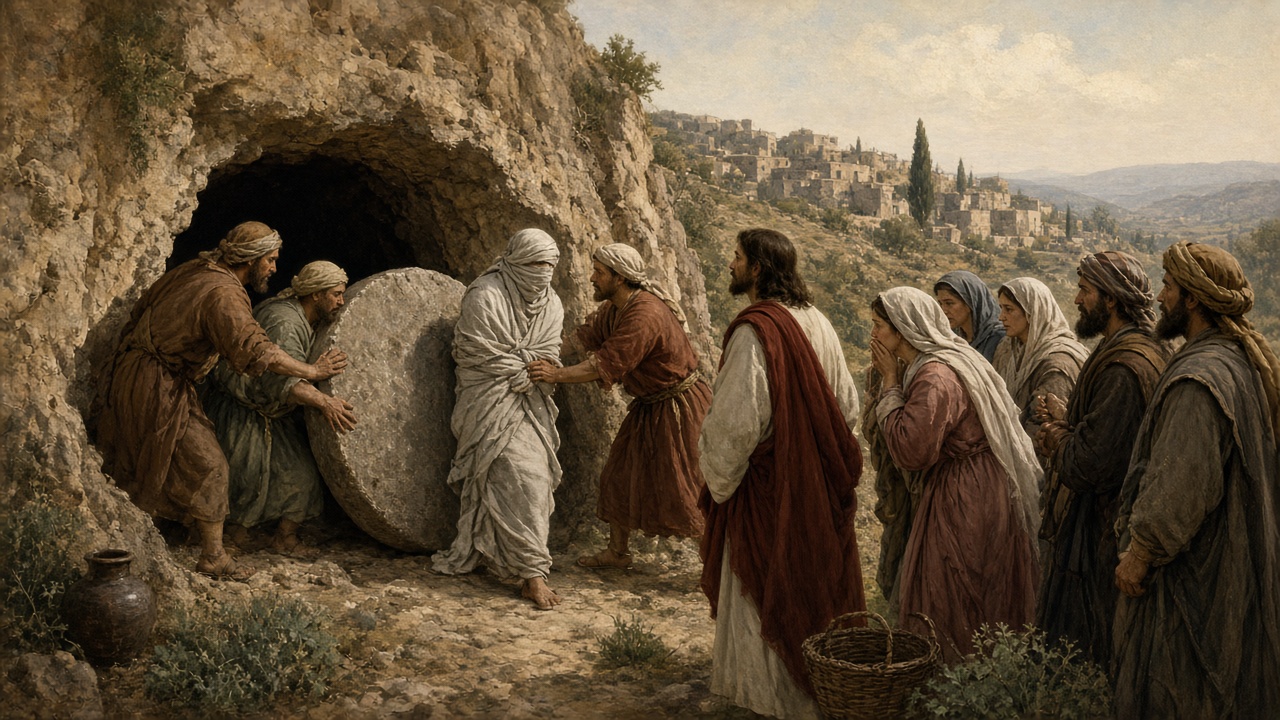
Lazarus Raised at Bethany
- John places Bethany, the village of Lazarus and his sisters Mary and Martha, a little less than two miles from Jerusalem. Easton's Bible Dictionary (1897) locates it on the southeastern slope of the Mount of Olives, on the road to Jericho, and says it took its name from the palm trees that grew there and was known as el-Azariyeh, “place of Lazarus.”Sources: Bethany · the Bible text itself
- Thomas, one of the twelve, was also called Didymus, the Greek equivalent of his name, which means “twin.” When Jesus chose to go back to Judea, where people had just tried to stone him, Thomas said to the other disciples, “Let us also go, so that we may die with Him.”Sources: Thomas · the Bible text itself
- After some reported what Jesus had done, the chief priests and Pharisees convened the Sanhedrin, afraid that if everyone believed in Jesus the Romans would take away both their place and their nation. Caiaphas, high priest that year and, according to Easton's Bible Dictionary (1897), a Sadducee who held office from A.D. 27 to 36, said it was better that one man die for the people than that the whole nation perish. John says that as high priest that year he was prophesying that Jesus would die for the nation, and from that day they plotted to kill him.Sources: Caiaphas · the Bible text itself
Notes written with AI assistance from open sources (Theographic Bible Metadata, CC BY-SA 4.0; Easton’s Bible Dictionary, public domain) and reviewed before publishing.
Places in this chapter
- Judea · Today: Judea 1 · 31.777, 35.234 · verses 7, 8, 54
- Jerusalem · 31.777, 35.234 · verses 18, 54, 55
- Ephraim · Today: Taybeh · 31.954, 35.300 · verse 54
Only places identified with high confidence are shown (90% or more according to the scholarly sources compiled by OpenBible). Period map: DARE (Digital Atlas of the Roman Empire), CC BY 4.0; modern map: © OpenStreetMap contributors; places: OpenBible.info (CC BY 4.0).
Credits and license for this translation
Alkawal Kesal
Portions of the New Testament in the Fulfulde Borgu language of Benin
copyright © 2011 SIM International
Language: Fulfulde Borgu (Fulfulde, Borgu)
Translation by: SIM
This translation text is made available to you under the
terms of the Creative Commons License: Attribution-Noncommercial-No Derivative Works.
( http://creativecommons.org/licenses/by-nc-nd/3.0/ )
In addition, you have permission to port the text to different file formats, as long as you
do not change any of the text or punctuation of the Bible.
You may share, copy, distribute, transmit, and extract portions
or quotations from this work, provided that you include the above copyright
information:
You must give Attribution to the work.
You do not sell this work for a profit.
You do not make any derivative works that change any of the actual words or punctuation of the Scriptures.
Permissions beyond the scope of this license may be
available if you contact
us with your request.
This translation is made available to you under the terms of the
Creative Commons Attribution-Noncommercial-No Derivatives license 4.0.
You may share and redistribute this Bible translation or extracts from it in any format, provided that:
You include the above copyright and source information.
You do not sell this work for a profit.
You do not change any of the words or punctuation of the Scriptures.
Pictures included with Scriptures and other documents on this site are licensed just for use with those Scriptures and documents.
For other uses, please contact the respective copyright owners.
2014-10-16
Source: http://ebible.org/fue/ · eBible.org