Job 18
Wycliffe's Bible with Modern Spelling (Enhanced) · Tap a verse to see its cross-references.
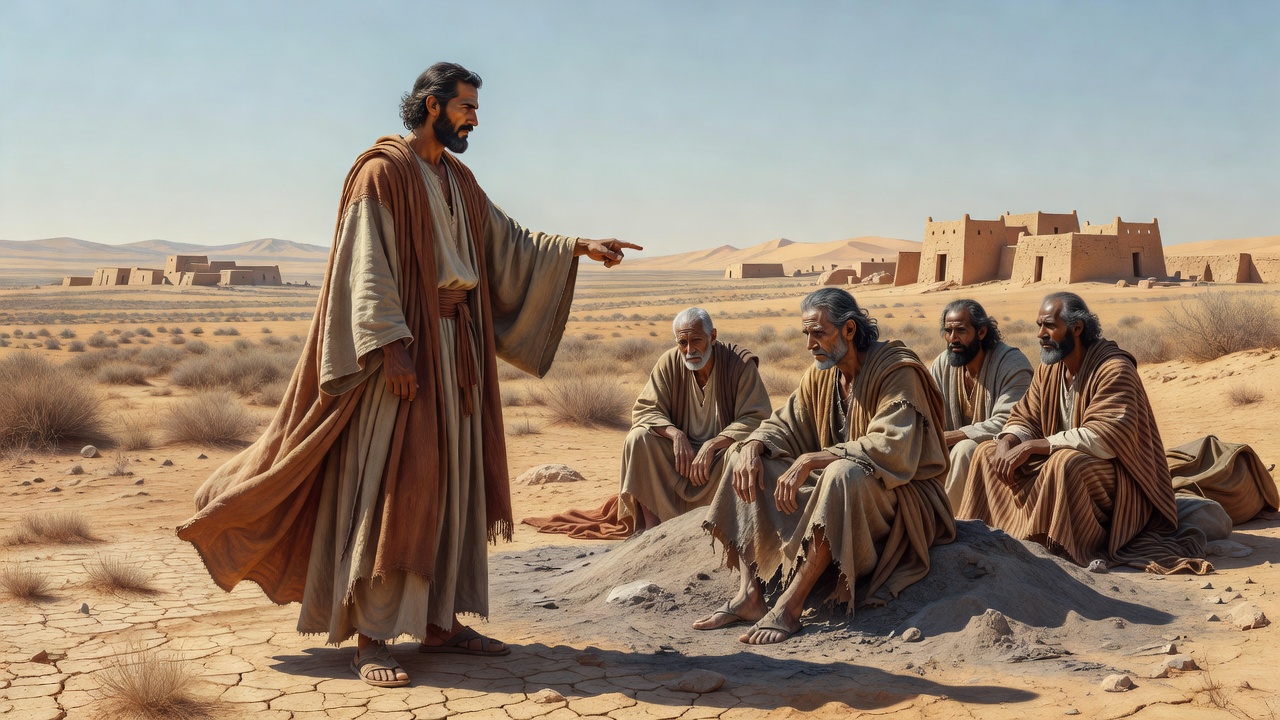
Bildad: God Punishes the Wicked
1Then Bildad (the) Shuhite answered, and said,
2Unto what end shalt thou boast with words? Understand thou us first, and so speak we together. (Unto what end shalt thou continue to boast with your words? First listen to us, and then we shall speak together.)
3Why be we areckoned as beasts, and why have we been (judged) foul before thee?
4What, or why, losest thou thy soul in thy strong vengeance? Whether the earth shall be forsaken for thee, and hard stones shall be borne over from their place, (just for thee)?
5Whether the light of a wicked man shall not be quenched; and the flame of his fire shall not shine? (The light of the wicked shall be quenched; and the flame of his fire shall not shine!)
6Light shall wax dark in his tabernacle; and the lantern, which is on him, shall be quenched. (The light shall grow dark in his tent; and the lantern, which shineth on him, shall be quenched.)
7The steps of his strength shall be made strait; and his (own) counsel shall cast him down.
8For he hath sent, or put, his feet into a net; and he goeth in the meshes, or knittings, thereof.
9His foot shall be holden with a snare; and thirst shall burn out against him.
10The foot-trap of him is hid in the earth, and his snare is laid on the path. (A foot-trap is hid on the ground for him, and a snare is laid on the path for him.)
11Dreads shall make him afeared on every side, and shall bewrap his feet. (Terror shall make him afraid on every side, and shall enwrap, or shall bind, his feet.)
12His strength [shall] be made feeble by hunger; and poverty (shall) assail his ribs.
13Devour it the fairness of his skin; the first engendered (of) death waste his arms. (Disease shall devour the beauty of his skin; and Death’s first-born shall destroy, or shall eat up, his arms and his legs.)
14His trust be taken away from his tabernacle; and perishing, as a king, above-tread on him. (He shall be torn away from the safety of his tent; and perishing, or destruction, shall tread all over him, like a king.)
15The fellows of him that is not, that is, the fellows of a dead man, dwell in his tabernacle; and brimstone be sprinkled in his tabernacle. (The fellows, or friends, of him who is not, that is, the friends of he who is dead, shall live in his tent; and brimstone, or sulphur, shall be sprinkled all around it to ward off evil.)
16The roots of him be made dry beneath; and be his ripe corn all-broken above. (His roots shall be made dry beneath; and all his branches shall wither above.)
17His mind perish from the earth; and his name be not made solemn in streets. (His memory shall perish from the earth; and his name shall be forgotten in the streets.)
18He shall put him out from light into darknesses; and he shall bear him over from the world. (He shall be put out from the light into the darkness; and he shall be carried over from this world into the next.)
19Neither his seed, neither his kindred, shall be in his people, neither any remnants of them (shall be) left in his countries. (Neither his descendants, nor his kindred, shall be among his own people, nor shall any remnant of them be left in his land.)
20The last men (of him) shall wonder in his days; and hideousness shall assail the first men. (The people who come after him shall wonder at his day; just as horror assailed those who came before him.)
21Therefore these be the tabernacles of a wicked man; and this is the place of him, that knoweth not God. (And so such shall be the fate of the wicked; the end, or the place, of those, who do not know God.)
Did you know?
Bildad's Second Speech on the Fate of the Wicked
- Bildad is identified as a Shuhite, a designation traditionally linked to Shuah, a region in Arabia associated with the descendants of Abraham and Keturah. In this second speech to Job, Bildad maintains a stern and severe tone as he rebukes Job and insists on the certain doom of the ungodly.Sources: Bildad · the Bible text itself
- To describe the destruction awaiting the wicked, Bildad draws heavily on ancient hunting imagery. He depicts their downfall through metaphors of hidden nooses, concealed ground snares, and sweeping nets that trap the wanderer.Sources: the Bible text itself
Notes written with AI assistance from open sources (Theographic Bible Metadata, CC BY-SA 4.0; Easton’s Bible Dictionary, public domain) and reviewed before publishing.
Credits and license for this translation
Wycliffe's Bible with Modern Spelling (Enhanced)
English: Wycliffe's Bible Modern Spelling (Enhanced) (with Deuterocanon)
Copyright © 2001,2010,2011,2012,2013,2015 Terry Noble
Language: English
Dialect: Archaic
Translation by: Terry Noble
Wycliffe's Bible with Modern Spelling (Enhanced)
Wycliffe’s Bible with Modern Spelling (Enhanced) is a composite of my Wycliffe’s Bible, a modern-spelling version of the 14th century Middle English translation, consisting of Wycliffe’s Old Testament and Wycliffe’s New Testament, and my modern-spelling version of Wycliffe’s Apocrypha. These books contain literally tens of thousands of rewritten verses, presented in parentheses “( ) “, to provide help in comprehending the 14th century Middle English vocabulary and grammar. Wycliffe’s Apocrypha also includes the books of the Apocrypha from the 1st edition of the King James Version of the Bible.
This translation is made available to you under the terms of the
Creative Commons Attribution-Noncommercial-No Derivatives license 4.0.
You may share and redistribute this Bible translation or extracts from it in any format, provided that:
You include the above copyright and source information.
You do not sell this work for a profit.
You do not change any of the words or punctuation of the Scriptures.
Pictures included with Scriptures and other documents on this site are licensed just for use with those Scriptures and documents.
For other uses, please contact the respective copyright owners.
2019-09-25
Section headings adapted from the Berean Standard Bible (public domain); they are not part of this translation’s text.
Source: http://ebible.org/engwyc2018/ · eBible.org