Job 17
Wycliffe's Bible with Modern Spelling (Enhanced) · Tap a verse to see its cross-references.
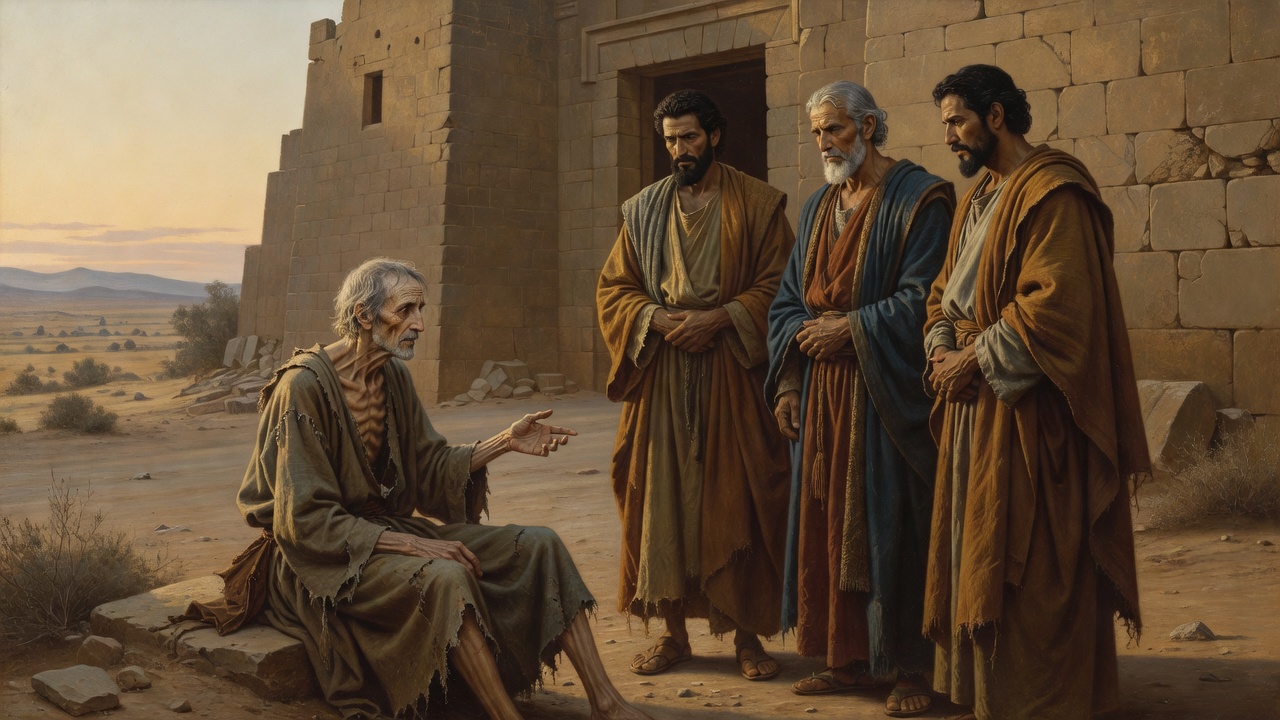
Job Prepares for Death
1My spirit shall be made feeble; my days shall be made short, and only the sepulchre is left to me. (My breath shall be made weak; my days shall be made short, and only the grave, or a tomb, is left to me.)
2I have not sinned, and mine eye dwelleth in bitternesses. (I have not sinned, and yet I see their bitterness toward me.)
3Lord, deliver thou me, and set me beside thee; and the hand of each man fight against me. (Lord, save thou me, and put me beside thee; then let someone try to fight against me!)
4Thou hast made the heart of them far from doctrine, that is, (far) from knowing of (the) truth; therefore they shall not be enhanced (or and so thou shalt not let them triumph).
5He promiseth prey to his fellows, and the eyes of his sons shall fail (or yet the eyes of his sons shall fail).
6He hath set [me] as into a proverb of the common people, and his ensample before them.
7Mine eye dimmed at [the] indignation (or My eyes dimmed with grief); and my members be driven as into nought.
8Just men shall wonder on this thing; and an innocent shall be raised up against an hypocrite.
9And a just man shall hold his way, and he shall add strength to clean hands. (The righteous shall hold to their way, and he who hath clean hands shall be made even stronger.)
10Therefore all ye be turned again, and come ye; and I shall not find in you any wise man. (And so come now, let all of you try again; for thus far, I have not found a wise man among you.)
11My days be passed; my thoughts be scattered, tormenting mine heart.
12Those have turned the night into day; and again after darknesses hope (for) light. (They have turned the night into day; and then again after darkness, hope for some light.)
13If I sustain, either suffer patiently, hell is mine house; and I have arrayed my bed in darknesses. (If I endure, Sheol, or the grave, shall be my house; and I shall array my bed in darkness.)
14I said to rot (or And I shall say to rot), Thou art my father; and to worms, Ye be my mother, and my sister.
15Therefore where is now mine abiding? and who beholdeth my patience?
16All my things shall go down into [the] deepest hell; guessest thou, whether rest shall be to me, namely there. (All my thoughts shall go down into Sheol; thinkest thou, that there shall be any rest for me there?)
Did you know?
Job's Despair and the Prospect of the Grave
- Job appeals directly to God to act as his pledge or guarantor. In ancient legal practice, a guarantor assumed responsibility for someone accused or indebted, and Job found no human ally willing or able to defend him.Sources: the Bible text itself
- Job describes himself as becoming a byword among the people, a status where an individual's suffering turns into an object of public mockery, contempt, and proverb-like warning.Sources: the Bible text itself
- In his grief, Job speaks of the realm of the dead (Sheol) and the grave as his only remaining home, metaphorically adopting the pit and worms as his closest family members.Sources: the Bible text itself
Notes written with AI assistance from open sources (Theographic Bible Metadata, CC BY-SA 4.0; Easton’s Bible Dictionary, public domain) and reviewed before publishing.
Credits and license for this translation
Wycliffe's Bible with Modern Spelling (Enhanced)
English: Wycliffe's Bible Modern Spelling (Enhanced) (with Deuterocanon)
Copyright © 2001,2010,2011,2012,2013,2015 Terry Noble
Language: English
Dialect: Archaic
Translation by: Terry Noble
Wycliffe's Bible with Modern Spelling (Enhanced)
Wycliffe’s Bible with Modern Spelling (Enhanced) is a composite of my Wycliffe’s Bible, a modern-spelling version of the 14th century Middle English translation, consisting of Wycliffe’s Old Testament and Wycliffe’s New Testament, and my modern-spelling version of Wycliffe’s Apocrypha. These books contain literally tens of thousands of rewritten verses, presented in parentheses “( ) “, to provide help in comprehending the 14th century Middle English vocabulary and grammar. Wycliffe’s Apocrypha also includes the books of the Apocrypha from the 1st edition of the King James Version of the Bible.
This translation is made available to you under the terms of the
Creative Commons Attribution-Noncommercial-No Derivatives license 4.0.
You may share and redistribute this Bible translation or extracts from it in any format, provided that:
You include the above copyright and source information.
You do not sell this work for a profit.
You do not change any of the words or punctuation of the Scriptures.
Pictures included with Scriptures and other documents on this site are licensed just for use with those Scriptures and documents.
For other uses, please contact the respective copyright owners.
2019-09-25
Section headings adapted from the Berean Standard Bible (public domain); they are not part of this translation’s text.
Source: http://ebible.org/engwyc2018/ · eBible.org