Psalms 102
The Orthodox Jewish Bible · Tap a verse to see its cross-references.
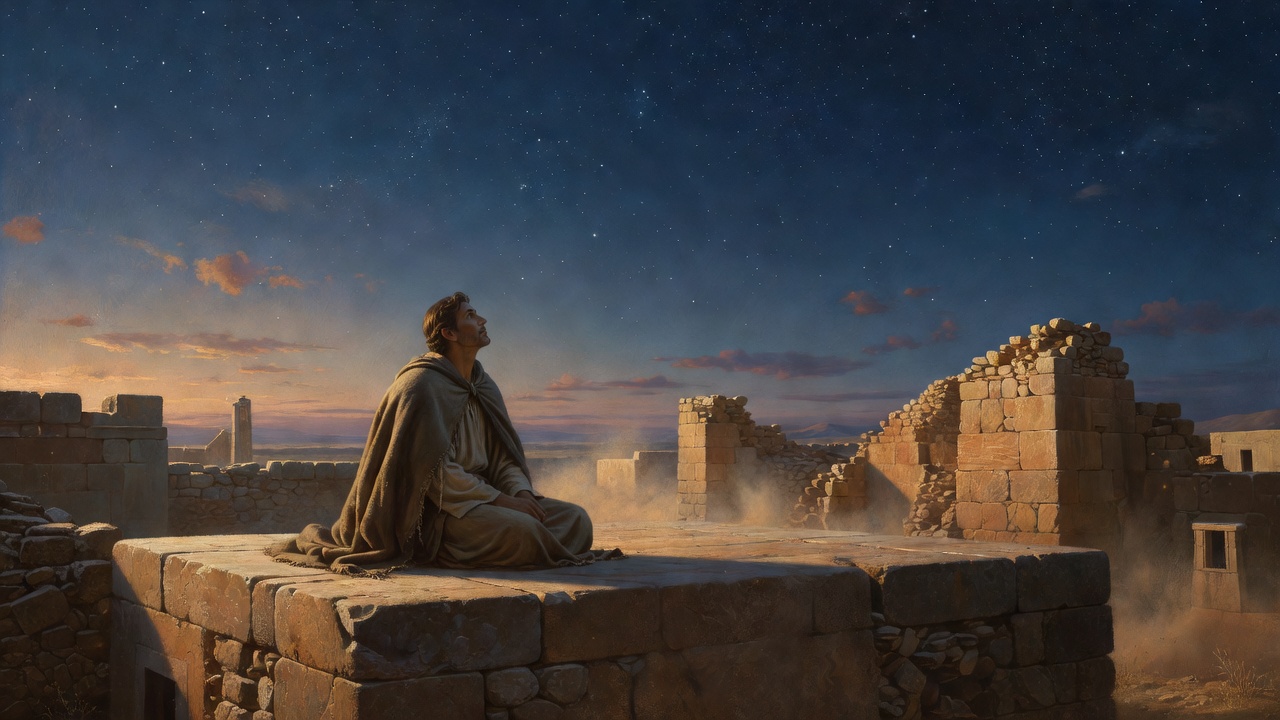
The Prayer of the Afflicted
1(A tefillah of one afflicted; when he is faint, he pours out his si'akh [complaint] before Hashem)
2Hear my tefillah, Hashem,
and let my cry for help come unto Thee.
3Hide not Thy face from me in the yom tzar (day of distress);
incline Thine ear unto me;
in the yom when I call, answer me speedily.
4For my yamim are consumed like ashan (smoke),
and my atzmot burn like a furnace.
5My lev is struck, and withered like esev;
so that I forget to eat my lechem.
6By reason of the voice of my groaning
my atzmot have deveykus to my basar.
7I am like a bird of the midbar;
I am like an owl of the desert.
8I keep watch, and am like a tzippor (bird)
alone upon the gag (housetop, roof).
9Mine oyevim (enemies) reproach me kol hayom;
and they that revile me curse by me.
10For I have eaten ashes like lechem,
and mingled my drink with tears.
11Because of Thine za'am (indignation) and Thy ketsef (wrath, anger);
for Thou hast lifted me up, and cast me down.
12My days are like a tzel (shadow) that lengtheneth;
and I am withered like esev (grass).
13But Thou, Hashem, shall endure l'olam;
and Thy memory unto dor vador.
14Thou shalt arise, and have mercy upon Tziyon;
for the time to favor her,
the mo'ed (set time, appointed time) has come.
15For Thy avadim cherish her avanim (stones),
and pity her aphar.
16So the Goyim shall fear the Shem Hashem,
and all the melachim of ha'aretz will revere Thy glory.
17When Hashem shall build up Tziyon,
He shall appear in His Kavod.
18He will regard the tefillah of the destitute,
and not despise their tefillah.
19This shall be written for a dor acharon (future generation);
and the people which shall be created shall praise Hashem.
20For He hath looked down from the height of His Kodesh;
from Shomayim did Hashem behold Eretz;
21To hear the groaning of the asir (prisoner);
to release those that are bnei temutah (men death);
22To declare the Shem Hashem in Tziyon,
and His tehillah (praise) in Yerushalayim;
23When the peoples are gathered together in assembly,
and the mamlachot (kingdoms), to serve Hashem.
24He bowed down my ko'ach in the derech;
He cut short my yamim.
25I said, O my G-d,
take me not away in the midst of my yamim;
Thy years are dor dorim (throughout all generations).
26Of old hast Thou laid the foundation of ha'aretz;
and Shomayim is the ma'aseh (work) of Thy hands.
27They shall perish, but Thou shalt remain;
and all of them shall wear out like a beged (garment);
like a vesture shalt Thou change them, and they shall be changed;
28But Thou art the same,
and Thy shanot (years) shall have no end.
29The children of Thy avadim shall dwell,
and their zera shall be established before Thee.
Did you know?
A Prayer of the Afflicted and the Hope of Zion
- Psalm 102 begins with a unique heading describing a prayer of an afflicted person pouring out a lament before the LORD. While the psalmist depicts deep personal suffering and solitary distress, the petition expands into a communal hope for God to have compassion on Zion and rebuild Jerusalem.Sources: the Bible text itself · Zion · Jerusalem
- The psalm explicitly states that this testimony of God delivering the destitute and prisoners should be written down for a future generation. To emphasize divine permanence in contrast to human transience, the author describes the heavens and earth as garments that will wear out and be changed, while God remains eternal.Sources: the Bible text itself
Notes written with AI assistance from open sources (Theographic Bible Metadata, CC BY-SA 4.0; Easton’s Bible Dictionary, public domain) and reviewed before publishing.
Places in this chapter
Only places identified with high confidence are shown (90% or more according to the scholarly sources compiled by OpenBible). Period map: DARE (Digital Atlas of the Roman Empire), CC BY 4.0; modern map: © OpenStreetMap contributors; places: OpenBible.info (CC BY 4.0).
Credits and license for this translation
The Orthodox Jewish Bible
The Orthodox Jewish Bible - Tanakh and Orthodox Jewish Brit Chadasha - The Holy Bible
copyright © 2002-2011, 2021, 2024 Artists for Israel International
Language: English
Contributor: Artists for Israel International
THE ORTHODOX JEWISH TANAKH
Artists For Israel Intl Inc.
This version also appears with the Orthodox Yiddish Triglot which presents the Hebrew Yiddish script in Latin script and an English word for word translation, available at afii.org/Torah
To donate PayPal.Me
This translation is made available to you under the terms of the
Creative Commons Attribution license 4.0.
You may share and redistribute this Bible translation or extracts from it in any format, provided that:
You include the above copyright and source information.
If you make any changes to the text, you must indicate that you did so in a way that makes it clear that the original licensor is not necessarily endorsing your changes.
Pictures included with Scriptures and other documents on this site are licensed just for use with those Scriptures and documents.
For other uses, please contact the respective copyright owners.
Note that in addition to the rules above, revising and adapting God's Word involves a great responsibility to be true to God's Word. See Revelation 22:18-19.
2026-01-06
Section headings adapted from the Berean Standard Bible (public domain); they are not part of this translation’s text.
Source: http://ebible.org/engojb/ · eBible.org