Proverbs 31
The Orthodox Jewish Bible · Tap a verse to see its cross-references.
The Sayings for King Lemuel
1The devarim of Lemuel Melech,
the massa (burden, oracle) that immo taught him.
2What, my bar (son)? And what, the bar of my womb?
And what, the bar of my nedarim (vows)?
3Give not thy strength unto nashim,
nor thy drakhim to that which destroyeth melachim.
4It is not for melachim, O Lemuel,
it is not for melachim to drink yayin;
nor for rulers to crave strong drink;
5Lest they drink, and forget the decree,
and pervert the justice of the bnei oni (all the oppressed afflicted people).
6Give strong drink unto him that is ready to perish,
and yayin unto those that be of bitter nefesh.
7Let him drink, and forget his poverty,
and remember his amal (misery) no more.
8Open thy peh (mouth) for the illem (mute)
in the cause of all such as are bnei chalof (sons of destitution).
9Open thy peh (mouth), judge tzedek,
and plead the cause of the oni and the evyon.
The Virtues of a Noble Woman
10Who can find an aishes chayil (a woman of valor, an excellent wife)?
For her worth is far above rubies.
11The lev of her ba'al (husband) doth securely trust in her,
so that he shall have no lack of gain.
12She will do him tov and not rah
all the days of her life.
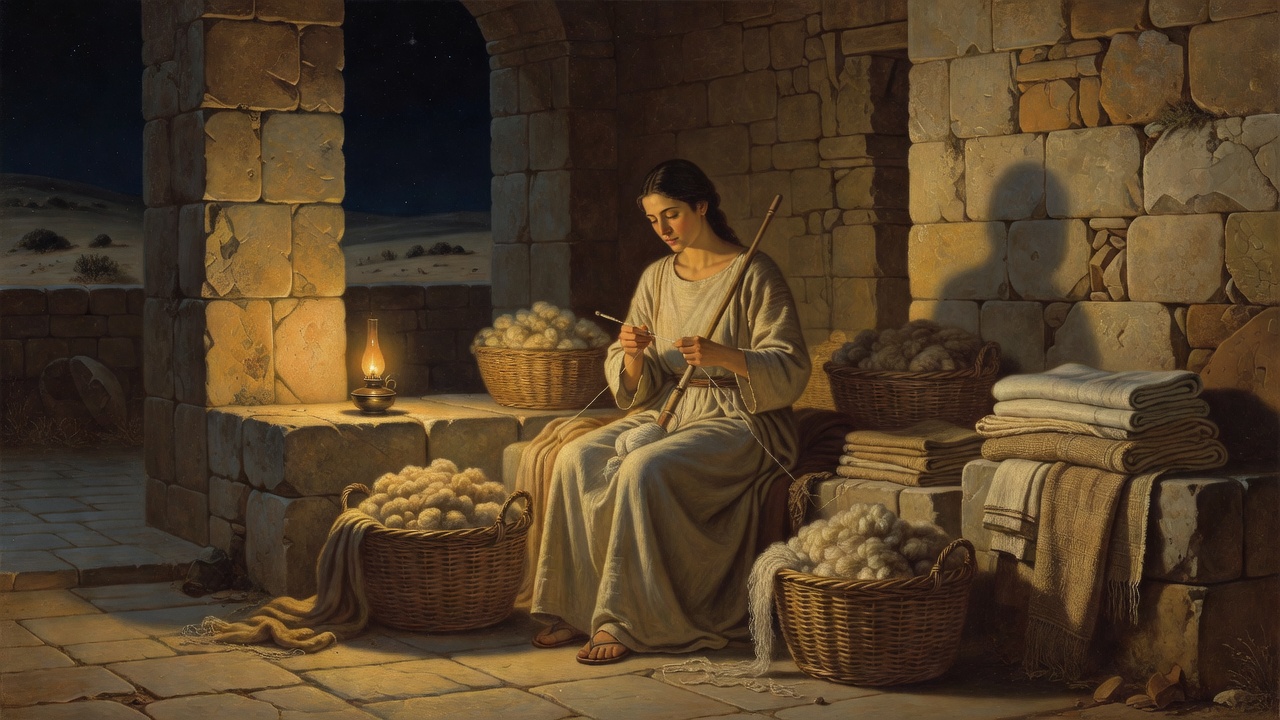
13She seeketh tzemer (wool), and flax,
and worketh willingly with her palms.
14She is like the oniyyot socher (ship merchant);
she bringeth her lechem from afar.
15She riseth also while it is yet lailah,
and provideth food to her bais,
and a chok (portion) to her na'arot (servant girls).
16She considereth a sadeh, and buyeth it;
with the fruit of her palms she planteth a kerem (vineyard).
17She girdeth her loins with strength,
and strengtheneth her zero'ot (arms).
18She perceiveth that her merchandise is tov;
her ner (light) goeth not out balailah.
19She layeth her yadayim to the distaff,
and her fingers lay hold of the spindle.
20She extends her palms to the oni;
indeed, she reacheth forth her yadayim to the evyon (needy).
21She is not afraid of the sheleg (snow) for her bais;
for all her bais are clothed with scarlet.
22She maketh herself coverings of tapestry;
her levush (clothing) is fine linen and purple.
23Her ba'al (husband) is known in the she'arim,
when he sitteth among the ziknei eretz.
24She maketh fine garments, and selleth them;
and delivereth sashes unto the kena'ani (merchant).
25Oz (strength) and hadar (dignity) are her clothing;
and her smile is toward the yom acharon (coming day, future).
26She openeth her peh (mouth) with chochmah;
and on her lashon is the torat chesed (teaching of kindness).
27She watcheth well over the halichot (goings, ways) of her bais (household),
and eateth not the lechem atzlut (bread of idleness).
28Her banim rise up, and call her blessed;
her ba'al (husband) also, and he praiseth her.
29Rabbot banot have done virtuously,
but thou excellest them all.
30Chen (charm) is sheker (deceitful), and yofi (beauty) is fleeting;
but an isha Yirat Hashem (a G-d fearing wife), she shall be praised.
31Give her of the p'ri (fruit) of her yadayim;
and let her own ma'asim praise her in the she'arim.
Did you know?
Advice to a King and the Noble Woman
- The historical identity of King Lemuel is not certainly known outside this passage. His name means dedicated to God, and while rabbinic tradition identified him with King Solomon, the text presents him receiving moral instruction and guidance on righteous leadership directly from his mother.Sources: Lemuel · Mother of Lemuel · the Bible text itself
- The poem in the second half of the chapter describes a capable woman managing varied economic affairs, including evaluating and buying real estate, planting a vineyard, producing textiles, and trading with merchants, all while providing for her household and aiding the poor.Sources: the Bible text itself
Notes written with AI assistance from open sources (Theographic Bible Metadata, CC BY-SA 4.0; Easton’s Bible Dictionary, public domain) and reviewed before publishing.
Credits and license for this translation
The Orthodox Jewish Bible
The Orthodox Jewish Bible - Tanakh and Orthodox Jewish Brit Chadasha - The Holy Bible
copyright © 2002-2011, 2021, 2024 Artists for Israel International
Language: English
Contributor: Artists for Israel International
THE ORTHODOX JEWISH TANAKH
Artists For Israel Intl Inc.
This version also appears with the Orthodox Yiddish Triglot which presents the Hebrew Yiddish script in Latin script and an English word for word translation, available at afii.org/Torah
To donate PayPal.Me
This translation is made available to you under the terms of the
Creative Commons Attribution license 4.0.
You may share and redistribute this Bible translation or extracts from it in any format, provided that:
You include the above copyright and source information.
If you make any changes to the text, you must indicate that you did so in a way that makes it clear that the original licensor is not necessarily endorsing your changes.
Pictures included with Scriptures and other documents on this site are licensed just for use with those Scriptures and documents.
For other uses, please contact the respective copyright owners.
Note that in addition to the rules above, revising and adapting God's Word involves a great responsibility to be true to God's Word. See Revelation 22:18-19.
2026-01-06
Section headings adapted from the Berean Standard Bible (public domain); they are not part of this translation’s text.
Source: http://ebible.org/engojb/ · eBible.org