Proverbs 30
The Orthodox Jewish Bible · Tap a verse to see its cross-references.
The Words of Agur
1The devarim of Agur Ben Yakeh, even the massa; the gever (man) spoke unto Itiel, even unto Itiel and Ukhal:
2Surely I am more stupid than any ish,
and have not the binat adam.
3I neither learned chochmah,
nor have the da'as of the Kedoshim.
4Who hath ascended into Shomayim, or descended?
Who hath gathered ruach in the hollows of His hands?
Who hath bound the mayim in a cloak?
Who hath established all the afsei aretz (ends of the earth)?
What is Shmo (His Name),
and what is Shem Bno (the Name of His Son ),
if thou canst tell?
5Every word of G-d is flawless;
He is a mogen unto them that take refuge in Him.
6Add thou not unto His devarim,
lest He rebuke thee, and thou be found a kazav (liar).
7Two things have I required of thee;
deny me them not before my mot;
8Remove far from me shav (vanity, falsehood) and davar kazav (word of a liar);
give me neither poverty nor osher;
feed me lechem chukki (my daily bread);
9Lest I be full, and deny Thee,
and say, Who is Hashem?
Or lest I be poor, and become a ganav,
and profane the Shem of Elohai.
10Do not slander an eved unto his adon,
lest he curse thee, and thou be found guilty.
11There is a dor (generation) that curseth its av,
and doth not make a bracha on its em.
12There is a dor (generation) that is tahor (pure) in its own eynayim,
and yet is not washed from its filthiness.
13There is a dor (generation), O how haughty in loftiness are their eynayim!
And their eyelids are proudly lifted up.
14There is a dor (generation), whose teeth are as charavot (swords),
and their jaw teeth are as knives,
to devour the aniyim (oppressed poor ones) from off ha'aretz,
and the evyonim (needy ones) from among adam.
15The leech hath two banot: Give! Give!
There are shalosh (three) that are never satisfied,
indeed, four things never say, Enough!
16Sheol, and the barren womb;
eretz that is never satisfied with mayim;
and eish that saith not, Enough!
17The ayin (eye) that mocketh at av,
and scorneth to obey em,
the ravens of the valley shall peck it out,
and the bnei nesher shall eat it.
18There are shalosh which are too wonderful for me,
indeed, four which I understand not;
19The derech hanesher (way of the eagle) in the sky;
the derech nachash upon a tzur (rock);
the derech oniyah (way of a sailing vessel) in the midst of the yam (sea);
and the derech gever (way of a man) with an almah (unmarried young virgin).
20Such is the derech isha mena'efet (way of an adulterous woman):
she eateth, and wipeth her peh (mouth),
and saith, I have done no wrong.
21For shalosh the eretz is disquieted,
and for four which it cannot bear:
22For an eved (slave) when he reigneth;
and a naval (fool) when he is full with lechem;
23For an unloved woman when she is married;
and a shifchah that displaces her gevirah (lady, mistress).
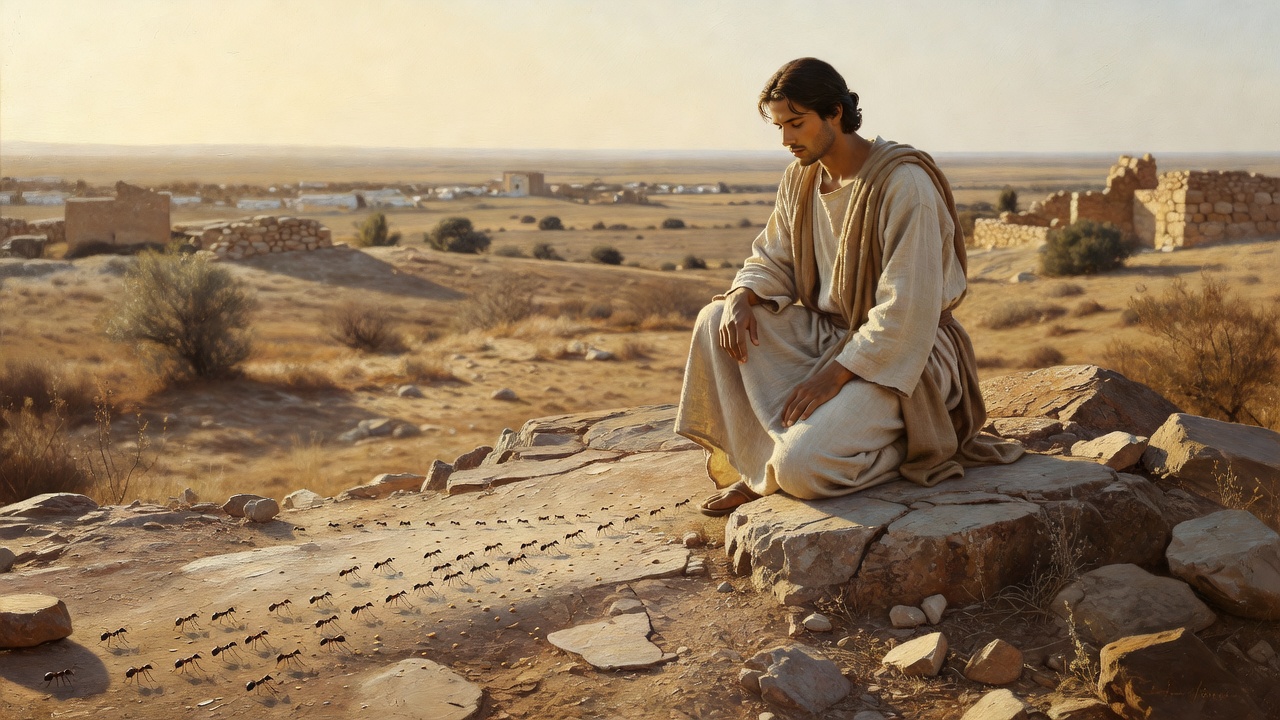
24There are four things which are little upon eretz,
but they are exceeding chachamim:
25The nemalim (ants) are an am (people) not strong,
yet they store up their lechem in the kayitz (summer);
26The badgers are but a feeble folk,
yet they make their bais in the rocks;
27The arbeh (locusts) have no melech,
yet they go forth all of them in ranks;
28The lizard can be held in the hands,
yet is in heikhelot (palaces) of a melech.
29There are shloshah which are majestic in stride,
indeed, four are stately in walk:
30A lion which is gibbor among behemah (beasts),
and retreateth not from any;
31The strutting rooster; the he-goat also;
and a melech, when his army is with him.
32If thou hast done foolishly in exalting thyself,
or if thou hast devised rah, lay thine yad upon thy peh.
33Surely the churning of cholov (milk) bringeth forth khemah (butter),
and the wringing of the nose bringeth forth dahm;
so the stirring up of anger bringeth forth strife.
Did you know?
The Sayings of Agur
- Proverbs 30 is attributed to Agur son of Jakeh, who addressed his sayings to Ithiel and Ucal. Beyond what is recorded in this chapter, nothing further is known about Agur or his father.Sources: Agur · Jakeh · Ucal · the Bible text itself
- The chapter frequently uses a graded numerical pattern ('three things... four that...') to group observations about nature and human behavior. Agur applies this structure to marvels of creation, social disruptions, stately walkers, and four small creatures that display remarkable wisdom: ants, rock badgers, locusts, and lizards.Sources: the Bible text itself
- Agur makes a specific two-part request, asking to be granted neither poverty nor riches, but only his daily portion of food. He explains that having too much might lead someone to disown the Lord, while falling into poverty might tempt a person to steal.Sources: the Bible text itself
Notes written with AI assistance from open sources (Theographic Bible Metadata, CC BY-SA 4.0; Easton’s Bible Dictionary, public domain) and reviewed before publishing.
Credits and license for this translation
The Orthodox Jewish Bible
The Orthodox Jewish Bible - Tanakh and Orthodox Jewish Brit Chadasha - The Holy Bible
copyright © 2002-2011, 2021, 2024 Artists for Israel International
Language: English
Contributor: Artists for Israel International
THE ORTHODOX JEWISH TANAKH
Artists For Israel Intl Inc.
This version also appears with the Orthodox Yiddish Triglot which presents the Hebrew Yiddish script in Latin script and an English word for word translation, available at afii.org/Torah
To donate PayPal.Me
This translation is made available to you under the terms of the
Creative Commons Attribution license 4.0.
You may share and redistribute this Bible translation or extracts from it in any format, provided that:
You include the above copyright and source information.
If you make any changes to the text, you must indicate that you did so in a way that makes it clear that the original licensor is not necessarily endorsing your changes.
Pictures included with Scriptures and other documents on this site are licensed just for use with those Scriptures and documents.
For other uses, please contact the respective copyright owners.
Note that in addition to the rules above, revising and adapting God's Word involves a great responsibility to be true to God's Word. See Revelation 22:18-19.
2026-01-06
Section headings adapted from the Berean Standard Bible (public domain); they are not part of this translation’s text.
Source: http://ebible.org/engojb/ · eBible.org