Matthew 5
The Orthodox Jewish Bible · Tap a verse to see its cross-references.
The Sermon on the Mount
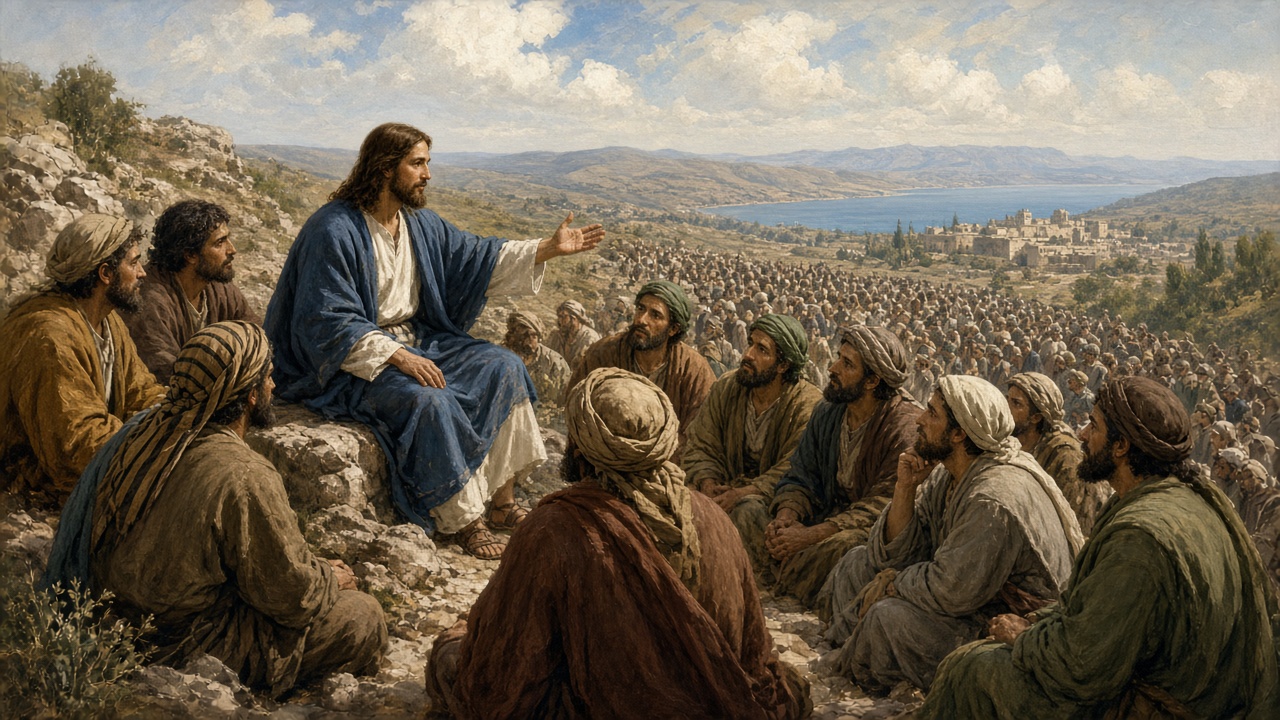
1When Rebbe, Melech HaMoshiach saw the multitudes, he ALAH HAHAR (went up the mountain) and when he sat down, his talmidim came to him.
2Then Rebbe, Melech HaMoshiach began to speak, and gave them this torah (teaching), saying,
The Beatitudes
3Ashrey ANIYEI HARUACH (Blessed, Happy are the poor in spirit) for theirs is the Malchut HaShomayim.
4Ashrey are the AVELIM (the ones mourning), for they will be comforted.
5Ashrey are the ANAVIM (humble), for YIRESHU ARETZ (they will inherit the land).
6Ashrey are the ones hungering and thirsting for TZIDKAT Hashem (Tzedek Olamim, Everlasting Righteousness), for they will be satisfied.
7Ashrey are the merciful, for they will be shown rachamim (mercy).
8Ashrey are those of LEV TAHOR (pure heart), for they will see Hashem.
9Ashrey are the peace-makers, for they will be called bnei haElohim (sons of G-d).
10Ashrey are the ones being persecuted because of TZIDKAT Hashem (righteousness of Hashem), for theirs is the Malchut HaShomayim.
11Ashrey are you when they reproach you and persecute you and speak all kinds of lashon horah against you, speaking sheker (falsehood, lies) because of me. 12Have simcha (joy) and lev sameach (glad heart), for your sachar (reward) is great in Shomayim, for thus they persecuted the Neviim before you.
Salt and Light
13You are the melach haaretz (salt of the earth), but if the salt becomes tasteless, in what way will it become salty again? It is no longer good for anything, but is thrown out and trampled by men.
14You are the Ohr HaOlam (the Light of the World). A city lying on a mountaintop cannot be nistar (hidden). 15No one, after lighting a menorah, places it under a measuring basket, but on the shulchan (table), and it gives ohr (light) to kol anshei habais (all in the house). 16In like manner, let your light so shine before Bnei Adam, that they may see your ma'asim tovim (good works) and give kavod (glory) to your Av sh'ba'Shomayim (Father in Heaven).
The Fulfillment of the Law
17Do not think that I came to abolish the Torah or the Neviim. I did not come to abolish but to complete. 18For, omein, truly I say to you, until Shomayim and haaretz pass away, not one yod, not one tag (ornamental flourish), will pass from the Torah until everything is accomplished. 19Therefore, whoever annuls one of the least of these mitzvot (divine commandments given by Hashem to Moshe Rabbenu) and so teaches Bnei Adam, shall be called katon (least) in the Malchut HaShomayim; but whoever practices and teaches them, this one will be called gadol (great) in the Malchut HaShomayim. 20For I say unto you that unless the Tzedek (Righteousness) of you exceeds that of the Sofrim and Perushim, you will certainly not enter the Malchut HaShomayim.
Anger and Reconciliation
21You have heard that it was said to the ancients, LO TIRTZACH (Do not murder), and every rotzeach (murderer) shall be liable before the Bet Din (Court). 22But I say to you, that everyone who harbors kaas (anger) against his Ach, his chaver, shall be subject to mishpat (judgment); and whoever shall say to his Ach, Reyka! (Good for nothing!) will be subject to the Sanhedrin; and whoever shall say Shoteh! (Fool) shall be subject to Eish Gehinnom (Fire of Hell). 23Therefore, if you bring your korban (sacrifice) to the Mizbeach (altar), and there you remember that your Ach has something against you, 24leave your korban there before the Mizbeach, and go and first be reconciled to your Ach; and then come offer your korban. 25Come to terms quickly with your ish riv (opponent in a lawsuit), while you are a fellow-traveler on the derech eretz, lest the ish riv might deliver you to the shofet (judge), and the shofet might deliver you to the shoter (law official), and the shoter might deliver you to the beit hasohar (prison house). 26For, omein, truly I say to you, you may never come out from there until you repay the last peruta (small coin).
Adultery
27You have heard that it was said, LO TINAF (Do not commit adultery). 28But I say to you that everyone looking upon a woman with taavah (lust) for her has already committed niuf (adultery) with her in his heart. 29And if your right eye causes you to commit chet (sin), tear it out and throw it from you, for it is better for you that one of your evarim (members) be lost and not your whole basar (body, flesh) be thrown into Gehinnom. 30And if your right hand causes you to commit chet, cut it off and throw it from you, for it is better for you that one of your evarim (members) be lost and not that your whole basar may go into Gehinnom.
Divorce
31It was also said, Whoever divorces his wife, let him give to her a “get,” a SEFER KERITUT (bill of divorce). 32But I say to you that everyone divorcing his wife, except for the DVAR (indecent thing) of zenut (fornication), makes her become a noefet (adulteress), and whoever marries a gerusha (divorcee) commits niuf (adultery).
Oaths and Vows
33Again, you have heard that it was said to the ancients, You shall not break your nederim (vows), but you shall repay your vows to Hashem. 34But I say to you, Do not swear shevuot (oaths) at all, neither by Shomayim, for it is the kes malchut of Hashem (throne of G-d), 35nor by haaretz, for it is the hadom (footstool) of his feet, nor by Yerushalayim, for it is the kiryat melech rav (city of the great king). 36Neither are you to swear by your rosh, for you are not able to make one hair turn white or black. 37But let your word be ken, ken (yes, yes) or lo, lo (no, no), but anything beyond this is lashon horah.
Love Your Enemies
38You have heard that it was said, AYIN TAKHAT AYIN, SHEN TAKHAT SHEN (An eye for an eye and a tooth for a tooth). 39But I say to you, Do not set yourself against the rasha (evil person), but whoever hits you on your right cheek, turn to him also the other cheek. 40And the one wishing to sue you and take your tunic, give to him also your kaftan. 41And whoever will force you to go one mile, go with him two. 42And the one asking you to give and the one wishing to borrow from you, from these do not turn away.
43You have heard that it was said, V'AHAVTA L'REACHA (You shall love your neighbor), and you shall hate your oyev (enemy). 44But I say to you, Love your enemies, and offer tefillos (prayers) for the ones bringing redifah (persecution) upon you. 45Do this so that you may become banim of your Av sh'ba'Shomayim, for His shemesh (sun) He makes to rise on the ra'im (evil ones) and the tovim (good ones), and He sends His geshem (rain) upon the tzaddikim (righteous ones) and the resha'im (unrighteous ones). 46For if you have ahavah (love) for the ones who have ahavah for you, what sachar (reward) do you have? Even the mochesim (tax collectors) do that, don't they? 47And if you give Drishat Shalom (greetings) only to your Achim, what extraordinary thing are you doing? Don't even the Goyim do the same? 48Therefore, be shlemim (complete), even as is your Av sh'ba'Shomayim.
Did you know?
The Sermon on the Mount
- When Jesus saw the crowds, he went up on the mountain, sat down, and began to teach his disciples. That discourse is known as the Sermon on the Mount. A chronological note places its start in AD 28 and gives it a duration of one day.Sources: the Bible text itself · Sermon on the Mount
- Teaching about oaths, Jesus says not to swear by Jerusalem, for it is the city of the great King. In the original the name is a dual form meaning possession of peace, or foundation of peace. That form probably refers to the two mountains on which the city was built, Zion and Moriah, or, as some suppose, to the upper and the lower city; it was also called the city of God and the holy city.Sources: the Bible text itself · Jerusalem
Notes written with AI assistance from open sources (Theographic Bible Metadata, CC BY-SA 4.0; Easton’s Bible Dictionary, public domain) and reviewed before publishing.
Places in this chapter
- Jerusalem · 31.777, 35.234 · verse 35
Only places identified with high confidence are shown (90% or more according to the scholarly sources compiled by OpenBible). Period map: DARE (Digital Atlas of the Roman Empire), CC BY 4.0; modern map: © OpenStreetMap contributors; places: OpenBible.info (CC BY 4.0).
Credits and license for this translation
The Orthodox Jewish Bible
The Orthodox Jewish Bible - Tanakh and Orthodox Jewish Brit Chadasha - The Holy Bible
copyright © 2002-2011, 2021, 2024 Artists for Israel International
Language: English
Contributor: Artists for Israel International
THE ORTHODOX JEWISH TANAKH
Artists For Israel Intl Inc.
This version also appears with the Orthodox Yiddish Triglot which presents the Hebrew Yiddish script in Latin script and an English word for word translation, available at afii.org/Torah
To donate PayPal.Me
This translation is made available to you under the terms of the
Creative Commons Attribution license 4.0.
You may share and redistribute this Bible translation or extracts from it in any format, provided that:
You include the above copyright and source information.
If you make any changes to the text, you must indicate that you did so in a way that makes it clear that the original licensor is not necessarily endorsing your changes.
Pictures included with Scriptures and other documents on this site are licensed just for use with those Scriptures and documents.
For other uses, please contact the respective copyright owners.
Note that in addition to the rules above, revising and adapting God's Word involves a great responsibility to be true to God's Word. See Revelation 22:18-19.
2026-01-06
Section headings adapted from the Berean Standard Bible (public domain); they are not part of this translation’s text.
Source: http://ebible.org/engojb/ · eBible.org