Amos 7
The Orthodox Jewish Bible · Tap a verse to see its cross-references.
The Locusts, Fire, and Plumb Line
1Thus hath Adonoi Hashem showed unto me; and, hinei, He formed locusts in the beginning of the springing up of the second crop; and, hinei, it was the second crop after the mowing of the melech. 2And it came to pass, that when they had made an end of eating the vegetation of ha'aretz, then I said:
O Adonoi Hashem, forgive, I beseech thee;
how shall Ya'akov survive? For he is katon.
3Hashem relented for this:
It shall not be, saith Hashem.
4Thus hath Adonoi Hashem showed unto me; and, hinei, Adonoi Hashem called to punish with eish, and it devoured the tehom rabbah (great deep), and did devour the chelek (portion). 5Then said I:
O Adonoi Hashem, cease, I beseech thee;
how shall Ya'akov survive? For he is katon.
6Hashem relented for this:
This also shall not be, saith Adonoi Hashem.
7Thus He showed me; and, hinei, Hashem stood upon a chomah (wall) made with a plumb line, and a plumb line in His hand. 8And Hashem said unto me: Amos, what seest thou? And I said, A plumb line. Then said Hashem:
Hineni, I will set a plumb line
in the midst of My people Yisroel;
I will not again pass by them anymore;
9And the high places of Yischak shall be desolate,
and the mikdeshei Yisroel shall be laid waste;
and I will rise against the Bais Yarov'am with the cherev.
Amaziah Accuses Amos
10Then Amatzyah the kohen of Beit-El sent to Yarov'am Melech Yisroel, saying: Amos hath conspired against thee in the midst of Bais Yisroel; the land is not able to bear all his words. 11For thus Amos saith:
Yarov'am shall die by the cherev,
and Yisroel shall surely be led away
into the golus out of their own land.
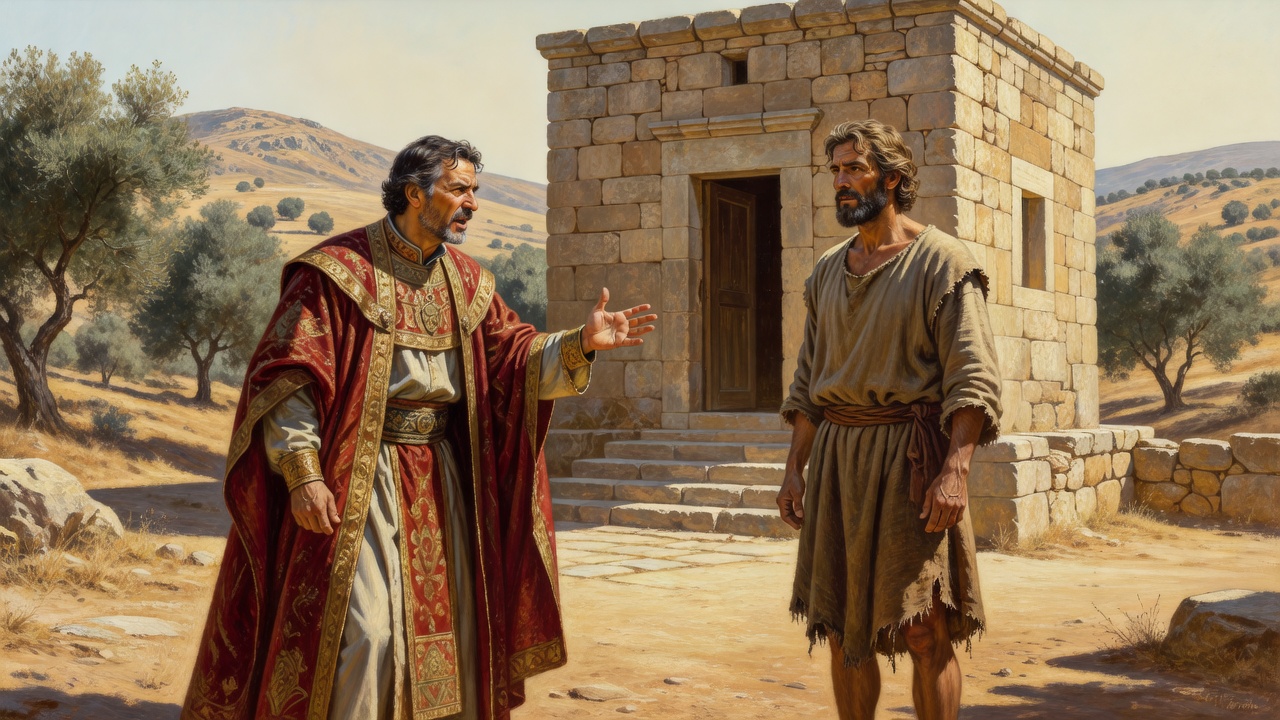
12Also Amatzyah said unto Amos: O thou seer, go, flee thee away into Eretz Yehudah, and there eat lechem, and prophesy there, 13But prophesy not again any more at Beit-El; for it is the Mikdash Melech, and it is the Bais Mamlachah.
14Then answered Amos, and said to Amatzyah: I was no navi, neither was I a ben navi; but I was a herder, and a dresser of sycamore-fig trees; 15And Hashem took me as I followed the tzon, and Hashem said unto me: Go, prophesy unto My people Yisroel. 16Now therefore hear thou the Devar Hashem: Thou sayest, Prophesy not against Yisroel, and drop not thy word against the Bais Yischak.
17Therefore thus saith Hashem:
Thy isha shall be a zonah in the city,
and thy banim and thy banot shall fall by the cherev,
and thy land shall be divided by line;
and thou shalt die in an adamah temei'ah (unclean land);
and Yisroel shall surely go forth of his land into golus (exile).
Did you know?
Visions of Judgment and the Confrontation at Bethel
- Unlike professional court prophets of his era, Amos was a herdsman and a cultivator of sycamore-fig trees from Tekoa in Judah. He emphasized that he was not trained in a prophetic guild, but was called directly by God to leave his flock and deliver messages of judgment to the northern kingdom of Israel.Sources: the Bible text itself · Amos
- Bethel served as a primary royal sanctuary for the northern kingdom of Israel, where kings maintained state-sponsored shrines. Amaziah, the priest serving there under King Jeroboam II, viewed Amos's prophecies as political treason and attempted to banish him back to Judah.Sources: the Bible text itself · Amaziah · Jeroboam · Bethel (of Palestine)
- Although the reign of Jeroboam II brought significant territorial expansion and material prosperity to Israel, Amos's visions warned that national destruction, the collapse of royal shrines, and impending exile were unavoidable.Sources: the Bible text itself · Jeroboam
Notes written with AI assistance from open sources (Theographic Bible Metadata, CC BY-SA 4.0; Easton’s Bible Dictionary, public domain) and reviewed before publishing.
Credits and license for this translation
The Orthodox Jewish Bible
The Orthodox Jewish Bible - Tanakh and Orthodox Jewish Brit Chadasha - The Holy Bible
copyright © 2002-2011, 2021, 2024 Artists for Israel International
Language: English
Contributor: Artists for Israel International
THE ORTHODOX JEWISH TANAKH
Artists For Israel Intl Inc.
This version also appears with the Orthodox Yiddish Triglot which presents the Hebrew Yiddish script in Latin script and an English word for word translation, available at afii.org/Torah
To donate PayPal.Me
This translation is made available to you under the terms of the
Creative Commons Attribution license 4.0.
You may share and redistribute this Bible translation or extracts from it in any format, provided that:
You include the above copyright and source information.
If you make any changes to the text, you must indicate that you did so in a way that makes it clear that the original licensor is not necessarily endorsing your changes.
Pictures included with Scriptures and other documents on this site are licensed just for use with those Scriptures and documents.
For other uses, please contact the respective copyright owners.
Note that in addition to the rules above, revising and adapting God's Word involves a great responsibility to be true to God's Word. See Revelation 22:18-19.
2026-01-06
Section headings adapted from the Berean Standard Bible (public domain); they are not part of this translation’s text.
Source: http://ebible.org/engojb/ · eBible.org