Amos 6
The Orthodox Jewish Bible · Tap a verse to see its cross-references.
Woe to Those at Ease in Zion
1Hoy to them that are complacent in Tziyon,
and have their bitachon in Har Shomron,
the notables of the foremost Goyim,
to whom Bais Yisroel comes!
2Pass ye unto Calneh, and see;
and from thence go ye to great Chamat;
then go down to Gat of the Pelishtim (Philistines);
be they better than these mamlachot?
Or their territory more vast than your territory?
3Ye that put far away the Yom Rah,
and cause the shevet chamas to come near;
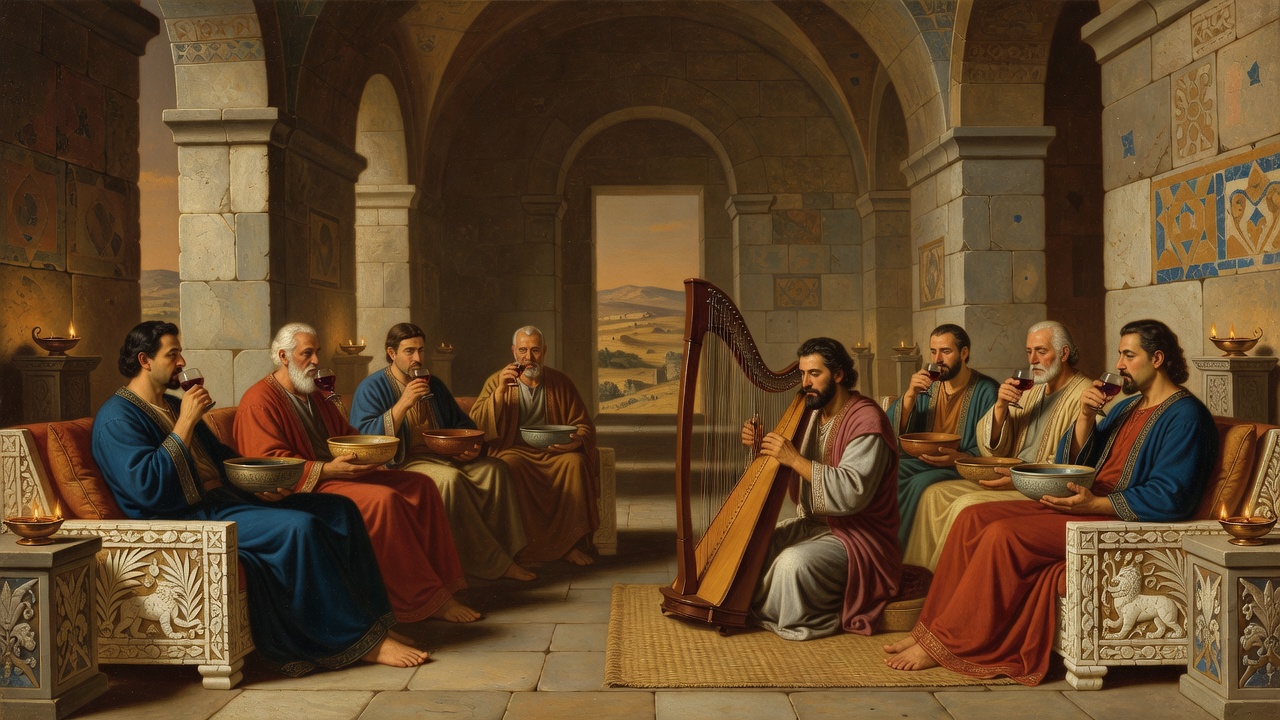
4That lie upon beds of ivory,
and stretch themselves upon their couches,
and eat the lambs out of the tzon,
and the calves from the stall;
5Who prattle to the tune of the nevel (harp);
like Dovid they invent string instruments.
6That drink yayin in sacrificial bowls,
and anoint themselves with the finest ointments;
but they are not grieved for the shever Yosef (ruin of Yosef).
7Therefore now shall they go
into captivity at the head of the golus,
and the merry shouting of the revellers will die.
The Pride of Israel
8Adonoi Hashem hath sworn by Himself, saith Hashem Elohei Tzva'os:
I abhor the ga'on Ya'akov,
and hate his fortresses;
therefore will I deliver up the city with all that is therein.
9And it shall come to pass, if there remain asarah anashim in one bais, they shall die. 10And a manʼs relative shall take him up, and he that burieth him, to carry out the bones out of the bais, and shall say unto him still hiding inside, Is there yet any with thee? And he shall say, Not one. Then shall he say, Hold thy tongue; for the Shem Hashem is not to be invoked.
11For, hinei, Hashem commandeth,
and He will strike the bais hagadol into ruins,
and the bais hakaton into pieces.
12Do susim run upon the rock?
Do men plow there with oxen?
For ye have turned mishpat into poison,
and the p'ri of tzedakah into wormwood;
13Ye which rejoice over what is worthless,
which say: Have we not taken to us
horns by chazekeinu (our own strength)?
14But, hineni, I will raise up against you a Goy (Nation),
O Bais Yisroel, saith Hashem Elohei Tzva'os;
and they shall afflict you from the territory of Chamat
unto the Wadi of the Aravah.
Did you know?
Complacency and Impending Exile
- Amos addresses the ruling elite who felt secure in both Zion, the fortified hill of Jerusalem, and Mount Samaria, the capital of the northern kingdom built on an elevated summit by King Omri. Despite the natural defenses and prestige of these cities, their leaders are warned that their ease and overconfidence would end in captivity.Sources: Zion · Samaria · the Bible text itself
- The prophet challenges Israel to look at renowned foreign cities such as Calneh near the Euphrates, Hamath on the Orontes in Upper Syria, and the Philistine stronghold of Gath. These neighboring powers were neither smaller nor less protected, yet they could not escape destruction.Sources: Calneh · Hamath · Gath · the Bible text itself
- Amos criticizes the aristocracy for indulging in extravagant banquets, resting on beds inlaid with ivory, and improvising music on harps like David, all while ignoring the impending ruin of Joseph. The name Joseph here designates the northern tribes of Israel, whose moral decay and social injustice were neglected by their wealthy leaders.Sources: David · Joseph (son of Jacob) · the Bible text itself
Notes written with AI assistance from open sources (Theographic Bible Metadata, CC BY-SA 4.0; Easton’s Bible Dictionary, public domain) and reviewed before publishing.
Places in this chapter
- Samaria · 32.276, 35.195 · verses 1, 8
- Zion · Today: Jerusalem · 31.777, 35.234 · verse 1
- Hamath · Today: Hama · 35.136, 36.750 · verse 2
- Philistia · 31.664, 34.546 · verse 2
Only places identified with high confidence are shown (90% or more according to the scholarly sources compiled by OpenBible). Period map: DARE (Digital Atlas of the Roman Empire), CC BY 4.0; modern map: © OpenStreetMap contributors; places: OpenBible.info (CC BY 4.0).
Credits and license for this translation
The Orthodox Jewish Bible
The Orthodox Jewish Bible - Tanakh and Orthodox Jewish Brit Chadasha - The Holy Bible
copyright © 2002-2011, 2021, 2024 Artists for Israel International
Language: English
Contributor: Artists for Israel International
THE ORTHODOX JEWISH TANAKH
Artists For Israel Intl Inc.
This version also appears with the Orthodox Yiddish Triglot which presents the Hebrew Yiddish script in Latin script and an English word for word translation, available at afii.org/Torah
To donate PayPal.Me
This translation is made available to you under the terms of the
Creative Commons Attribution license 4.0.
You may share and redistribute this Bible translation or extracts from it in any format, provided that:
You include the above copyright and source information.
If you make any changes to the text, you must indicate that you did so in a way that makes it clear that the original licensor is not necessarily endorsing your changes.
Pictures included with Scriptures and other documents on this site are licensed just for use with those Scriptures and documents.
For other uses, please contact the respective copyright owners.
Note that in addition to the rules above, revising and adapting God's Word involves a great responsibility to be true to God's Word. See Revelation 22:18-19.
2026-01-06
Section headings adapted from the Berean Standard Bible (public domain); they are not part of this translation’s text.
Source: http://ebible.org/engojb/ · eBible.org