Ezra 3
NET Bible · Tap a verse to see its cross-references.
1When the seventh month arrived and the Israelites were living in their towns, the people assembled in Jerusalem. 2Then Jeshua the son of Jozadak and his priestly colleagues and Zerubbabel son of Shealtiel and his colleagues started to build the altar of the God of Israel so they could offer burnt offerings on it as required by the law of Moses the man of God. 3They established the altar on its foundations, even though they were in terror of the local peoples, and they offered burnt offerings on it to the Lord, both the morning and the evening offerings. 4They observed the Festival of Temporary Shelters as required and offered the proper number of daily burnt offerings according to the requirement for each day. 5Afterward they offered the continual burnt offerings and those for the new moons and those for all the holy assemblies of the Lord and all those that were being voluntarily offered to the Lord. 6From the first day of the seventh month they began to offer burnt offerings to the Lord. However, the Lord’s temple was not at that time established.
Preparations for Rebuilding the Temple
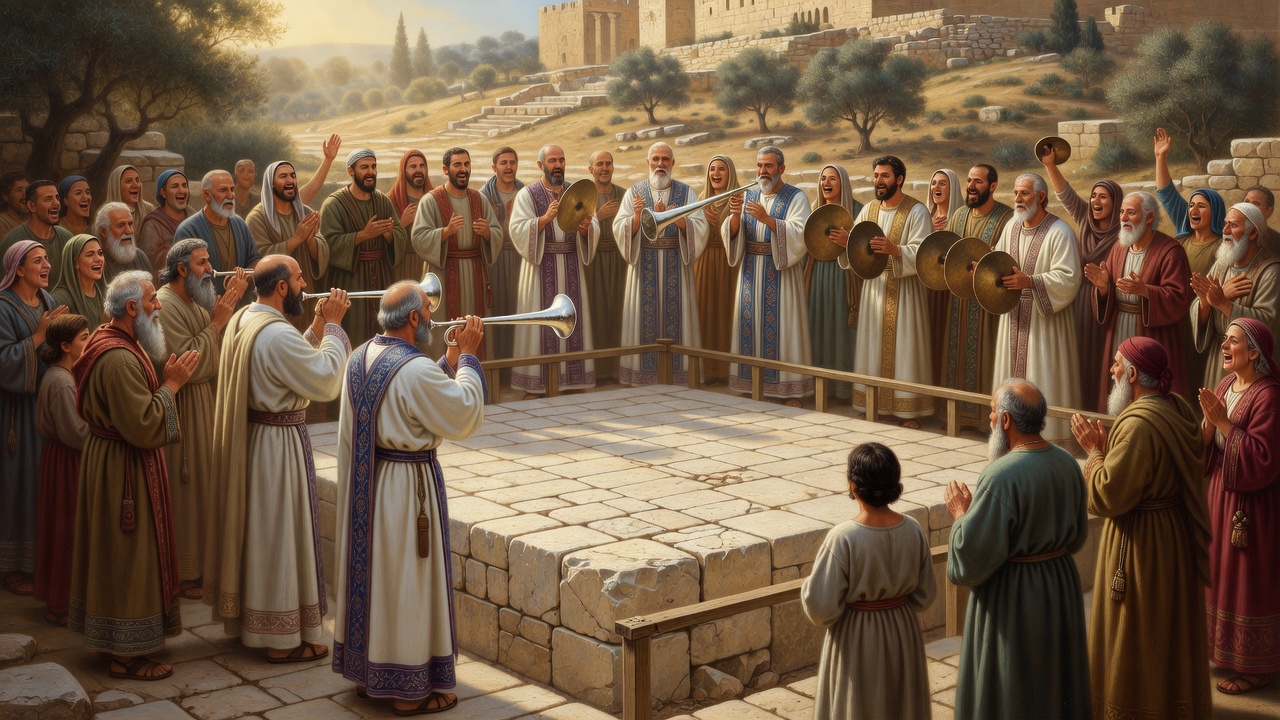
7So they provided money for the masons and carpenters, and food, beverages, and olive oil for the people of Sidon so that they would bring cedar timber from Lebanon to the seaport at Joppa, in accord with the edict of King Cyrus of Persia. 8In the second year after they had come to the temple of God in Jerusalem, in the second month, Zerubbabel the son of Shealtiel and Jeshua the son of Jozadak initiated the work, along with the rest of their associates, the priests and the Levites, and all those who were coming to Jerusalem from the exile. They appointed the Levites who were at least twenty years old to take charge of the work on the Lord’s temple. 9So Jeshua appointed both his sons and his relatives, Kadmiel and his sons (the sons of Yehudah ), to take charge of the workers in the temple of God, along with the sons of Henadad, their sons, and their relatives the Levites. 10When the builders established the Lord’s temple, the priests, ceremonially attired and with their clarions, and the Levites (the sons of Asaph) with their cymbals, stood to praise the Lord according to the instructions left by King David of Israel. 11With antiphonal response they sang, praising and glorifying the Lord:
“For he is good;
his loyal love toward Israel is forever.”
All the people gave a loud shout as they praised the Lord when the temple of the Lord was established. 12Many of the priests, the Levites, and the leaders – older people who had seen with their own eyes the former temple while it was still established – were weeping loudly, and many others raised their voice in a joyous shout. 13People were unable to tell the difference between the sound of joyous shouting and the sound of the people’s weeping, for the people were shouting so loudly that the sound was heard a long way off.
Did you know?
Rebuilding the Altar and Temple Foundation
- The returned exiles restored sacrificial worship on the temple mount before beginning major construction. Under Zerubbabel and the priest Jeshua, they rebuilt the altar on its original site to resume daily offerings and celebrate the Feast of Tabernacles before laying the temple foundation.Sources: the Bible text itself · Zerubbabel · Joshua
- To secure timber for the rebuilding effort, the community paid masons and carpenters, and sent food, drink, and oil to Tyre and Sidon to transport cedar logs from Lebanon by sea to the port of Joppa, as permitted by Cyrus, king of Persia.Sources: the Bible text itself · Lebanon · Joppa · Cyrus
- Laying the foundation of the house of the Lord triggered intense, mixed reactions. While many shouted joyfully to the accompaniment of trumpets and cymbals, older priests, Levites, and family heads who remembered the first temple wept aloud.Sources: the Bible text itself
Notes written with AI assistance from open sources (Theographic Bible Metadata, CC BY-SA 4.0; Easton’s Bible Dictionary, public domain) and reviewed before publishing.
Places in this chapter
- Jerusalem · 31.777, 35.234 · verses 1, 8
- Great Sea · Today: Mediterranean Sea · 31.805, 34.170 · verse 7
- Joppa · Today: Jaffa · 32.054, 34.753 · verse 7
- Lebanon · 33.540, 35.584 · verse 7
- Persia · 34.806, 48.516 · verse 7
- Sidon · Today: Sandikli archaeological site in Sidon · 33.561, 35.372 · verse 7
- Tyre · 33.271, 35.196 · verse 7
Only places identified with high confidence are shown (90% or more according to the scholarly sources compiled by OpenBible). Period map: DARE (Digital Atlas of the Roman Empire), CC BY 4.0; modern map: © OpenStreetMap contributors; places: OpenBible.info (CC BY 4.0).
Credits and license for this translation
NET Bible
NET Bible®, New English Translation (NET)
copyright © 1996-2016 Biblical Studies Press, L. L. C.
Please see https://netbible.com/copyright/ for full NET Bible copyright and permissions information. You can also read the NET Bible at http://NETBible.org .
Language: English
Dialect (if applicable): American
Language in English: English
Translation by:
Please see https://netbible.com/copyright/ for full NET Bible copyright and permissions information. You can also read the NET Bible at http://NETBible.org .
The NET Bible (New English Translation) is a completely new translation of the Bible with 58,506 translators’ notes ! It was completed by more than 25 scholars – experts in the original biblical languages – who worked directly from the best currently available Hebrew, Aramaic, and Greek texts. Turn the pages and see the breadth of the translators’ notes, documenting their decisions and choices as they worked.
The translators’ notes make the original languages far more accessible, allowing you to look over the translator’s shoulder at the very process of translation. This level of documentation is a first for a Bible translation, making transparent the textual basis and the rationale for key renderings (including major interpretive options and alternative translations).
This unparalleled level of detail helps connect people to the Bible in the original languages in a way never before possible without years of study of Hebrew, Aramaic, and Greek. It unlocks the riches of the Bible’s truth from entirely new perspectives.
A donation is appreciated. Donate at Bible.org/donations_form so we can continue to provide our material for free for our 16,000+ articles on Bible.org and our world class Bible Study tool at lumina.bible.org .
2026-10-02
Source: http://ebible.org/engnet/ · eBible.org