Exodus 3
Isaac Leeser Tanakh · Tap a verse to see its cross-references.
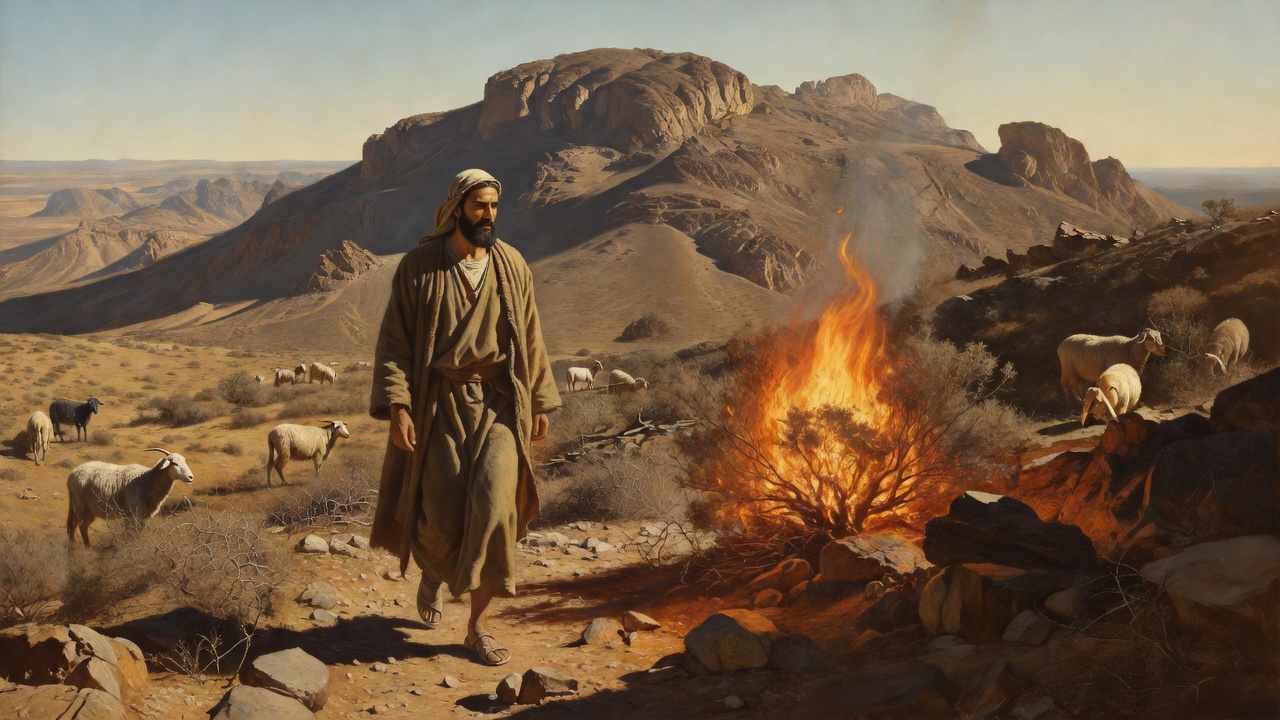
Moses at the Burning Bush
1And Moses was keeping the flock of Jithro his father-in-law, the priest of Midian; and he led the flock far away into the desert, and came to the mountain of God, to Choreb. 2And an angel of the Lord appeared unto him in a flame of fire out of the midst of a thorn-bush; and he looked, and, behold, the thorn-bush was burning with fire, but the thorn-bush was not consumed. 3And Moses said, I must turn aside, and see this great sight, why the thorn-bush is not burnt. 4And when the Lord saw that he turned aside to see God called unto him out of the midst of the thorn-bush, and said, Moses, Moses; and he said, Here am I. 5And he said, Draw not nigh hither; put off thy shoes from off thy feet; for the place whereon thou standest is holy ground. 6And he said, I am the God of thy father, the God of Abraham, the God of Isaac, and the God of Jacob; and Moses hid his face; for he was afraid to look up to God. 7And the Lord said, I have truly seen the affliction of my people that is in Egypt, and have heard its cry by reason of its taskmasters; yea, I know its sorrows; 8And I am come down to deliver it out of the hand of the Egyptians, and to bring it up out of that land unto a land, good and large, unto a land flowing with milk and honey; unto the place of the Canaanites, and the Hittites, and the Emorites, and the Perizzites, and the Hivites, and the Jebusites. 9Now therefore, behold, the cry of the children of Israel is come unto me: and I have also seen the oppression wherewith the Egyptians oppress them. 10And now then go, and I will send thee unto Pharaoh, and thou shalt bring forth my people the children of Israel out of Egypt. 11And Moses said unto God, Who am I, that I should go unto Pharaoh, and that I should bring forth the children of Israel out of Egypt? 12And he said, Because I will be with thee; and this shall be unto thee the token, that I have sent thee: when thou hast brought forth the people out of Egypt, ye shall serve God upon this mountain. 13And Moses said unto God, Behold, if I come unto the children of Israel, and say unto them, The God of your fathers hath sent me unto you; and they then say to me, What is his name? what shall I say unto them? 14And God said unto Moses, I will be that I will be: and he said, Thus shalt thou say unto the children of Israel, I will be hath sent me unto you. 15And God said moreover unto Moses, Thus shalt thou say unto the children of Israel, The Everlasting One, the God of your fathers, the God of Abraham, the God of Isaac, and the God of Jacob, hath sent me unto you: this is my name for ever, and this is my memorial unto all generations. 16Go, and assemble the elders of Israel, and say unto them, The Everlasting One, the God of your fathers, the God of Abraham, of Isaac, and of Jacob, hath appeared unto me, saying, I have surely taken cognizance of you and of that which is done to you in Egypt: 17And I have said, I will bring you up out of the affliction of Egypt, unto the land of the Canaanites, and the Hittites, and the Emorites, and the Perizzites, and the Hivites, and the Jebusites, unto a land flowing with milk and honey. 18And they will hearken to thy voice: and thou shalt come, thou and the elders of Israel, unto the king of Egypt, and ye shall say unto him, The Everlasting One, the God of the Hebrews hath met with us; and now let us go, we beseech thee, a three days' journey into the wilderness, that we may sacrifice to the Lord our God. 19But I am sure that the king of Egypt will not let you go, unless it happen through a mighty hand. 20And I will stretch out my hand, and smite Egypt with all my wonders which I will do in the midst thereof; and after that he will let you go. 21And I will give this people favor in the eyes of the Egyptians; and it shall come to pass, that, when ye go, ye shall not go empty: 22But every woman shall ask of her neighbor, and of her that sojourneth in her house, vessels of silver, and vessels of gold, and garments; and ye shall put them upon your sons, and upon your daughters; and ye shall empty out Egypt.
Did you know?
The Call of Moses at the Burning Bush
- Moses is shepherding in Midian when this chapter begins. The Midianites were a nomadic Arabian tribe descended from Midian, Abraham's fourth son by Keturah, whose name is explained as strife. They lived chiefly in the desert north of Arabia, and the Sinai peninsula was grazing land for their flocks; it was there, after fleeing Egypt, that Moses became a servant and then the priest's son-in-law.Sources: the Bible text itself · Midian · Midian
- His father-in-law is Jethro, called the priest of Midian. Easton's Bible Dictionary (1897) equates that priest with Raguel and says that, if the two names belong to one man, Raguel may be regarded as his personal name and Jethro, meaning excellency, as an official title.Sources: the Bible text itself · Jethro
- Moses leads the flock to Horeb, the mountain of God. The name is explained as desert, or mountain, of the dried-up ground, a general term for the whole range of which Sinai was one summit; Easton's Bible Dictionary (1897) gives the modern name of the range as Jebel Musa and describes a huge block about two miles long and about one mile wide, with a very spacious plain called Er Rahah at its north-east end, where the Israelites later camped for nearly a year.Sources: the Bible text itself · Horeb
Notes written with AI assistance from open sources (Theographic Bible Metadata, CC BY-SA 4.0; Easton’s Bible Dictionary, public domain) and reviewed before publishing.
Places in this chapter
- Midian · 28.495, 35.012 · verse 1
- Mount Horeb · Today: Jebel Musa · 28.540, 33.973 · verse 1
- Egypt · 30.129, 31.308 · verses 7, 8, 10, 11, 12, 16, 17, 18, 19, 20, 22
Only places identified with high confidence are shown (90% or more according to the scholarly sources compiled by OpenBible). Period map: DARE (Digital Atlas of the Roman Empire), CC BY 4.0; modern map: © OpenStreetMap contributors; places: OpenBible.info (CC BY 4.0).
Credits and license for this translation
Isaac Leeser Tanakh
The Isaac Leeser Tanakh (Jewish Bible)
Public Domain
Language: English
Dialect: archaic British
Translation by: Isaac Leeser
2020-10-14
Section headings adapted from the Berean Standard Bible (public domain); they are not part of this translation’s text.
Source: http://ebible.org/englee/ · eBible.org