Exodus 2
Isaac Leeser Tanakh · Tap a verse to see its cross-references.
The Birth and Adoption of Moses
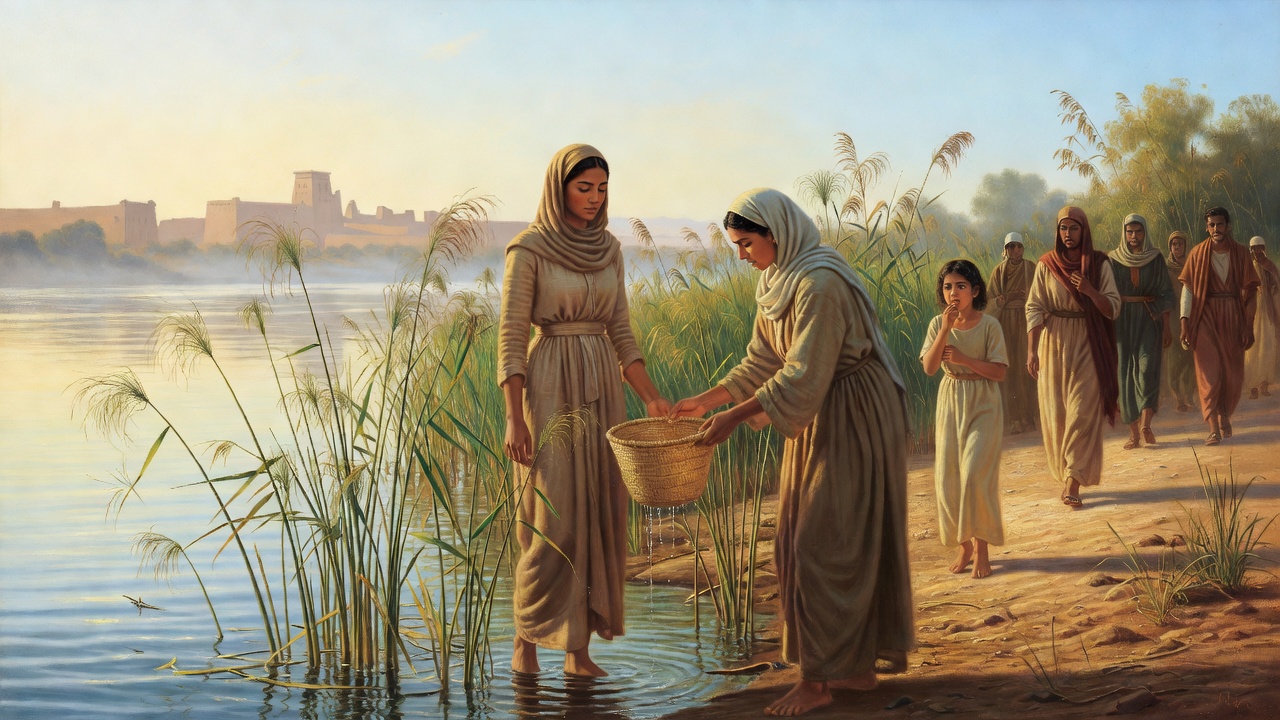
1And there went a man of the house of Levi, and took a daughter of Levi. 2And the woman conceived, and bore a son; and when she saw him that he was a goodly child, she hid him three months. 3And when she could no longer hide him, she took for him a box of bulrushes, and daubed it with slime and with pitch; and she put the child therein, and laid it amidst the flags by the brink of the river. 4And his sister placed herself afar off, to ascertain what would be done to him. 5And the daughter of Pharaoh came down to wash herself at the river; and her maidens walked along by the side of the river; and when she saw the box among the flags, she sent her maid and fetched it. 6And she opened it, and saw the child, and, behold, it was a weeping boy; and she had compassion on him, and said, This is one of the Hebrews' children. 7Then said his sister to Pharaoh's daughter, Shall I go and call thee a nurse of the Hebrew women, that she may nurse for thee the child? 8And Pharaoh's daughter said to her, Go; and the maiden went and called the mother of the child. 9And Pharaoh's daughter said unto her, Take away this child, and nurse him for me, and I will give thee thy wages; and the woman took the child, and nursed him. 10And the child grew up, and she brought him unto Pharaoh's daughter, and he became to her as a son; and she called his name Moses; and she said, Because out of the water have I drawn him.
The Rejection and Flight of Moses
11And it came to pass in those days, when Moses was grown up, that he went out unto his brethren, and looked on their burdensome labors; and he saw an Egyptian man smiting a Hebrew man, one of his brethren. 12And he looked this way and that way, and when he saw that there was no one by, he smote the Egyptian, and hid him in the sand. 13And when he went out the second day, behold, two Hebrew men were striving together; and he said unto him that was in the wrong, Wherefore smitest thou thy fellow? 14And he said, Who made thee a chief and a judge over us? intendest thou to kill me, as thou hast killed the Egyptian! And Moses feared, and said, Surely the thing is become known. 15And Pharaoh heard this thing, and he sought to slay Moses; but Moses fled from the face of Pharaoh, and tarried in the land of Midian, and he sat down by a well. 16Now the priest of Midian had seven daughters; and they came and drew water, and filled the troughs to water their father's flock. 17And the shepherds came and drove them away; but Moses arose and helped them, and watered their flock. 18And when they came to Reuel their father, he said, Wherefore are ye come home so soon today? 19And they said, An Egyptian man delivered us out of the hand of the shepherds; and he also drew water for us, and watered the flock. 20And he said unto his daughters, And where is he? wherefore have ye left the man? call him, that he may eat bread. 21And Moses was content to dwell with the man; and he gave Zipporah his daughter to Moses. 22And she bore a son, and he called his name Gershom; for he said, I have been a stranger in a foreign land.
God Hears the Cry of the Israelites
23And it came to pass in this long time, that the king of Egypt died; and the children of Israel sighed by reason of the bondage, and they cried; and their complaint came up unto God by reason of the bondage. 24And God heard their groaning, and God remembered his covenant with Abraham, with Isaac, and with Jacob. 25And God looked upon the children of Israel, and God took cognizance of them.
Did you know?
The birth and flight of Moses
- Pharaoh’s daughter named the child Moses, explaining that she had drawn him out of the water. Easton's Bible Dictionary (1897) links his name with “drawn,” or with the Egyptian word mesu, “son”—the element from which the dictionary also explains Rameses as “royal son.”Sources: the Bible text itself · Moses
- In Exodus 2 a daughter of Levi hides her son for three months, and Pharaoh’s daughter, finding him among the Nile reeds, recognizes a Hebrew child. Easton's Bible Dictionary (1897) links the Israelites’ affliction to “the new king who knew not Joseph,” long supposed to be Aahmes I, called Amosis by Josephus, though the dictionary, citing discoveries then recent, names Seti instead. Their hardship, it says, began after the Hyksos, masters of Egypt for some five centuries, were driven out and the old dynasty restored.Sources: the Bible text itself · Pharaoh
- After Pharaoh sought to kill him, Moses fled to Midian and sat down beside a well; he later married Zipporah, one of the seven daughters of the priest of Midian. The Midianites were nomadic Arabians descended from Midian, Abraham’s fourth son by Keturah, and they pastured their flocks in the Sinai peninsula and in the desert north of the Arabian peninsula. This chapter calls the priest Reuel, whom Easton's Bible Dictionary (1897) names Raguel, regarding that form as his personal name and Jethro—“excellency”—as an official title if the two are identified.Sources: the Bible text itself · Midian · Midian · Jethro
Notes written with AI assistance from open sources (Theographic Bible Metadata, CC BY-SA 4.0; Easton’s Bible Dictionary, public domain) and reviewed before publishing.
Places in this chapter
- Nile · Today: Nile River · 31.465, 30.367 · verses 3, 5
- Midian · 28.495, 35.012 · verses 15, 16
- Egypt · 30.129, 31.308 · verse 23
Only places identified with high confidence are shown (90% or more according to the scholarly sources compiled by OpenBible). Period map: DARE (Digital Atlas of the Roman Empire), CC BY 4.0; modern map: © OpenStreetMap contributors; places: OpenBible.info (CC BY 4.0).
Credits and license for this translation
Isaac Leeser Tanakh
The Isaac Leeser Tanakh (Jewish Bible)
Public Domain
Language: English
Dialect: archaic British
Translation by: Isaac Leeser
2020-10-14
Section headings adapted from the Berean Standard Bible (public domain); they are not part of this translation’s text.
Source: http://ebible.org/englee/ · eBible.org