Exodus 2
JPS TaNaKH 1917 · Tap a verse to see its cross-references.
The Birth and Adoption of Moses
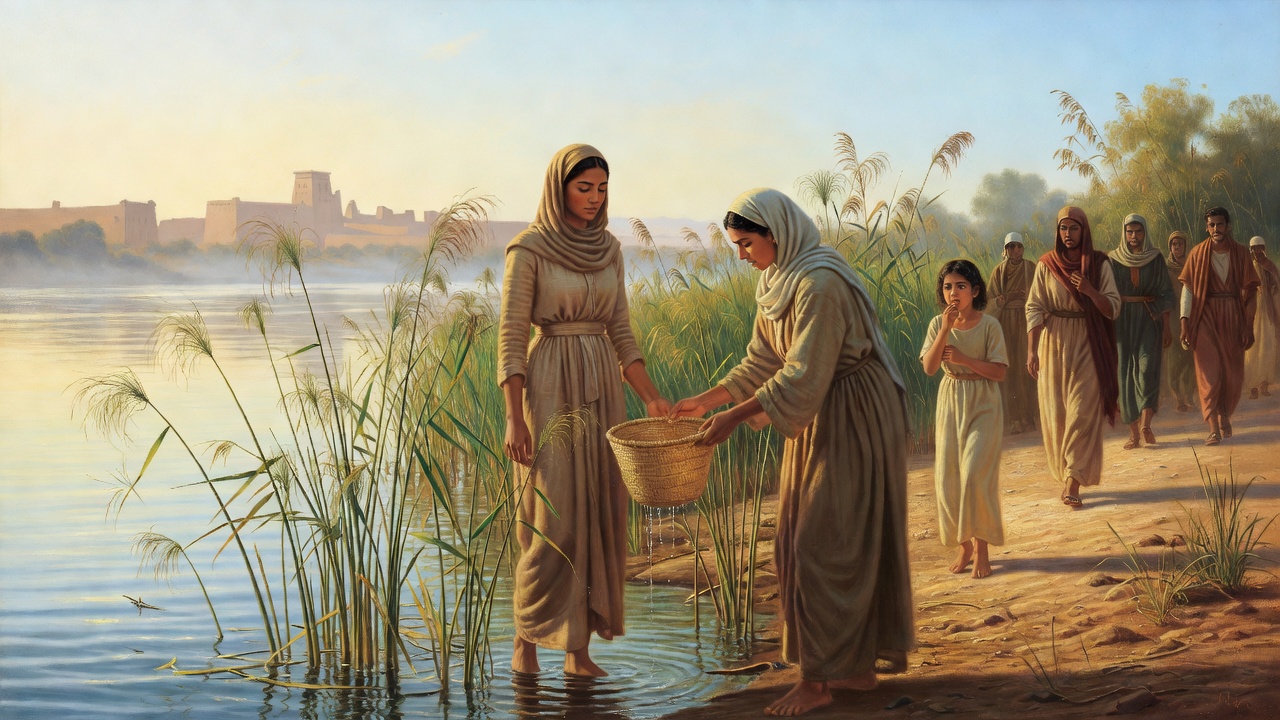
1And there went a man of the house of Levi, and took to wife a daughter of Levi. 2And the woman conceived, and bore a son; and when she saw him that he was a goodly child, she hid him three months. 3And when she could not longer hide him, she took for him an ark of bulrushes, and daubed it with slime and with pitch; and she put the child therein, and laid it in the flags by the river's brink. 4And his sister stood afar off, to know what would be done to him. 5And the daughter of Pharaoh came down to bathe in the river; and her maidens walked along by the river-side; and she saw the ark among the flags, and sent her handmaid to fetch it. 6And she opened it, and saw it, even the child; and behold a boy that wept. And she had compassion on him, and said: 'This is one of the Hebrews' children.' 7Then said his sister to Pharaoh's daughter: 'Shall I go and call thee a nurse of the Hebrew women, that she may nurse the child for thee?' 8And Pharaoh's daughter said to her: 'Go.' And the maiden went and called the child's mother. 9And Pharaoh's daughter said unto her: 'Take this child away, and nurse it for me, and I will give thee thy wages.' And the woman took the child, and nursed it. 10And the child grew, and she brought him unto Pharaoh's daughter, and he became her son. And she called his name Moses, and said: 'Because I drew him out of the water.'
The Rejection and Flight of Moses
11And it came to pass in those days, when Moses was grown up, that he went out unto his brethren, and looked on their burdens; and he saw an Egyptian smiting a Hebrew, one of his brethren. 12And he looked this way and that way, and when he saw that there was no man, he smote the Egyptian, and hid him in the sand. 13And he went out the second day, and, behold, two men of the Hebrews were striving together; and he said to him that did the wrong: 'Wherefore smitest thou thy fellow?' 14And he said: 'Who made thee a ruler and a judge over us? thinkest thou to kill me, as thou didst kill the Egyptian?' And Moses feared, and said: 'Surely the thing is known.' 15Now when Pharaoh heard this thing, he sought to slay Moses. But Moses fled from the face of Pharaoh, and dwelt in the land of Midian; and he sat down by a well. 16Now the priest of Midian had seven daughters; and they came and drew water, and filled the troughs to water their father's flock. 17And the shepherds came and drove them away; but Moses stood up and helped them, and watered their flock. 18And when they came to Reuel their father, he said: 'How is it that ye are come so soon to-day?' 19And they said: 'An Egyptian delivered us out of the hand of the shepherds, and moreover he drew water for us, and watered the flock.' 20And he said unto his daughters: 'And where is he? Why is it that ye have left the man? call him, that he may eat bread.' 21And Moses was content to dwell with the man; and he gave Moses Zipporah his daughter. 22And she bore a son, and he called his name Gershom; for he said: 'I have been a stranger in a strange land.'
God Hears the Cry of the Israelites
23And it came to pass in the course of those many days that the king of Egypt died; and the children of Israel sighed by reason of the bondage, and they cried, and their cry came up unto God by reason of the bondage. 24And God heard their groaning, and God remembered His covenant with Abraham, with Isaac, and with Jacob. 25And God saw the children of Israel, and God took cognizance of them.
Did you know?
The birth and flight of Moses
- Pharaoh’s daughter named the child Moses, explaining that she had drawn him out of the water. Easton's Bible Dictionary (1897) links his name with “drawn,” or with the Egyptian word mesu, “son”—the element from which the dictionary also explains Rameses as “royal son.”Sources: the Bible text itself · Moses
- In Exodus 2 a daughter of Levi hides her son for three months, and Pharaoh’s daughter, finding him among the Nile reeds, recognizes a Hebrew child. Easton's Bible Dictionary (1897) links the Israelites’ affliction to “the new king who knew not Joseph,” long supposed to be Aahmes I, called Amosis by Josephus, though the dictionary, citing discoveries then recent, names Seti instead. Their hardship, it says, began after the Hyksos, masters of Egypt for some five centuries, were driven out and the old dynasty restored.Sources: the Bible text itself · Pharaoh
- After Pharaoh sought to kill him, Moses fled to Midian and sat down beside a well; he later married Zipporah, one of the seven daughters of the priest of Midian. The Midianites were nomadic Arabians descended from Midian, Abraham’s fourth son by Keturah, and they pastured their flocks in the Sinai peninsula and in the desert north of the Arabian peninsula. This chapter calls the priest Reuel, whom Easton's Bible Dictionary (1897) names Raguel, regarding that form as his personal name and Jethro—“excellency”—as an official title if the two are identified.Sources: the Bible text itself · Midian · Midian · Jethro
Notes written with AI assistance from open sources (Theographic Bible Metadata, CC BY-SA 4.0; Easton’s Bible Dictionary, public domain) and reviewed before publishing.
Places in this chapter
- Nile · Today: Nile River · 31.465, 30.367 · verses 3, 5
- Midian · 28.495, 35.012 · verses 15, 16
- Egypt · 30.129, 31.308 · verse 23
Only places identified with high confidence are shown (90% or more according to the scholarly sources compiled by OpenBible). Period map: DARE (Digital Atlas of the Roman Empire), CC BY 4.0; modern map: © OpenStreetMap contributors; places: OpenBible.info (CC BY 4.0).
Credits and license for this translation
JPS TaNaKH 1917
The Jewish Bible (Old Testament) in English, published by the Jewish Publication Society in 1917
Public Domain
Language: English
Dialect: American
Translation by: Jewish Publication Society
This copy of the Old JPS TaNaKH by the Jewish Publication Society is brought to you courtesy of eBible.org . For the new JPS TaNaKH (1972, 1978, 1980), please see jps.org .
2023-09-19
Section headings adapted from the Berean Standard Bible (public domain); they are not part of this translation’s text.
Source: http://ebible.org/engjps/ · eBible.org