Exodus 1
JPS TaNaKH 1917 · Tap a verse to see its cross-references.
About this book
About Exodus
- Easton's Bible Dictionary (1897) dates Israel's departure from Egypt to about 1490 B.C., four hundred and eighty years before Solomon's temple was built. How long they had sojourned there is disputed: Exodus 12:40 gives four hundred and thirty years, Genesis 15 speaks of about four hundred, and the Greek and Samaritan versions also count the years in Canaan, so some reckon only two hundred and fifteen years in Egypt.Sources: Easton: Exodus
- Easton's Bible Dictionary (1897) does not name the author of Exodus. The entry on Moses says Jacob and his sons went down into Egypt, probably about three hundred and fifty years before Moses was born, and that a Hyksos king, from a pastoral Semitic people of Asia who then ruled Egypt, settled them in Goshen. Moses later spent forty years in Midian, where that people pastured flocks on the Sinai peninsula, and became the son-in-law of Jethro, priest of Midian.Sources: Moses · Easton: Exodus · Midian · Jethro
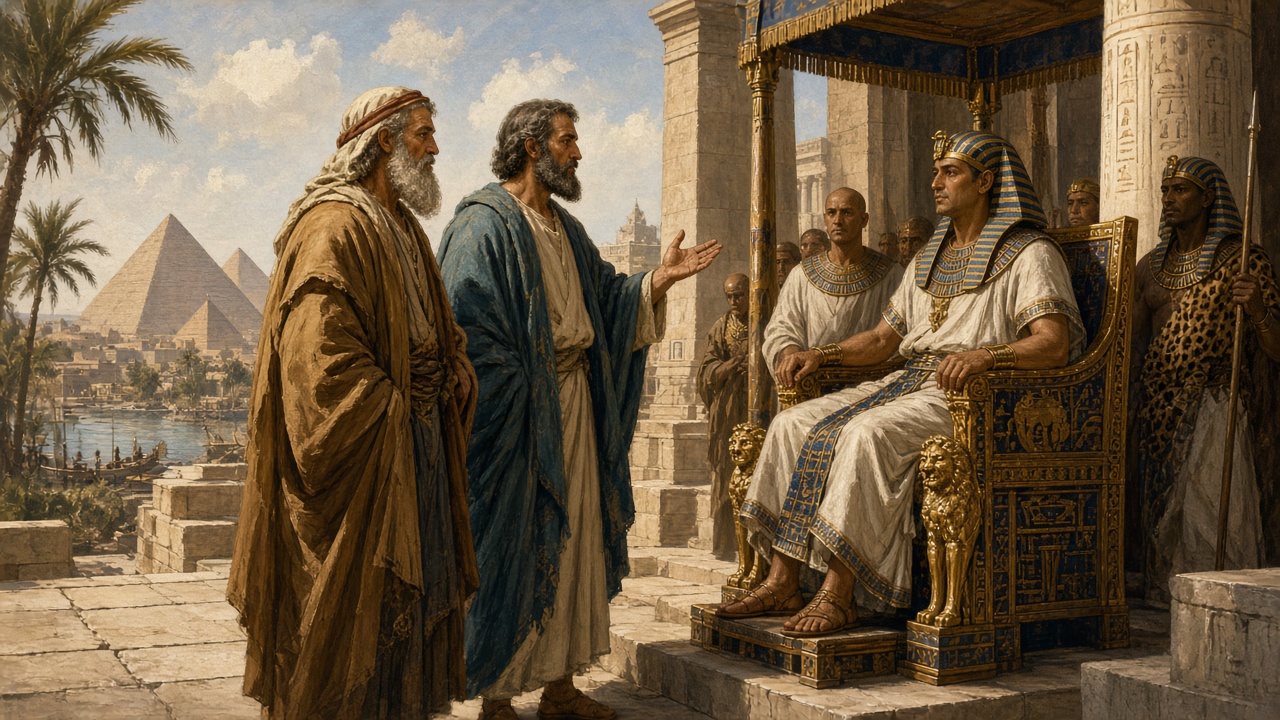
- Who was Pharaoh at the departure is also disputed. Easton's Bible Dictionary (1897) calls him probably Menephtah I, the fourteenth and eldest surviving son of Rameses II, who lived at Zoan and met Moses and Aaron there, while noting that some favor Seti II, whose reign began peacefully and ended in sudden disaster.Sources: Pharaoh (of the Exodus)
- The plagues, Easton writes, loosened Pharaoh's hold, and the Passover was instituted as a perpetual memorial, with the lamb's blood sprinkled on the doorposts. In the third month the people reached Mount Sinai, also called Horeb, about one hundred and fifty miles from the Red Sea, and camped there about a year. The last twenty-two chapters of Exodus record that stay, including the tabernacle, whose Holy Place had no opening for daylight and was lit only by the golden candlestick.Sources: Easton: Exodus · Mount Sinai · Holy Place
- Aaron, eldest son of Amram and Jochebed, was born in Egypt three years before Moses and was sent to meet him so the two could work together. At Rephidim, Joshua, also born in Egypt, commanded Israel's fighters when the Amalekites, a pastoral people living between the Dead Sea and the Red Sea, tried to bar their way.Sources: Aaron · Joshua · Amalek
Notes written with AI assistance from open sources (Theographic Bible Metadata, CC BY-SA 4.0; Easton’s Bible Dictionary, public domain) and reviewed before publishing.
The Israelites Multiply in Egypt
1NOW THESE are the names of the sons of Israel, who came into Egypt with Jacob; every man came with his household: 2Reuben, Simeon, Levi, and Judah; 3Issachar, Zebulun, and Benjamin; 4Dan and Naphtali, Gad and Asher. 5And all the souls that came out of the loins of Jacob were seventy souls; and Joseph was in Egypt already. 6And Joseph died, and all his brethren, and all that generation. 7And the children of Israel were fruitful, and increased abundantly, and multiplied, and waxed exceeding mighty; and the land was filled with them.
Oppression by a New King
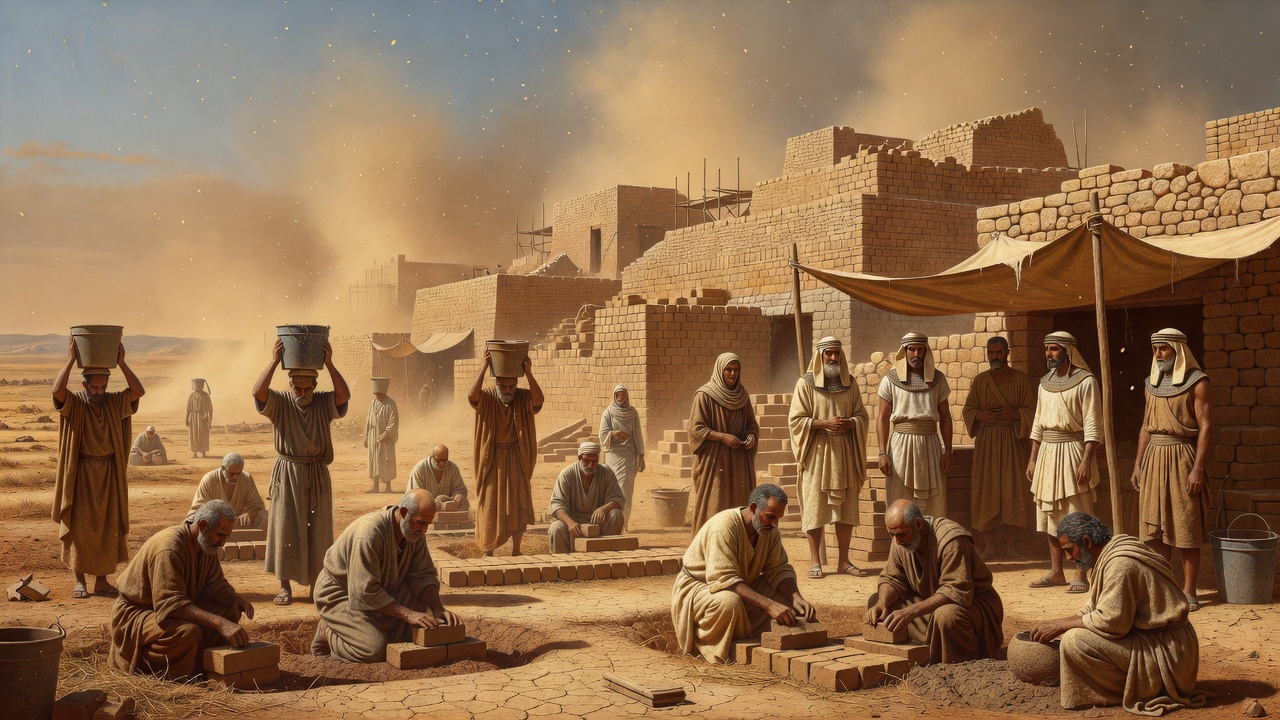
8Now there arose a new king over Egypt, who knew not Joseph. 9And he said unto his people: 'Behold, the people of the children of Israel are too many and too mighty for us; 10come, let us deal wisely with them, lest they multiply, and it come to pass, that, when there befalleth us any war, they also join themselves unto our enemies, and fight against us, and get them up out of the land.' 11Therefore they did set over them taskmasters to afflict them with their burdens. And they built for Pharaoh store-cities, Pithom and Raamses. 12But the more they afflicted them, the more they multiplied and the more they spread abroad. And they were adread because of the children of Israel. 13And the Egyptians made the children of Israel to serve with rigour. 14And they made their lives bitter with hard service, in mortar and in brick, and in all manner of service in the field; in all their service, wherein they made them serve with rigour. 15And the king of Egypt spoke to the Hebrew midwives, of whom the name of the one was Shiphrah, and the name of the other Puah; 16and he said: 'When ye do the office of a midwife to the Hebrew women, ye shall look upon the birthstool: if it be a son, then ye shall kill him; but if it be a daughter, then she shall live.' 17But the midwives feared God, and did not as the king of Egypt commanded them, but saved the men-children alive. 18And the king of Egypt called for the midwives, and said unto them: 'Why have ye done this thing, and have saved the men-children alive?' 19And the midwives said unto Pharaoh: 'Because the Hebrew women are not as the Egyptian women; for they are lively, and are delivered ere the midwife come unto them.' 20And God dealt well with the midwives; and the people multiplied, and waxed very mighty. 21And it came to pass, because the midwives feared God, that He made them houses. 22And Pharaoh charged all his people, saying: 'Every son that is born ye shall cast into the river, and every daughter ye shall save alive.'
Did you know?
Israel's Growth and Oppression in Egypt
- Easton's Bible Dictionary (1897) says that the Hebrews in Egypt were under Joseph's protection for about seventy years, and that after his death their condition changed only gradually. It notes that the new king who did not know Joseph was generally supposed to be Aahmes I, whom Josephus calls Amosis, though discoveries of that time led the dictionary to conclude that he was Seti, after the Hyksos were driven out and the former dynasty restored.Sources: Pharaoh · the Bible text itself
- Set to forced labor, the Israelites built Pithom and Rameses as store cities for Pharaoh. Easton's Bible Dictionary (1897) explains Pithom as Egyptian Pa-Tum, 'house of Tum,' the sun-god, and calls it a treasure city built for Pharaoh Rameses II; it identifies the site with Tell-el-Maskhuta, where ruins of supposed grain-chambers were reported in 1883.Sources: Pithom · Raamses · the Bible text itself
- Pharaoh then commanded that every son born to the Hebrews be thrown into the river. Easton's Bible Dictionary (1897) notes that the name Nile does not appear in Scripture; the Old Testament calls that river Sihor, 'the black stream,' or simply 'the river,' as in Exodus 1:22.Sources: Nile · the Bible text itself
Notes written with AI assistance from open sources (Theographic Bible Metadata, CC BY-SA 4.0; Easton’s Bible Dictionary, public domain) and reviewed before publishing.
Places in this chapter
- Egypt · 30.129, 31.308 · verses 1, 5, 8, 15, 17, 18
- Nile · Today: Nile River · 31.465, 30.367 · verse 22
Only places identified with high confidence are shown (90% or more according to the scholarly sources compiled by OpenBible). Period map: DARE (Digital Atlas of the Roman Empire), CC BY 4.0; modern map: © OpenStreetMap contributors; places: OpenBible.info (CC BY 4.0).
Credits and license for this translation
JPS TaNaKH 1917
The Jewish Bible (Old Testament) in English, published by the Jewish Publication Society in 1917
Public Domain
Language: English
Dialect: American
Translation by: Jewish Publication Society
This copy of the Old JPS TaNaKH by the Jewish Publication Society is brought to you courtesy of eBible.org . For the new JPS TaNaKH (1972, 1978, 1980), please see jps.org .
2023-09-19
Section headings adapted from the Berean Standard Bible (public domain); they are not part of this translation’s text.
Source: http://ebible.org/engjps/ · eBible.org