Berean Standard Bible · Tap a verse to see its cross-references.
AI-generated narration · text: Berean Standard Bible (public domain)
The Joy of Forgiveness
Of David. A Maskil.
1Blessed is he whose transgressions are forgiven,
whose sins are covered.
2Blessed is the man
whose iniquity the LORD does not count against him,
in whose spirit there is no deceit.
3When I kept silent, my bones became brittle
from my groaning all day long.
4For day and night
Your hand was heavy upon me;
my strength was drained
as in the summer heat.
Selah
5Then I acknowledged my sin to You
and did not hide my iniquity.
I said, “I will confess my transgressions to the LORD,”
and You forgave the guilt of my sin.
Selah
6Therefore let all the godly pray to You
while You may be found.
Surely when great waters rise,
they will not come near.
7You are my hiding place.
You protect me from trouble;
You surround me with songs of deliverance.
Selah
8I will instruct you and teach you the way you should go;
I will give you counsel and watch over you.
9Do not be like the horse or mule,
which have no understanding;
they must be controlled with bit and bridle
to make them come to you.
10Many are the sorrows of the wicked,
but loving devotion surrounds him who trusts in the LORD.
11Be glad in the LORD and rejoice, O righteous ones;
shout for joy, all you upright in heart.
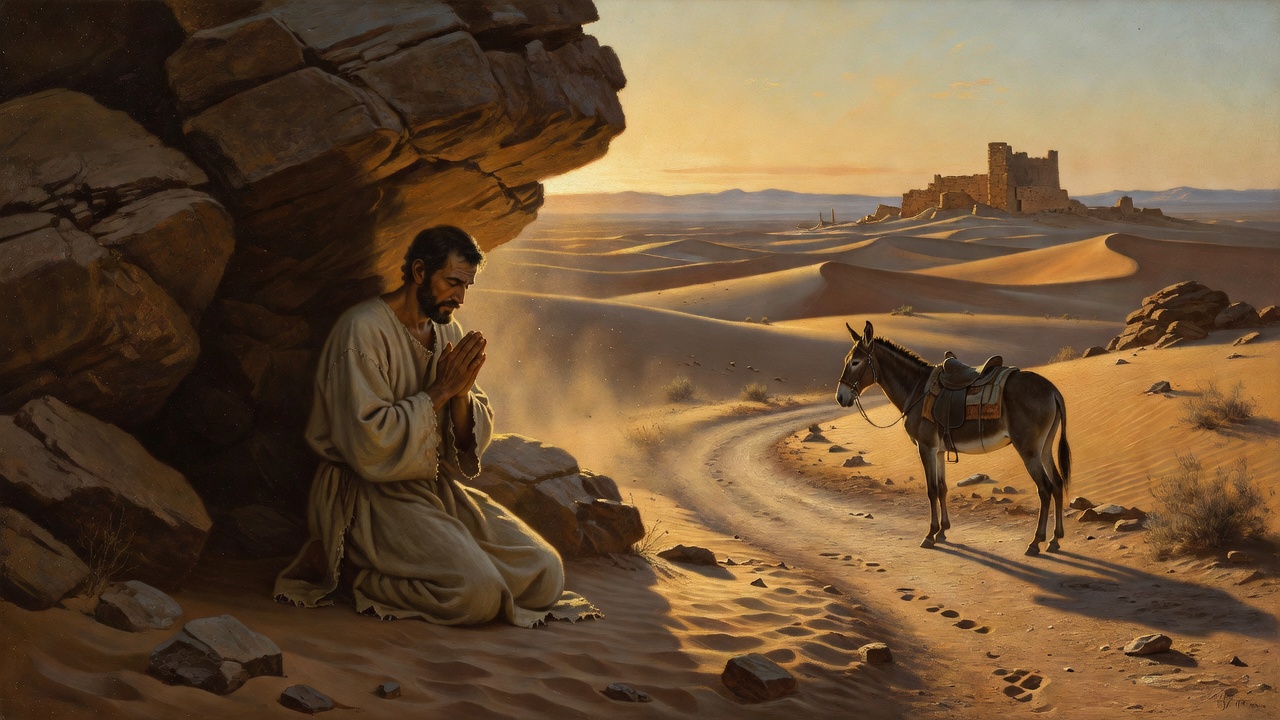
Artistic illustration — an interpretation, not a historical record.
Did you know?
The Joy of Forgiveness and Guidance
The psalm opens with the title designating it as a Maskil of David, a term traditionally associated with an instructional or contemplative song, reflecting on the contrast between the distress of hidden sin and the blessing of forgiveness.Sources: the Bible text itself
The Hebrew term Selah appears three times in this psalm (verses 4, 5, and 7), commonly interpreted as a musical pause or a moment for reflection during the recitation of the text.Sources: the Bible text itself
The psalm uses the imagery of working animals, contrasting the willing follower of divine counsel with stubborn horses and mules that require a bit and bridle to be guided.Sources: the Bible text itself
Notes written with AI assistance from open sources (Theographic Bible Metadata, CC BY-SA 4.0; Easton’s Bible Dictionary, public domain) and reviewed before publishing.
Credits and license for this translation
Berean Standard Bible
The Holy Bible in English: Berean Standard Bible
Public Domain
Language: English
Contributor: BSB Publishing, LLC
2026-10-02