Lamentations 1
Berean Standard Bible · Tap a verse to see its cross-references.
About this book
About Lamentations
- In the Hebrew canon the book is called 'Ekhah, meaning “How,” the formula that opens a song of wailing and the first word of the book. The Septuagint adopted the name rendered “Lamentations” (Greek threnoi, equivalent to Hebrew qinoth) to mark its character, and in the Hebrew Bible it is placed among the Khethubim.Sources: Easton: Lamentations, Book of
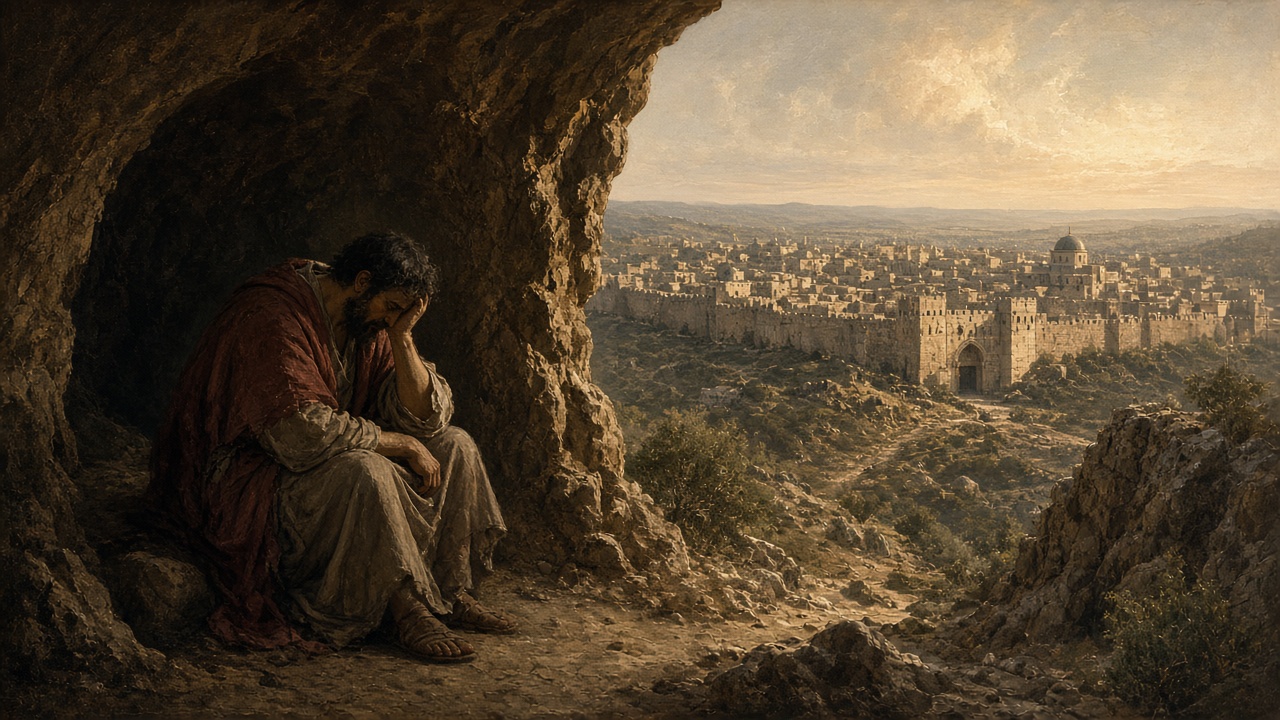
- The Septuagint and the Targum ascribe Lamentations to Jeremiah, and Easton's Bible Dictionary (1897) follows that tradition. Tradition says that after Nebuchadnezzar destroyed Jerusalem he withdrew to a cavern outside the Damascus gate and wrote the book there, mourning the desolations the Chaldeans brought on the city and the holy land; the dictionary notes that the cavern was still pointed out, and local belief placed the “grotto of Jeremiah” in the face of a rocky hill on the western side of the city.Sources: Easton: Lamentations, Book of
- The book consists of five separate poems. The first four are acrostics, like Psalms 25, 34, 37, and 119: each verse begins with a letter of the Hebrew alphabet in order. Chapters 1, 2, and 4 each have twenty-two verses, the number of letters in the Hebrew alphabet; chapter 3 has sixty-six verses, with each letter beginning three successive verses; chapter 5 is not an acrostic.Sources: Easton: Lamentations, Book of
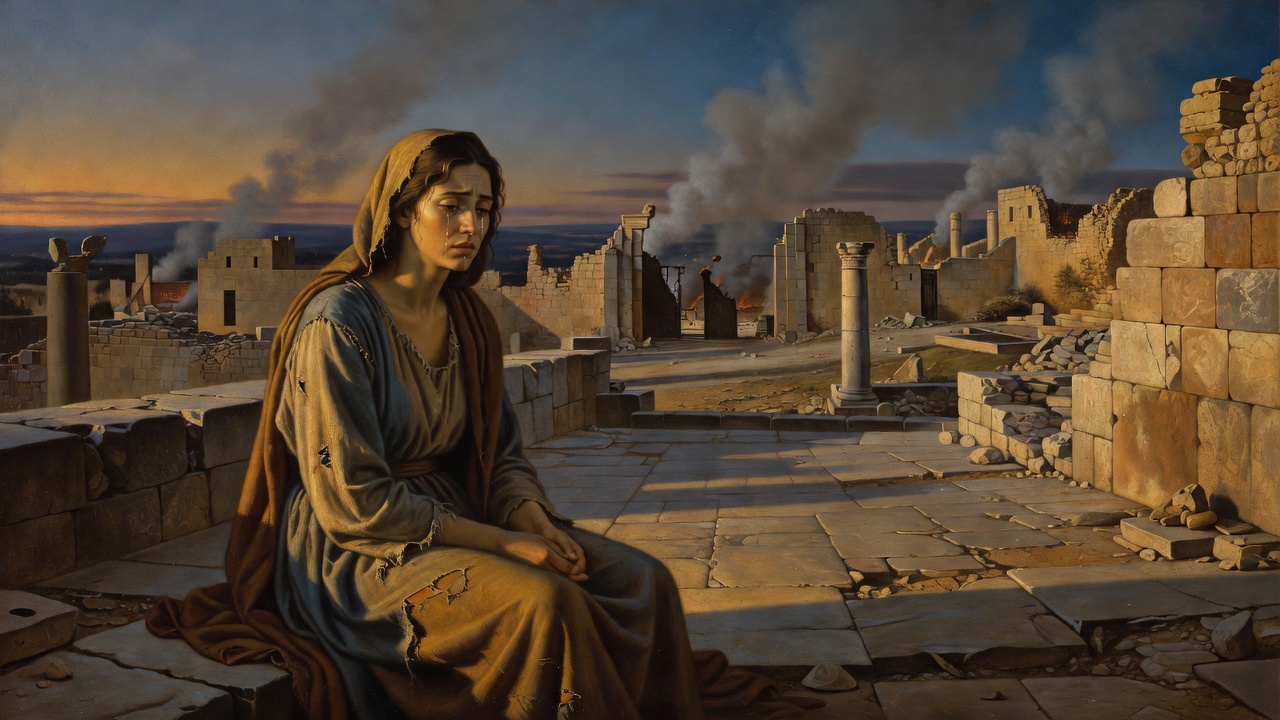
- In chapter 1 the prophet dwells on the many miseries under which the city sits as a solitary widow, weeping sorely. Chapter 2 describes those miseries in connection with the national sins that had caused them; chapter 3 speaks of hope for the people of God, that the chastisement would only be for their good and that a better day would dawn; chapter 4 laments the ruin and desolation of the city and the temple and traces it only to the people’s sins; and chapter 5 is a prayer that the reproach of Zion—the south-eastern hill of Jerusalem, called the city of David—might be taken away in the people’s repentance and recovery.Sources: Easton: Lamentations, Book of · Zion
- At the Wailing-place of the Jews in Jerusalem, a portion of the old wall of Solomon’s temple, Schaff reported that Jews assembled every Friday afternoon to bewail the fall of the holy city, kissing the stone wall and watering it with their tears, and that they repeated the Lamentations of Jeremiah and suitable psalms from worn Hebrew Bibles and prayer books.Sources: Easton: Lamentations, Book of
Notes written with AI assistance from open sources (Theographic Bible Metadata, CC BY-SA 4.0; Easton’s Bible Dictionary, public domain) and reviewed before publishing.
How Lonely Lies the City!
1How lonely lies the city,
once so full of people!
She who was great among the nations
has become a widow.
The princess of the provinces
has become a slave.
2She weeps aloud in the night,
with tears upon her cheeks.
Among all her lovers
there is no one to comfort her.
All her friends have betrayed her;
they have become her enemies.
3Judah has gone into exile
under affliction and harsh slavery;
she dwells among the nations
but finds no place to rest.
All her pursuers have overtaken her
in the midst of her distress.
4The roads to Zion mourn,
because no one comes to her appointed feasts.
All her gates are deserted;
her priests groan,
her maidens grieve,
and she herself is bitter with anguish.
5Her foes have become her masters;
her enemies are at ease.
For the LORD has brought her grief
because of her many transgressions.
Her children have gone away
as captives before the enemy.
6All the splendor has departed
from the Daughter of Zion.
Her princes are like deer
that find no pasture;
they lack the strength to flee
in the face of the hunter.
7In the days of her affliction and wandering
Jerusalem remembers all the treasures
that were hers in days of old.
When her people fell into enemy hands
she received no help.
Her enemies looked upon her,
laughing at her downfall.
8Jerusalem has sinned greatly;
therefore she has become an object of scorn.
All who honored her now despise her,
for they have seen her nakedness;
she herself groans and turns away.
9Her uncleanness stains her skirts;
she did not consider her end.
Her downfall was astounding;
there was no one to comfort her.
Look, O LORD, on my affliction,
for the enemy has triumphed!
10The adversary has seized
all her treasures.
For she has seen the nations
enter her sanctuary—
those You had forbidden
to enter Your assembly.
11All her people groan
as they search for bread.
They have traded their treasures for food
to keep themselves alive.
Look, O LORD, and consider,
for I have become despised.
12Is this nothing to you, all you who pass by?
Look around and see!
Is there any sorrow like mine,
which was inflicted on me,
which the LORD made me suffer
on the day of His fierce anger?
13He sent fire from on high,
and it overpowered my bones.
He spread a net for my feet
and turned me back.
He made me desolate,
faint all the day long.
14My transgressions are bound into a yoke,
knit together by His hand;
they are draped over my neck,
and the Lord has broken my strength.
He has delivered me into the hands
of those I cannot withstand.
15The Lord has rejected
all the mighty men in my midst;
He has summoned an army against me
to crush my young warriors.
Like grapes in a winepress,
the Lord has trampled the Virgin Daughter of Judah.
16For these things I weep;
my eyes flow with tears.
For there is no one nearby to comfort me,
no one to revive my soul.
My children are destitute
because the enemy has prevailed.
17Zion stretches out her hands,
but there is no one to comfort her.
The LORD has decreed against Jacob
that his neighbors become his foes.
Jerusalem has become
an unclean thing among them.
18The LORD is righteous,
for I have rebelled against His command.
Listen, all you people;
look upon my suffering.
My young men and maidens
have gone into captivity.
19I called out to my lovers,
but they have betrayed me.
My priests and elders
perished in the city
while they searched for food
to keep themselves alive.
20See, O LORD, how distressed I am!
I am churning within;
my heart is pounding within me,
for I have been most rebellious.
Outside, the sword bereaves;
inside, there is death.
21People have heard my groaning,
but there is no one to comfort me.
All my enemies have heard of my trouble;
they are glad that You have caused it.
May You bring the day You have announced,
so that they may become like me.
22Let all their wickedness come before You,
and deal with them
as You have dealt with me
because of all my transgressions.
For my groans are many,
and my heart is faint.
Did you know?
The Desolation of Jerusalem
- Lamentations portrays Jerusalem—also called Zion after the historic hill fortified by King David—as a grieving widow stripped of her majesty, abandoned by former allies, and forced into harsh servitude following the city's destruction.Sources: the Bible text itself · Jerusalem · Zion
- The poem highlights the cessation of religious life, noting that the roads leading to Zion lie empty because pilgrims no longer journey there for appointed festival feasts, while foreign invaders have entered and seized the sacred sanctuary.Sources: the Bible text itself · Zion
- During and after the siege, the surviving population experienced severe famine, with priests, elders, and common citizens trading their remaining family treasures just to obtain enough bread to survive.Sources: the Bible text itself
Notes written with AI assistance from open sources (Theographic Bible Metadata, CC BY-SA 4.0; Easton’s Bible Dictionary, public domain) and reviewed before publishing.
Places in this chapter
- Jerusalem · 31.777, 35.234 · verses 1, 5, 7, 8, 17, 18
- Zion · Today: Jerusalem · 31.777, 35.234 · verses 4, 6, 17
Only places identified with high confidence are shown (90% or more according to the scholarly sources compiled by OpenBible). Period map: DARE (Digital Atlas of the Roman Empire), CC BY 4.0; modern map: © OpenStreetMap contributors; places: OpenBible.info (CC BY 4.0).
Credits and license for this translation
Berean Standard Bible
The Holy Bible in English: Berean Standard Bible
Public Domain
Language: English
Contributor: BSB Publishing, LLC
2026-10-02
Source: http://ebible.org/engbsb/ · eBible.org