Jonah 1
Berean Standard Bible · Tap a verse to see its cross-references.
About this book
About Jonah
- Jonah, whose name means “a dove,” was the son of Amittai of Gath-hepher and a prophet of Israel. Easton's Bible Dictionary (1897) holds that he wrote the book himself. His ministry is placed very early in the reign of Jeroboam II: he was contemporary with Hosea and Amos, or possibly earlier, and so may have been the oldest of the prophets whose writings survive.Sources: Jonah · Amittai · Easton: Jonah, Book of
- The book professes to tell what actually happened to the prophet. Some critics have read it as a parable or allegory rather than history, because miracle is so prominent and the form is narrative rather than prophecy, or because they deny miracles altogether. Easton's Bible Dictionary (1897) instead treats it as history, attaching great weight to the mention of Jonah in Matthew 12:39-40 and Luke 11:29.Sources: Easton: Jonah, Book of
- Jonah was commissioned to go to Nineveh, described as a great and populous city and the flourishing capital of the Assyrian empire, but he sailed from Joppa, Judea's chief seaport, to flee toward Tarshish. Where Tarshish lay is disputed: some place it in the east, on the Indian coast, some identify it with Carthage, and Easton's dictionary takes it to be a Phoenician port in Spain.Sources: Easton: Jonah, Book of · Nineveh · Joppa · Tarshish
- Easton's outline has four movements: the divine commission, disobedience, and punishment; Jonah's prayer and deliverance; a second commission, the Ninevites' repentance, and God's sparing mercy; and Jonah's anger at that mercy, followed by a rebuke. The same dictionary notes that Nineveh was spared for more than a century after his mission.Sources: Easton: Jonah, Book of
- As a prophet of Israel, Jonah foretold the restoration of the kingdom's ancient borders. A biographical note presents him both as a missionary to Nineveh and as a type of the Son of man. The book of Nahum is taken up almost entirely with denunciations of that city, and Zephaniah also predicts its destruction.Sources: Jonah · Nineveh
Notes written with AI assistance from open sources (Theographic Bible Metadata, CC BY-SA 4.0; Easton’s Bible Dictionary, public domain) and reviewed before publishing.
Jonah Flees from the LORD
1Now the word of the LORD came to Jonah son of Amittai, saying, 2“Get up! Go to the great city of Nineveh and preach against it, because its wickedness has come up before Me.”
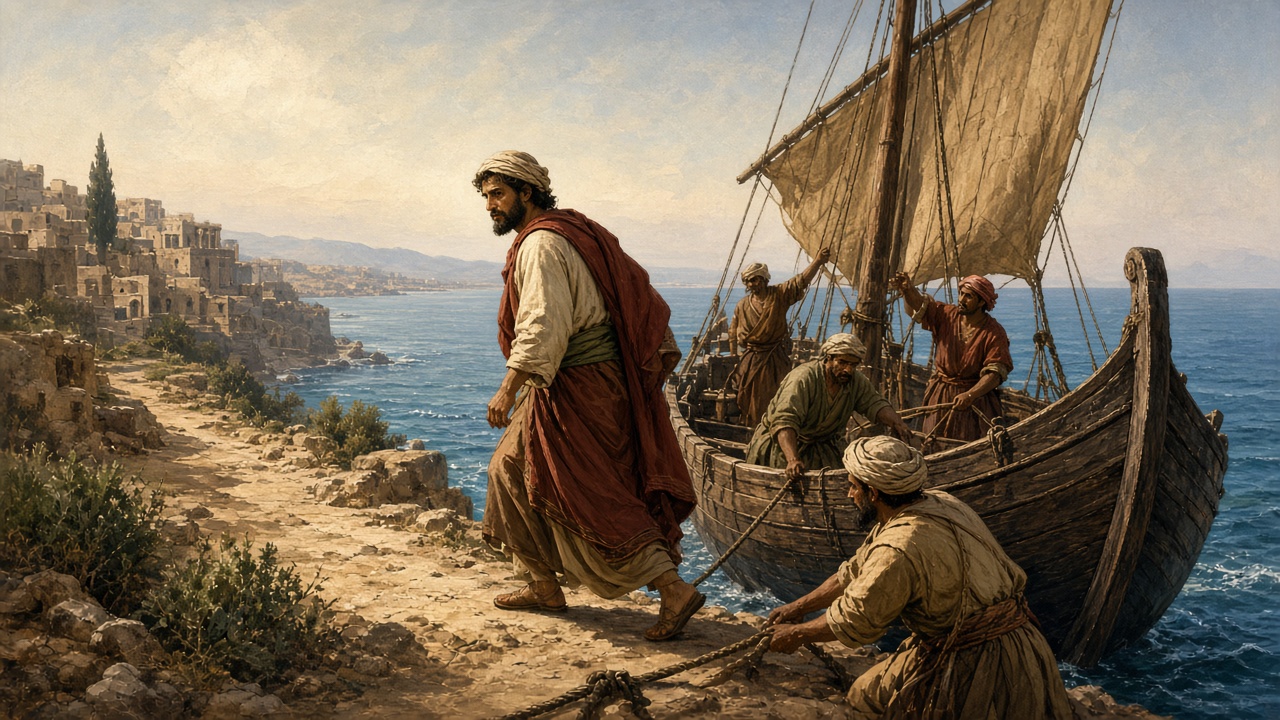
3Jonah, however, got up to flee to Tarshish, away from the presence of the LORD. He went down to Joppa and found a ship bound for Tarshish. So he paid the fare and went aboard to sail for Tarshish, away from the presence of the LORD.
The Great Storm
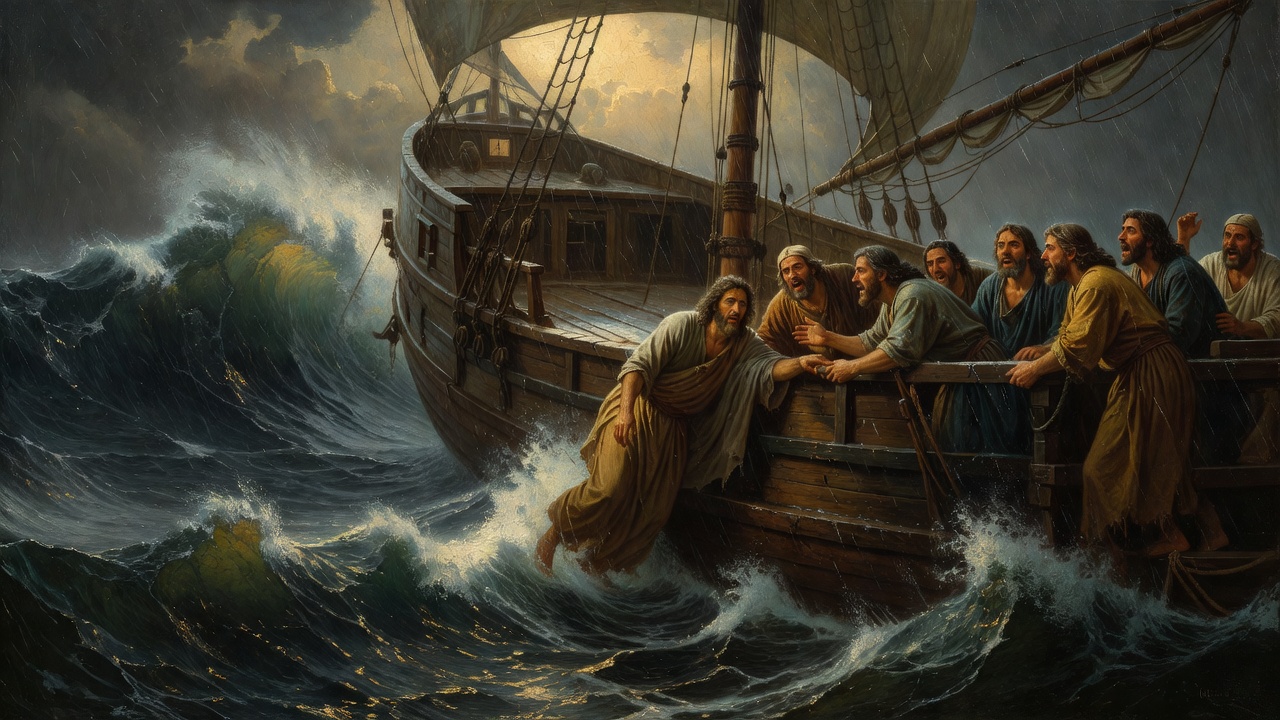
4Then the LORD hurled a great wind upon the sea, and such a violent storm arose that the ship was in danger of breaking apart. 5The sailors were afraid, and each cried out to his own god. And they threw the ship’s cargo into the sea to lighten the load. But Jonah had gone down to the lowest part of the vessel, where he lay down and fell into a deep sleep.
6The captain approached him and said, “How can you sleep? Get up and call upon your God. Perhaps this God will consider us, so that we may not perish.”
7“Come!” said the sailors to one another. “Let us cast lots to find out who is responsible for this calamity that is upon us.”
So they cast lots, and the lot fell on Jonah.
8“Tell us now,” they demanded, “who is to blame for this calamity that is upon us? What is your occupation, and where have you come from? What is your country, and who are your people?”
9“I am a Hebrew,” replied Jonah. “I worship the LORD, the God of the heavens, who made the sea and the dry land.”
10Then the men were even more afraid and said to him, “What have you done?” The men knew that he was fleeing from the presence of the LORD, because he had told them.
Jonah Cast into the Sea
11Now the sea was growing worse and worse, so they said to Jonah, “What must we do to you to calm this sea for us?”
12“Pick me up,” he answered, “and cast me into the sea, so it may quiet down for you. For I know that I am to blame for this violent storm that has come upon you.”
13Nevertheless, the men rowed hard to get back to dry land, but they could not, for the sea was raging against them more and more.
14So they cried out to the LORD: “Please, O LORD, do not let us perish on account of this man’s life! Do not charge us with innocent blood! For You, O LORD, have done as You pleased.”
15At this, they picked up Jonah and cast him into the sea, and the raging sea grew calm.
16Then the men feared the LORD greatly, and they offered a sacrifice to the LORD and made vows to Him.
17Now the LORD had appointed a great fish to swallow Jonah, and Jonah spent three days and three nights in the belly of the fish.
Did you know?
Jonah Flees from the Lord
- Jonah, the son of Amittai from Gath-hepher, is also recorded in 2 Kings 14:25 as a prophet active in the northern kingdom of Israel during the reign of Jeroboam II. God instructed him to travel east to Nineveh, the prominent and populous capital of the Assyrian empire, to preach against its wickedness.Sources: Jonah · Amittai · Nineveh · the Bible text itself
- Rather than traveling northeast overland to Nineveh, Jonah journeyed down to the Mediterranean seaport of Joppa to board a ship for Tarshish. Tarshish is traditionally identified as a Phoenician trading port located far to the west in southern Spain, representing the exact opposite direction.Sources: Joppa · Tarshish · the Bible text itself
- The sailors aboard the cargo ship came from polytheistic backgrounds, each calling out to his own deity during the violent tempest. After throwing the ship's cargo overboard to lighten the vessel, they turned to the ancient practice of casting lots to determine who was responsible for the calamity.Sources: the Bible text itself
Notes written with AI assistance from open sources (Theographic Bible Metadata, CC BY-SA 4.0; Easton’s Bible Dictionary, public domain) and reviewed before publishing.
Places in this chapter
Only places identified with high confidence are shown (90% or more according to the scholarly sources compiled by OpenBible). Period map: DARE (Digital Atlas of the Roman Empire), CC BY 4.0; modern map: © OpenStreetMap contributors; places: OpenBible.info (CC BY 4.0).
Credits and license for this translation
Berean Standard Bible
The Holy Bible in English: Berean Standard Bible
Public Domain
Language: English
Contributor: BSB Publishing, LLC
2026-10-02
Source: http://ebible.org/engbsb/ · eBible.org