Esther 1
Berean Standard Bible · Tap a verse to see its cross-references.
About this book
About Esther
- Easton's Bible Dictionary (1897) places the deliverance recorded in Esther about fifty-two years after the Return, in the year of the battles of Plataea and Mycale (B.C. 479). It identifies Ahasuerus, in all probability, with Xerxes, son of Darius Hystaspes, who succeeded his father in B.C. 485 and reigned twenty-one years (B.C. 486–465). In the Septuagint the name Artaxerxes occurs for Ahasuerus.Sources: Easton: Esther · Ahasuerus
- The story is set in the Persian empire of Ahasuerus, who ruled Persia, Media, and Babylonia from India to Ethiopia. Most of the events take place at Susa, called Shushan in the palace, once the capital of Elam and now the ruins of Shush, east of the Tigris. Esther's family had not used the permission Cyrus gave the exiles to return to Jerusalem; she lived there with her cousin Mordecai, who held an office in the king's household.Sources: Ahasuerus · Susa · Easton: Esther
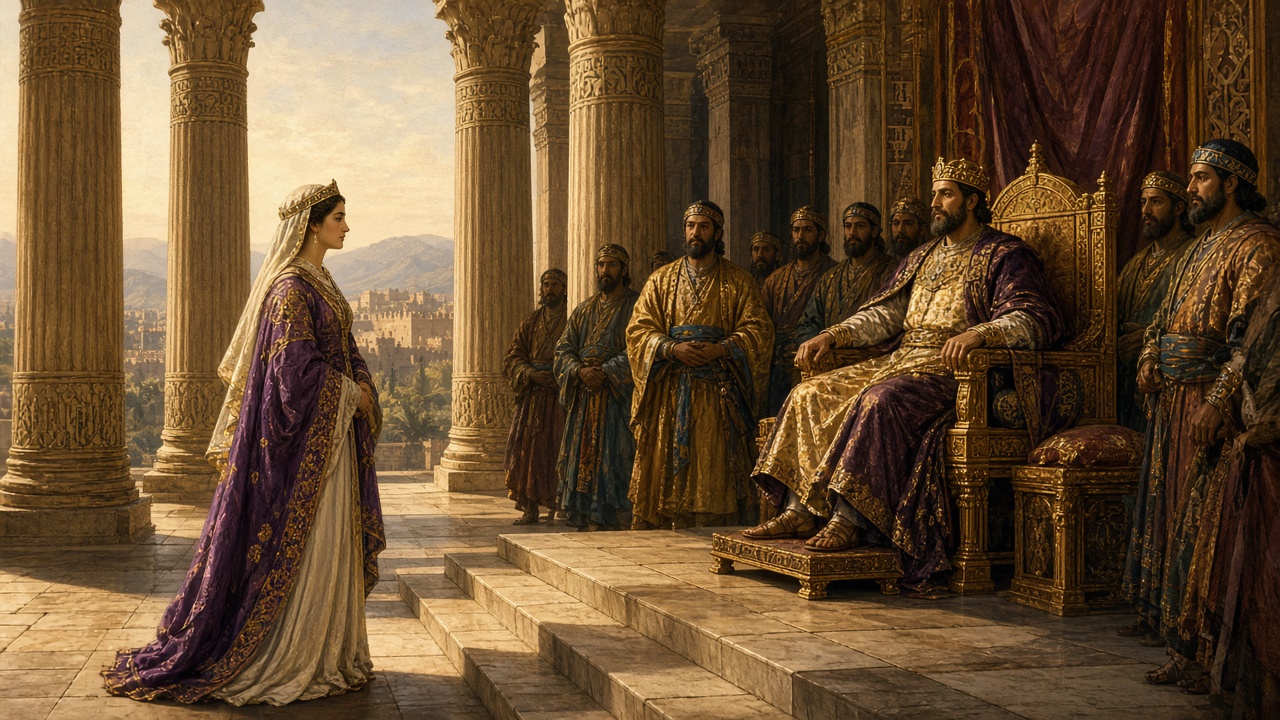
- After Ahasuerus divorced Vashti because she refused to appear in the banqueting hall of the palace, he chose Esther as his queen. Haman the Agagite, his vizier, was then given power to kill the Jews throughout the empire; Esther's intervention averted that catastrophe, and Haman was hanged on the gallows he had prepared for Mordecai. The Jews established the annual feast of Purim in memory of their deliverance.Sources: Easton: Esther · Vashti · Haman
- Esther was a Benjamite Jewess, the daughter of Abihail, whose Hebrew name Hadassah means myrtle; the name Esther is a Syro-Arabian modification of the Persian word satarah, which means a star. Haman, the son of Hammedatha, is called an Agagite, which the sources take to suggest descent from the royal family of the Amalekites, described as the bitterest enemies of the Jews.Sources: Easton: Esther · Haman · Hammedatha
Notes written with AI assistance from open sources (Theographic Bible Metadata, CC BY-SA 4.0; Easton’s Bible Dictionary, public domain) and reviewed before publishing.
Xerxes’ Royal Feast
1This is what happened in the days of Xerxes, who reigned over 127 provinces from India to Cush. 2In those days King Xerxes sat on his royal throne in the citadel of Susa.
3In the third year of his reign, Xerxes held a feast for all his officials and servants. The military leaders of Persia and Media were there, along with the nobles and princes of the provinces. 4And for a full 180 days he displayed the glorious riches of his kingdom and the magnificent splendor of his greatness.
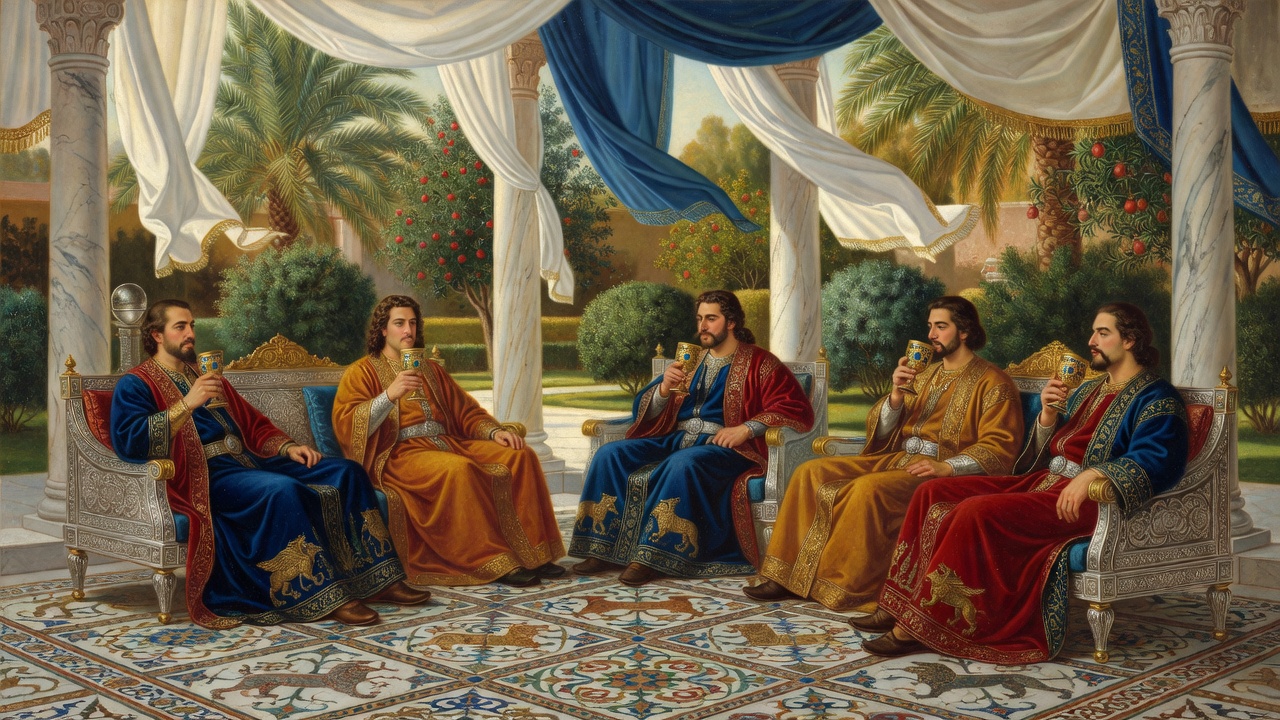
5At the end of this time, in the garden court of the royal palace, the king held a seven-day feast for all the people in the citadel of Susa, from the least to the greatest. 6Hangings of white and blue linen were fastened with cords of fine white and purple material to silver rings on the marble pillars. Gold and silver couches were arranged on a mosaic pavement of porphyry, marble, mother-of-pearl, and other costly stones.
7Beverages were served in an array of goblets of gold, each with a different design, and the royal wine flowed freely, according to the king’s bounty. 8By order of the king, no limit was placed on the drinking, and every official of his household was to serve each man whatever he desired.
Queen Vashti’s Refusal
9Queen Vashti also gave a banquet for the women in the royal palace of King Xerxes.
10On the seventh day, when the king’s heart was merry with wine, he ordered the seven eunuchs who served him—Mehuman, Biztha, Harbona, Bigtha, Abagtha, Zethar, and Carkas— 11to bring Queen Vashti before him, wearing her royal crown, to display her beauty to the people and officials. For she was beautiful to behold.
12Queen Vashti, however, refused to come at the king’s command brought by his eunuchs. And the king became furious, and his anger burned within him.
Queen Vashti Deposed
13Then the king consulted the wise men who knew the times, for it was customary for him to confer with the experts in law and justice. 14His closest advisors were Carshena, Shethar, Admatha, Tarshish, Meres, Marsena, and Memucan, the seven princes of Persia and Media who had personal access to the king and ranked highest in the kingdom.
15“According to law,” he asked, “what should be done with Queen Vashti, since she refused to obey the command of King Xerxes delivered by the eunuchs?”
16And in the presence of the king and his princes, Memucan replied, “Queen Vashti has wronged not only the king, but all the princes and the peoples in all the provinces of King Xerxes. 17For the conduct of the queen will become known to all women, causing them to despise their husbands and say, ‘King Xerxes ordered Queen Vashti to be brought before him, but she did not come.’
18This very day the noble women of Persia and Media who have heard about the queen’s conduct will say the same thing to all the king’s officials, resulting in much contempt and wrath.
19So if it pleases the king, let him issue a royal decree, and let it be recorded in the laws of Persia and Media so that it cannot be repealed, that Vashti shall never again enter the presence of King Xerxes, and that her royal position shall be given to a woman better than she. 20The edict the king issues will be heard throughout his vast kingdom—and so all women, from the least to the greatest, will honor their husbands.”
21The king and his princes were pleased with this counsel; so the king did as Memucan had advised. 22He sent letters to all the provinces of the kingdom, to each province in its own script and to each people in their own language, proclaiming that every man should be master of his own household.
Did you know?
The King's Banquet and Vashti's Defiance
- King Ahasuerus is widely identified with Xerxes I (reigned 486–465 BC), who ruled an empire stretching across 127 provinces from the Indus region to Cush (Ethiopia). Most of the events recorded in the Book of Esther take place in the royal citadel of Susa.Sources: Ahasuerus · Susa · India · the Bible text itself
- In his third year, the king held a 180-day display of his kingdom's splendor, followed by a seven-day feast in the palace garden court in Susa. The lavish courtyard was decorated with fine linen hangings and gold and silver couches arranged on an elaborate mosaic floor of costly stones.Sources: the Bible text itself · Susa
- When Queen Vashti refused to appear before the king and his guests, the counselor Memucan advised issuing an unalterable decree under the laws of Persia and Media to depose her. Official letters announcing the decision were sent to all imperial provinces, each written in its own script and language.Sources: Memucan · Vashti · the Bible text itself
Notes written with AI assistance from open sources (Theographic Bible Metadata, CC BY-SA 4.0; Easton’s Bible Dictionary, public domain) and reviewed before publishing.
Places in this chapter
- Ethiopia · 16.935, 33.751 · verse 1
- India · 23.994, 67.431 · verse 1
- Susa · Today: Shush · 32.189, 48.258 · verses 2, 5
- Media · 34.806, 48.516 · verses 3, 14, 18, 19
- Persia · 34.806, 48.516 · verses 3, 14, 18, 19
Only places identified with high confidence are shown (90% or more according to the scholarly sources compiled by OpenBible). Period map: DARE (Digital Atlas of the Roman Empire), CC BY 4.0; modern map: © OpenStreetMap contributors; places: OpenBible.info (CC BY 4.0).
Credits and license for this translation
Berean Standard Bible
The Holy Bible in English: Berean Standard Bible
Public Domain
Language: English
Contributor: BSB Publishing, LLC
2026-10-02
Source: http://ebible.org/engbsb/ · eBible.org