Colossians 1
Berean Standard Bible · Tap a verse to see its cross-references.
About this book
About Colossians
- Easton's Bible Dictionary (1897) presents the Epistle to the Colossians as written by Paul at Rome during his first imprisonment there, probably in the spring of A.D. 57 or, as some think, in 62, and soon after the Epistle to the Ephesians. It says the letter followed news that had reached him about the inner life of the church there.Sources: Easton: Colossians, Epistle to the
- Colossae was a city of Phrygia on the Lycus, a tributary of the Maeander, about twelve miles above Laodicea and near the great road from Ephesus to the Euphrates, which gave it some mercantile importance. The Colossae entry says Paul does not appear to have visited the city when he wrote, and that Epaphras has been concluded to be the founder of the church. Paul calls Epaphras his dear fellow-servant and a faithful minister of Christ, and Epaphras was with him at Rome when the letter was written.Sources: Colossae · Epaphras
- Easton says the object was to counteract false teaching: a large part answers those who tried to combine Oriental mysticism and asceticism with Christianity, promising a higher spiritual life and a deeper insight into the world of spirits, and the mention of the new moon and sabbath days is taken to show Judaizing teachers as well. The doctrinal part is the first two chapters, with the main theme in chapter 2: a warning not to be drawn away from the one in whom, Easton writes, all the fulness of the Godhead dwelt, the head of all spiritual powers and of the body of which they were members. The practical part, chapters 3 and 4, urges duties that flow from those teachings, including minding things above and putting on the new man.Sources: Easton: Colossians, Epistle to the
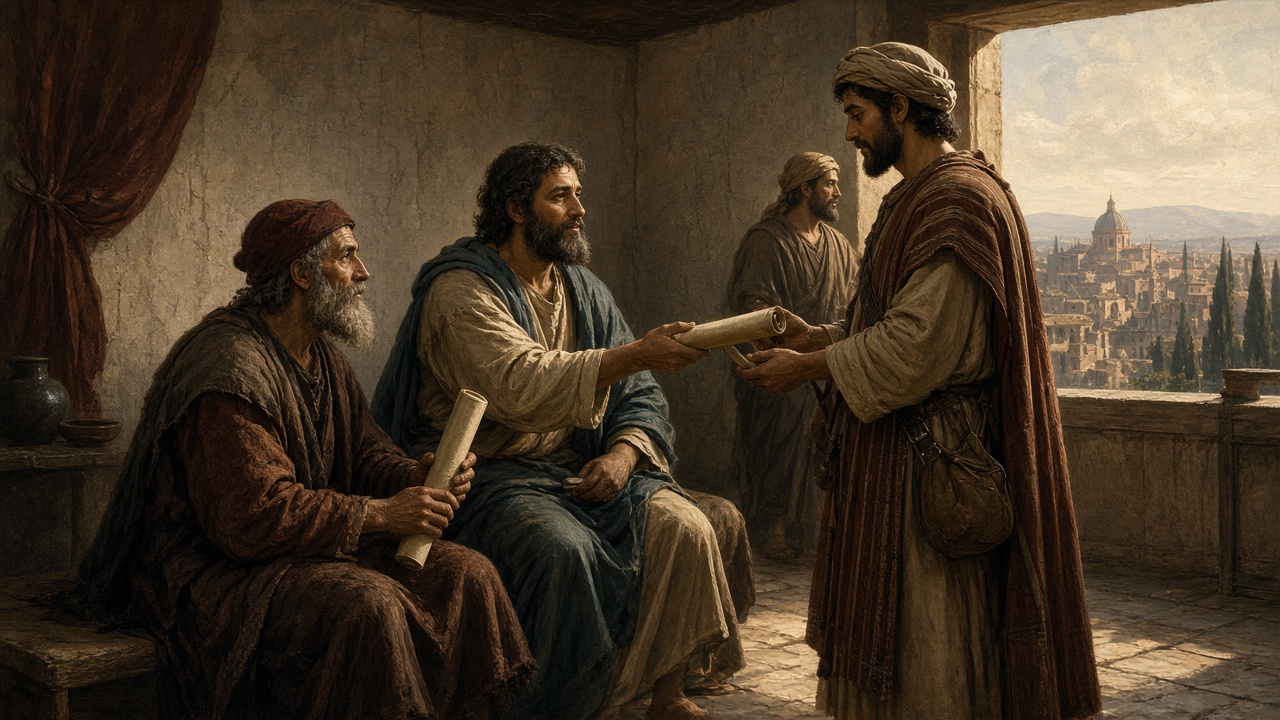
- Tychicus, an Asiatic Christian called a faithful minister, was the bearer of the letter, as he was also of the letters to the Ephesians and to Philemon, and he was to tell the church of the apostle's condition. Easton notes that, after friendly greetings, Paul asks them to exchange this letter with the one he had sent to the neighbouring church of Laodicea, and that there is a remarkable resemblance between this epistle and the one to the Ephesians.Sources: Easton: Colossians, Epistle to the · Tychicus
Notes written with AI assistance from open sources (Theographic Bible Metadata, CC BY-SA 4.0; Easton’s Bible Dictionary, public domain) and reviewed before publishing.
Greetings from Paul and Timothy
1Paul, an apostle of Christ Jesus by the will of God, and Timothy our brother,
2To the saints and faithful brothers in Christ at Colossae:
Grace and peace to you from God our Father.
Thanksgiving and Prayer
3We always thank God, the Father of our Lord Jesus Christ, when we pray for you, 4because we have heard about your faith in Christ Jesus and your love for all the saints— 5the faith and love proceeding from the hope stored up for you in heaven, of which you have already heard in the word of truth, the gospel 6that has come to you.
All over the world this gospel is bearing fruit and growing, just as it has been doing among you since the day you heard it and truly understood the grace of God. 7You learned it from Epaphras, our beloved fellow servant, who is a faithful minister of Christ on our behalf, 8and who also informed us of your love in the Spirit.
9For this reason, since the day we heard about you, we have not stopped praying for you and asking God to fill you with the knowledge of His will in all spiritual wisdom and understanding, 10so that you may walk in a manner worthy of the Lord and may please Him in every way: bearing fruit in every good work, growing in the knowledge of God, 11being strengthened with all power according to His glorious might so that you may have full endurance and patience, and joyfully 12giving thanks to the Father, who has qualified you to share in the inheritance of the saints in the light.
13He has rescued us from the dominion of darkness and brought us into the kingdom of His beloved Son, 14in whom we have redemption, the forgiveness of sins.
The Supremacy of the Son
15The Son is the image of the invisible God, the firstborn over all creation. 16For in Him all things were created, things in heaven and on earth, visible and invisible, whether thrones or dominions or rulers or authorities. All things were created through Him and for Him.
17He is before all things, and in Him all things hold together. 18And He is the head of the body, the church; He is the beginning and firstborn from among the dead, so that in all things He may have preeminence. 19For God was pleased to have all His fullness dwell in Him, 20and through Him to reconcile to Himself all things, whether things on earth or things in heaven, by making peace through the blood of His cross.
21Once you were alienated from God and were hostile in your minds, engaging in evil deeds. 22But now He has reconciled you by Christ’s physical body through death to present you holy, unblemished, and blameless in His presence— 23if indeed you continue in your faith, established and firm, not moved from the hope of the gospel you heard, which has been proclaimed to every creature under heaven, and of which I, Paul, have become a servant.
Paul’s Suffering for the Church
24Now I rejoice in my sufferings for you, and I fill up in my flesh what is lacking in regard to Christ’s afflictions for the sake of His body, which is the church. 25I became its servant by the commission God gave me to fully proclaim to you the word of God, 26the mystery that was hidden for ages and generations but is now revealed to His saints. 27To them God has chosen to make known among the Gentiles the glorious riches of this mystery, which is Christ in you, the hope of glory.
28We proclaim Him, admonishing and teaching everyone with all wisdom, so that we may present everyone perfect in Christ. 29To this end I also labor, striving with all His energy working powerfully within me.
Did you know?
The Preeminence of Christ and the Church at Colossae
- Colossae was a city of Phrygia on the Lycus, a tributary of the Maeander, about twelve miles above Laodicea and near the great road from Ephesus to the Euphrates, and therefore of some mercantile importance. Easton's Bible Dictionary (1897) notes that Paul does not appear to have visited the city when he wrote this letter, which fits his saying that he had heard of their faith and love, and that in the letter to Philemon he hopes to visit once delivered from imprisonment.Sources: Colossae · the Bible text itself
- The Colossians had learned the gospel from Epaphras, whom Paul calls a beloved fellow servant and a faithful minister of Christ, and who also informed them of their love in the Spirit. Easton's Bible Dictionary (1897) describes Epaphras as a distinguished disciple and probably the founder of that church, and concludes that he was with Paul at Rome when this letter was written; in the letter to Philemon, Paul calls him a fellow-prisoner.Sources: Epaphras · Colossae · the Bible text itself
- The greeting names Timothy, our brother, together with Paul. Easton's Bible Dictionary (1897) describes him as a young disciple whose name means honouring God, a companion on many of Paul's journeys, with a Greek father and with a mother and grandmother, Eunice and Lois, mentioned for their piety.Sources: Timotheus · the Bible text itself
Notes written with AI assistance from open sources (Theographic Bible Metadata, CC BY-SA 4.0; Easton’s Bible Dictionary, public domain) and reviewed before publishing.
Places in this chapter
- Colossae · 37.787, 29.260 · verse 2
Only places identified with high confidence are shown (90% or more according to the scholarly sources compiled by OpenBible). Period map: DARE (Digital Atlas of the Roman Empire), CC BY 4.0; modern map: © OpenStreetMap contributors; places: OpenBible.info (CC BY 4.0).
Credits and license for this translation
Berean Standard Bible
The Holy Bible in English: Berean Standard Bible
Public Domain
Language: English
Contributor: BSB Publishing, LLC
2026-10-02
Source: http://ebible.org/engbsb/ · eBible.org