Acts 1
Berean Standard Bible · Tap a verse to see its cross-references.
About this book
About Acts
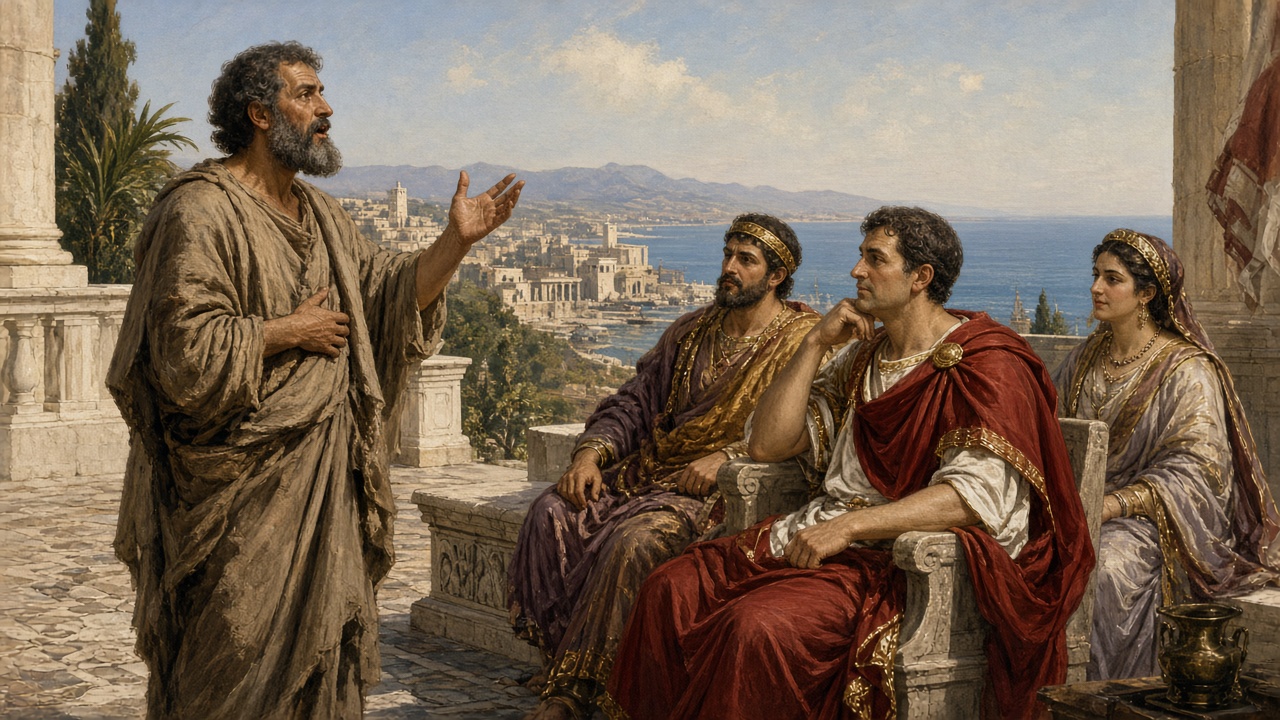
- Ancient tradition, which Easton's Bible Dictionary (1897) calls uniform, attributes Acts to Luke, the "beloved physician," although the writer never names himself. Easton notes that the style and the words and phrases shared by Luke's Gospel and Acts support that view. Easton says the narrator first appears at Acts 16:11, later travels with Paul, including at Rome, and wrote much of that history from personal observation, drawing on Paul's instruction for what lay beyond his own experience.Sources: Easton: Acts of the Apostles
- Easton's Bible Dictionary (1897) dates the writing no earlier than A.D. 61 or 62, because the narrative extends to the close of the second year of Paul's first imprisonment at Rome.Sources: Easton: Acts of the Apostles
- Antioch in Syria, on the river Orontes about sixteen miles from the Mediterranean and some three hundred miles north of Jerusalem, is described as ranking third, after Rome and Alexandria, among the cities of the Roman empire. Christianity was introduced there early, and the name "Christian" was first applied in that city to those who professed the faith. Caesarea, built by Herod the Great on the Mediterranean shore and the seat of the Roman procurators of Judea, is where Festus, successor of Felix in A.D. 60, heard the prisoner Paul and sent him to Rome after Paul appealed to Caesar.Sources: Antioch (Syria) · Caesarea · Portius Festus
- Easton presents Acts as the sequel to Luke's Gospel: that Gospel ends with Jesus taken up from his disciples into heaven, and the opening of Acts expands those closing words. He describes the book as continuing the history of the church after the ascension and as illustrating the gospel preached among all nations, "beginning at Jerusalem." In his account it is only a book of beginnings, a history of the founding of churches and a cycle of "representative events," and it follows Peter and Paul rather than all the apostles.Sources: Easton: Acts of the Apostles
- The book was early called "The Acts," "The Gospel of the Holy Ghost," and "The Gospel of the Resurrection." Easton observes that the later title "Acts of the Apostles" is broader than the contents, since John is noticed only three times and all that is recorded of James, the son of Zebedee, is his execution by Herod.Sources: Easton: Acts of the Apostles
Notes written with AI assistance from open sources (Theographic Bible Metadata, CC BY-SA 4.0; Easton’s Bible Dictionary, public domain) and reviewed before publishing.
Prologue
1In my first book, O Theophilus, I wrote about all that Jesus began to do and to teach, 2until the day He was taken up to heaven, after giving instructions through the Holy Spirit to the apostles He had chosen. 3After His suffering, He presented Himself to them with many convincing proofs that He was alive. He appeared to them over a span of forty days and spoke about the kingdom of God.
4And while they were gathered together, He commanded them: “Do not leave Jerusalem, but wait for the gift the Father promised, which you have heard Me discuss. 5For John baptized with water, but in a few days you will be baptized with the Holy Spirit.”
The Ascension
6So when they came together, they asked Him, “Lord, will You at this time restore the kingdom to Israel?”
7Jesus replied, “It is not for you to know times or seasons that the Father has fixed by His own authority. 8But you will receive power when the Holy Spirit comes upon you, and you will be My witnesses in Jerusalem, and in all Judea and Samaria, and to the ends of the earth.”
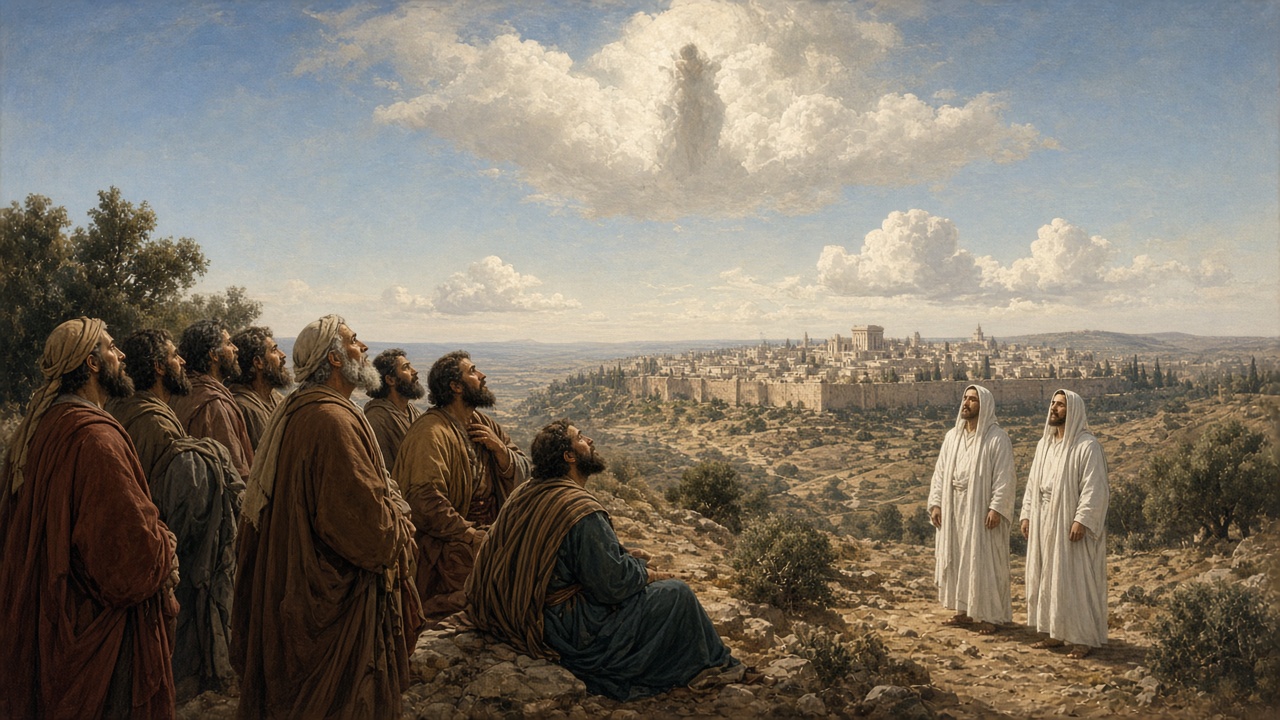
9After He had said this, they watched as He was taken up, and a cloud hid Him from their sight. 10They were looking intently into the sky as He was going, when suddenly two men dressed in white stood beside them. 11“Men of Galilee,” they said, “why do you stand here looking into the sky? This same Jesus, who has been taken from you into heaven, will come back in the same way you have seen Him go into heaven.”
Matthias Replaces Judas
12Then they returned to Jerusalem from the Mount of Olives, which is near the city, a Sabbath day’s journey away. 13When they arrived, they went to the upper room where they were staying: Peter and John, James and Andrew, Philip and Thomas, Bartholomew and Matthew, James son of Alphaeus, Simon the Zealot, and Judas son of James. 14With one accord they all continued in prayer, along with the women and Mary the mother of Jesus, and with His brothers.
15In those days Peter stood up among the brothers (a gathering of about a hundred and twenty) and said, 16“Brothers, the Scripture had to be fulfilled which the Holy Spirit foretold through the mouth of David concerning Judas, who became a guide for those who arrested Jesus. 17He was one of our number and shared in this ministry.”
18(Now with the reward for his wickedness Judas bought a field; there he fell headlong and burst open in the middle, and all his intestines spilled out. 19This became known to all who lived in Jerusalem, so they called that field in their own language Akeldama, that is, Field of Blood.)
20“For it is written in the book of Psalms:
‘May his place be deserted;
let there be no one to dwell in it,’
and,
‘May another take his position.’
21Therefore it is necessary to choose one of the men who have accompanied us the whole time the Lord Jesus went in and out among us, 22beginning from John’s baptism until the day Jesus was taken up from us. For one of these must become a witness with us of His resurrection.”
23So they proposed two men: Joseph called Barsabbas (also known as Justus) and Matthias. 24And they prayed, “Lord, You know everyone’s heart. Show us which of these two You have chosen 25to take up this ministry and apostleship, which Judas abandoned to go to his rightful place.”
26Then they cast lots, and the lot fell to Matthias; so he was added to the eleven apostles.
Did you know?
Waiting in Jerusalem after the Ascension
- This chapter opens as a sequel: the writer tells Theophilus that his first book covered all that Jesus began to do and to teach until the day he was taken up to heaven. Easton's Bible Dictionary (1897) says Luke dedicated both that Gospel and Acts to Theophilus, a name meaning "lover of God," and describes him as a Christian, probably a Roman, of whom nothing else is known. From the title "most excellent," the same title Paul uses for the governors Felix and Festus, the dictionary reports that it has been concluded he was a person of rank, perhaps a Roman officer.Sources: Theophilus · the Bible text itself
- Jesus tells the apostles they will be his witnesses in Jerusalem, in all Judea and Samaria, and to the ends of the earth, and the two men in white address them as "men of Galilee." In the Roman period Judea was the southernmost of the three divisions of Palestine, distinguished from Galilee and Samaria, though the name was sometimes used for the whole land, and it was part of the province of Syria. Galilee, called Galil by the Jews, had long been known as "Galilee of the Gentiles" because its original inhabitants remained there.Sources: the Bible text itself · Judea · Galilee
- Peter says Judas, one of their number, became a guide for those who arrested Jesus and then abandoned his place in the ministry. Acts records that with the reward for his wickedness Judas bought a field, fell headlong, and died there, and that the people of Jerusalem called that field Akeldama, "Field of Blood," in their own language. Easton's Bible Dictionary identifies that language as Aramaic, notes that the field had previously been called the potter's field and was set aside as a burial place for strangers, and places it on a narrow level terrace on the south face of the valley of Hinnom.Sources: the Bible text itself · Akeldama
Notes written with AI assistance from open sources (Theographic Bible Metadata, CC BY-SA 4.0; Easton’s Bible Dictionary, public domain) and reviewed before publishing.
Places in this chapter
- Jerusalem · 31.777, 35.234 · verses 4, 8, 12, 13, 19
- Judea · Today: Judea 1 · 31.777, 35.234 · verse 8
- Samaria · Today: Samaria 2 · 32.276, 35.195 · verse 8
- Galilee · 32.760, 35.527 · verse 11
- Mount of Olives · 31.778, 35.246 · verse 12
Only places identified with high confidence are shown (90% or more according to the scholarly sources compiled by OpenBible). Period map: DARE (Digital Atlas of the Roman Empire), CC BY 4.0; modern map: © OpenStreetMap contributors; places: OpenBible.info (CC BY 4.0).
Credits and license for this translation
Berean Standard Bible
The Holy Bible in English: Berean Standard Bible
Public Domain
Language: English
Contributor: BSB Publishing, LLC
2026-10-02
Source: http://ebible.org/engbsb/ · eBible.org