Matthew 5
Wycliffe Bible · Tap a verse to see its cross-references.
The Sermon on the Mount
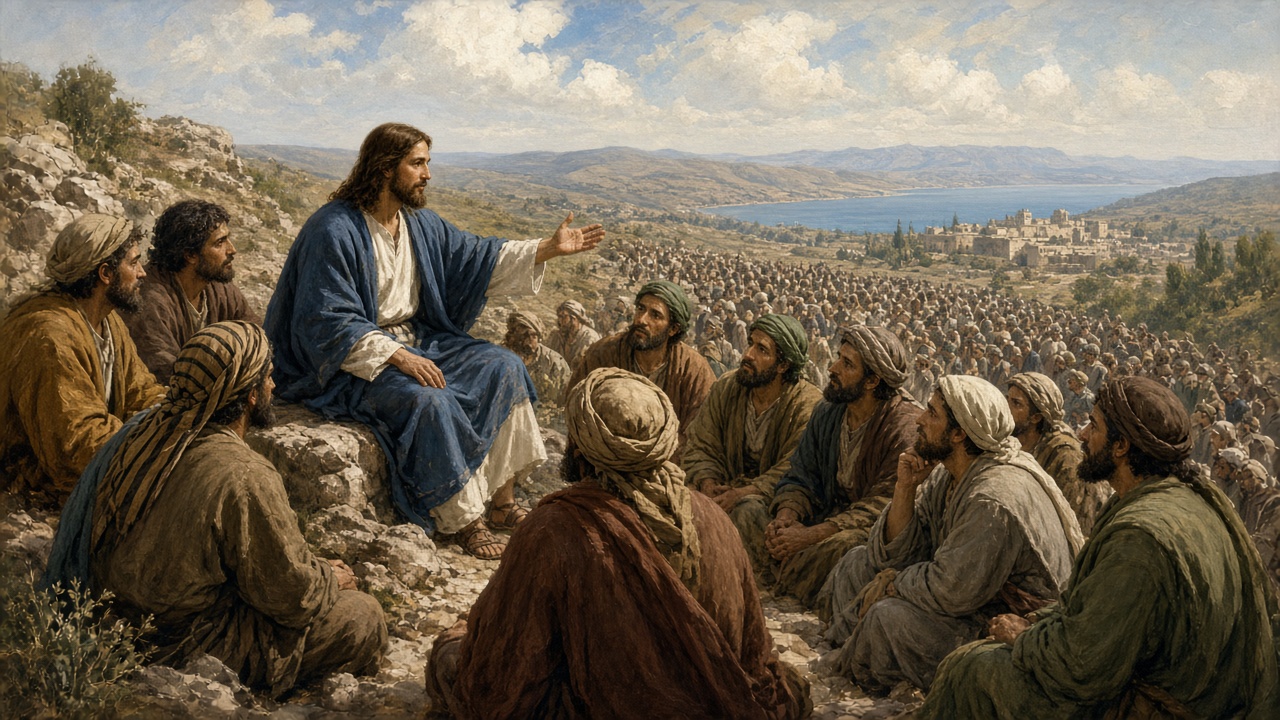
1And Jhesus, seynge the puple, wente vp in to an hil; and whanne he was set, hise disciplis camen to hym. 2And he openyde his mouth, and tauyte hem, and seide,
The Beatitudes
3Blessed ben pore men in spirit, for the kyngdom of heuenes is herne. 4Blessid ben mylde men, for thei schulen welde the erthe. 5Blessid ben thei that mornen, for thei schulen be coumfortid. 6Blessid ben thei that hungren and thristen riytwisnesse, for thei schulen be fulfillid. 7Blessid ben merciful men, for thei schulen gete merci. 8Blessid ben thei that ben of clene herte, for thei schulen se God. 9Blessid ben pesible men, for thei schulen be clepid Goddis children. 10Blessid ben thei that suffren persecusioun for riytfulnesse, for the kingdam of heuenes is herne. 11`Ye schulen be blessid, whanne men schulen curse you, and schulen pursue you, and shulen seie al yuel ayens you liynge, for me. 12Ioie ye, and be ye glad, for youre meede is plenteuouse in heuenes; for so thei han pursued `also profetis that weren bifor you.
Salt and Light
13Ye ben salt of the erthe; that if the salt vanysche awey, whereynne schal it be saltid? To no thing it is worth ouere, no but that it be cast out, and be defoulid of men. 14Ye ben liyt of the world; a citee set on an hil may not be hid; 15ne me teendith not a lanterne, and puttith it vndur a busschel, but on a candilstike, that it yyue liyt to alle that ben in the hous. 16So schyne youre liyt befor men, that thei se youre goode werkis, and glorifie youre fadir that is in heuenes.
The Fulfillment of the Law
17Nil ye deme, that Y cam to vndo the lawe, or the profetis; Y cam not to vndo the lawe, but to fulfille. 18Forsothe Y seie to you, til heuene and erthe passe, o lettir or o titel shal not passe fro the lawe, til alle thingis be doon. 19Therfor he that brekith oon of these leeste maundementis, and techith thus men, schal be clepid the leste in the rewme of heuenes; `but he that doith, and techith, schal be clepid greet in the kyngdom of heuenes. 20And Y seie to you, that but your riytfulnesse be more plenteuouse than of scribis and of Farisees, ye schulen not entre into the kyngdom of heuenes.
Anger and Reconciliation
21Ye han herd that it was seid to elde men, Thou schalt not slee; and he that sleeth, schal be gilti to doom. 22But Y seie to you, that ech man that is wrooth to his brothir, schal be gilti to doom; and he that seith to his brother, Fy! schal be gilti to the counseil; but he that seith, Fool, schal be gilti to the fier of helle. 23Therfor if thou offrist thi yifte `at the auter, and ther thou bithenkist, that thi brothir hath sum what ayens thee, 24leeue there thi yifte bifor the auter, and go first to be recounselid to thi brothir, and thanne thou schalt come, and schalt offre thi yifte. 25Be thou consentynge to thin aduersarie soone, while thou art in the weie with hym, lest perauenture thin aduersarie take thee to the domesman, and the domesman take thee to the mynystre, and thou be sent in to prisoun. 26Treuli Y seie to thee, thou shalt not go out fro thennus, til thou yelde the last ferthing.
Adultery
27Ye han herd that it was seid to elde men, Thou schalt `do no letcherie. 28But Y seie to you, that euery man that seeth a womman for to coueite hir, hath now do letcherie bi hir in his herte. 29That if thi riyt iye sclaundre thee, pulle hym out, and caste fro thee; for it spedith to thee, that oon of thi membris perische, than that al thi bodi go in to helle. 30And if thi riyt hond sclaundre thee, kitte hym aweye, and caste fro thee; for it spedith to thee that oon of thi membris perische, than that al thi bodi go in to helle.
Divorce
31And it hath be seyd, Who euere leeueth his wijf, yyue he to hir a libel of forsakyng. 32But Y seie to you, that euery man that leeueth his wijf, outtakun cause of fornycacioun, makith hir to do letcherie, and he that weddith the forsakun wijf, doith auowtrye.
Oaths and Vows
33Eftsoone ye han herd, that it was seid to elde men, Thou schalt not forswere, but thou schalt yelde thin othis to the Lord. 34But Y seie to you, that ye swere not `for ony thing; nethir bi heuene, for it is the trone of God; 35nether bi the erthe, for it is the stole of his feet; nether bi Jerusalem, for it is the citee of a greet kyng; nether thou shalt not swere bi thin heed, 36for thou maist not make oon heere white, ne blacke; 37but be youre word, Yhe, yhe; Nay, nay; and that that is more than these, is of yuel.
Love Your Enemies
38Ye han herd that it hath be seid, Iye for iye, and tothe for tothe. 39But Y seie to you, that ye ayenstonde not an yuel man; but if ony smyte thee in the riyt cheke, schewe to him also the tothir; 40and to hym that wole stryue with thee in doom, and take awey thi coote, leeue thou `to him also thi mantil; 41and who euer constreyneth thee a thousynde pacis, go thou with hym othir tweyne. 42Yyue thou to hym that axith of thee, and turne not awey fro hym that wole borewe of thee. 43Ye han herd that it was seid, Thou shalt loue thi neiybore, and hate thin enemye. 44But Y seie to you, loue ye youre enemyes, do ye wel to hem that hatiden you, and preye ye for hem that pursuen, and sclaundren you; 45that ye be the sones of your fadir that is in heuenes, that makith his sunne to rise vpon goode `and yuele men, and reyneth on iust men and vniuste. 46For if ye louen hem that louen you, what mede schulen ye han? whether pupplicans doon not this? 47And if ye greten youre britheren oonli, what schulen ye do more? ne doon not hethene men this? 48Therfore be ye parfit, as youre heuenli fadir is parfit.
Did you know?
The Sermon on the Mount
- When Jesus saw the crowds, he went up on the mountain, sat down, and began to teach his disciples. That discourse is known as the Sermon on the Mount. A chronological note places its start in AD 28 and gives it a duration of one day.Sources: the Bible text itself · Sermon on the Mount
- Teaching about oaths, Jesus says not to swear by Jerusalem, for it is the city of the great King. In the original the name is a dual form meaning possession of peace, or foundation of peace. That form probably refers to the two mountains on which the city was built, Zion and Moriah, or, as some suppose, to the upper and the lower city; it was also called the city of God and the holy city.Sources: the Bible text itself · Jerusalem
Notes written with AI assistance from open sources (Theographic Bible Metadata, CC BY-SA 4.0; Easton’s Bible Dictionary, public domain) and reviewed before publishing.
Places in this chapter
- Jerusalem · 31.777, 35.234 · verse 35
Only places identified with high confidence are shown (90% or more according to the scholarly sources compiled by OpenBible). Period map: DARE (Digital Atlas of the Roman Empire), CC BY 4.0; modern map: © OpenStreetMap contributors; places: OpenBible.info (CC BY 4.0).
Credits and license for this translation
Wycliffe Bible
This is the Pentateuch and Gospels from The Holy Bible, containing the Old and New Testaments, with the apocryphal books, in the earliest English version made from the latin Vulgate by John Wycliffe and his followers. c.1395
Public Domain
Language: Middle English (English)
Dialect: Middle
Translation by: John Wycliffe
2016-11-08
Section headings adapted from the Berean Standard Bible (public domain); they are not part of this translation’s text.
Source: http://ebible.org/engWycliffe/ · eBible.org