Leviticus 24
Wycliffe Bible · Tap a verse to see its cross-references.
The Oil for the Lamps
1And the Lord spak to Moises, and seide, Comaunde thou to the sones of Israel, 2that thei brynge to thee oile of olyues, pureste oile, and briyt, to the lanternes to be ordeyned contynueli with out the veil of witnessyng, 3in the tabernacle of boond of pees; and Aaron schal araye tho lanternes fro euentid `til to euentid bifor the Lord, bi religioun and custom euerlastynge in youre generaciouns; 4tho schulen be set euere on a clenneste candilstike in the siyt of the Lord.
The Showbread
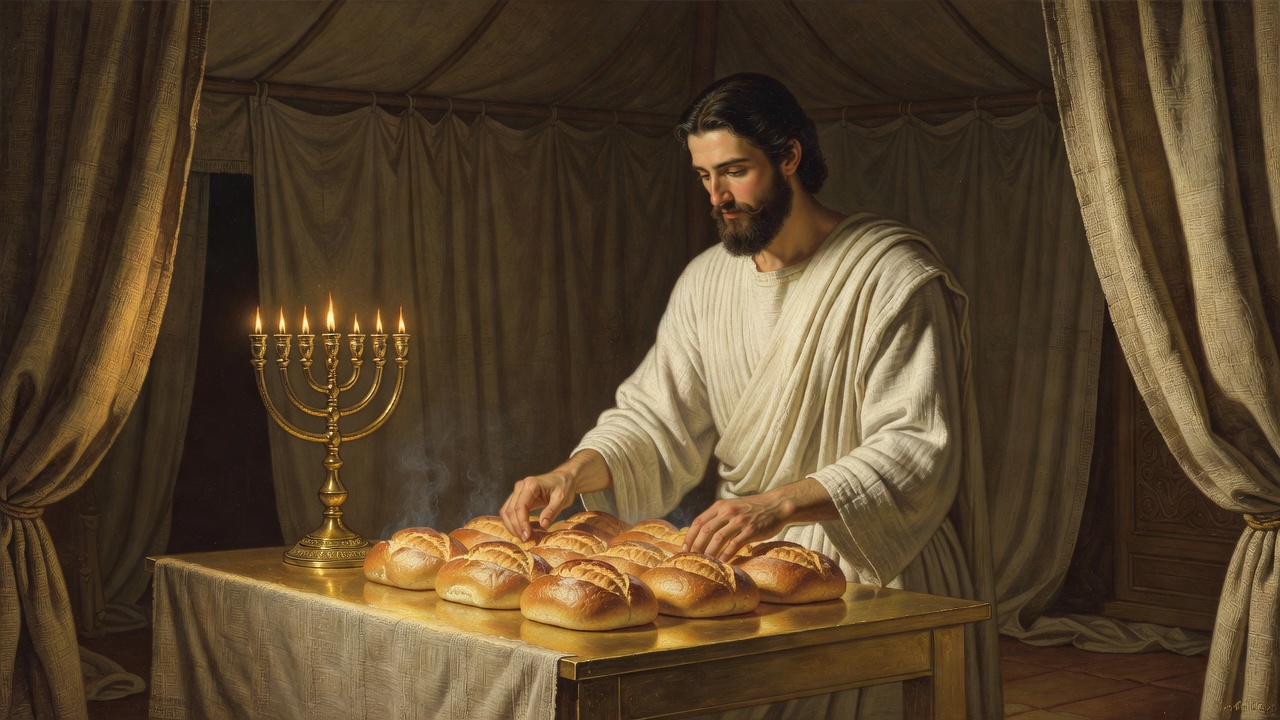
5Also thou schalt take wheete flour, and thou schalt bake therof twelue looues, which schulen haue ech bi hem silf twei tenthe partis, 6of whiche thou schalt sette sexe on euer eithir side, on a clenneste boord bifor the Lord; 7and thou schalt sette clereste encense on tho looues, that the looues be in to mynde of offryng of the Lord; 8bi ech sabat tho schulen be chaungid bifor the Lord, and schulen be takun of the sones of Israel bi euerlastynge boond of pees; 9and tho schulen be Aarons and hise sones, that thei ete tho in the hooli place, for it is hooli of the noumbre of hooli thingis, of the sacrifices of the Lord, bi euerlastynge lawe.
Punishment for Blasphemy
10Lo! forsothe the sone of a womman of Israel, whom sche childide of a man Egipcian, yede out among the sones of Israel, and chidde in the castels with a man of Israel, 11and whanne he hadde blasfemyd the name of the Lord, and hadde cursid the Lord, he was brouyt to Moises; forsothe his modir was clepid Salumyth, the douytir of Dabry, of the lynage of Dan; 12and thei senten hym to prisoun, til thei wisten what the Lord comaundide. 13And the Lord spak to Moises and seide, 14Lede out the blasfemere without the castels, and alle men that herden, sette her hondis on his heed, and al the puple stone hym. 15And thou schalt speke to the sones of Israel, A man that cursith his God, 16schal bere his synne, and he that blasfemeth the name of the Lord, die bi deeth; al the multitude of the puple schal oppresse hym with stoonus, whether he that blasfemede the name of the Lord is a citeseyn, whether a pilgrym, die he bi deeth.
An Eye for an Eye
17He that smytith and sleeth a man, die bi deeth; 18he that smytith a beeste, yelde oon in his stide, that is, lijf for lijf. 19If a man yyueth a wem to ony of hise citeseyns, as he dide, so be it don to him; 20he schal restore brekyng for brekyng, iye for iye, tooth for tooth; what maner wem he yaf, he schal be compellid to suffre sich a wem. 21He that smytith werk beeste, yeelde another; he that smytith a man, schal be punyschid. 22Euene doom be among you, whether a pilgrym ethir a citeseyn synneth, for Y am youre Lord God. 23And Moyses spak to the sones of Israel, and thei brouyten forth out of the castels hym that blasfemede, and oppressiden with stoonus. And the sones of Israel diden, as the Lord comaundide to Moyses.
Did you know?
Tabernacle Lamps, Showbread, and Equal Justice
- Aaron was commanded to tend the golden lampstand outside the veil of the Testimony every evening until morning, using pure oil of pressed olives brought by the Israelites. Beside the lampstand stood a pure gold table holding twelve loaves of bread arranged in two rows with pure frankincense, renewed each Sabbath and eaten exclusively by Aaron and his sons in a holy place.Sources: the Bible text itself · Aaron
- A dispute in the camp involved a man whose mother, Shelomith daughter of Dibri, belonged to the tribe of Dan, while his father was Egyptian. When the man blasphemed the Name during a fight, he was held in custody until Moses received divine instruction regarding how justice should be administered.Sources: the Bible text itself · Shelomith · Dibri · Dan
- The legal ruling given in this passage established that the same legal standard applied equally to foreign residents and native-born Israelites. It also reiterated the principle of proportional justice, often summarized as fracture for fracture, eye for eye, and tooth for tooth.Sources: the Bible text itself
Notes written with AI assistance from open sources (Theographic Bible Metadata, CC BY-SA 4.0; Easton’s Bible Dictionary, public domain) and reviewed before publishing.
Credits and license for this translation
Wycliffe Bible
This is the Pentateuch and Gospels from The Holy Bible, containing the Old and New Testaments, with the apocryphal books, in the earliest English version made from the latin Vulgate by John Wycliffe and his followers. c.1395
Public Domain
Language: Middle English (English)
Dialect: Middle
Translation by: John Wycliffe
2016-11-08
Section headings adapted from the Berean Standard Bible (public domain); they are not part of this translation’s text.
Source: http://ebible.org/engWycliffe/ · eBible.org