Genesis 8
Wycliffe Bible · Tap a verse to see its cross-references.
The Ark Rests on Ararat
1Forsothe the Lord hadde mynde of Noe, and of alle lyuynge beestis, and of alle werk beestis, that weren with hym in the schip; and brouyte a wynd on the erthe. 2And watris weren decreessid, and the wellis of the see weren closid, and the wyndowis of heuene weren closid, and reynes of heuene weren ceessid. 3And watrys turneden ayen fro erthe, and yeden ayen, and bigunnen to be decreessid aftir an hundrid and fifti daies. 4And the schip restide in the seuenthe monthe, in the seuene and twentithe dai of the monthe, on the hillis of Armenye. 5And sotheli the watrys yeden and decresiden til to the tenthe monethe, for in the tenthe monethe, in the firste dai of the monethe, the coppis of hillis apperiden.
Noah Sends a Raven and a Dove
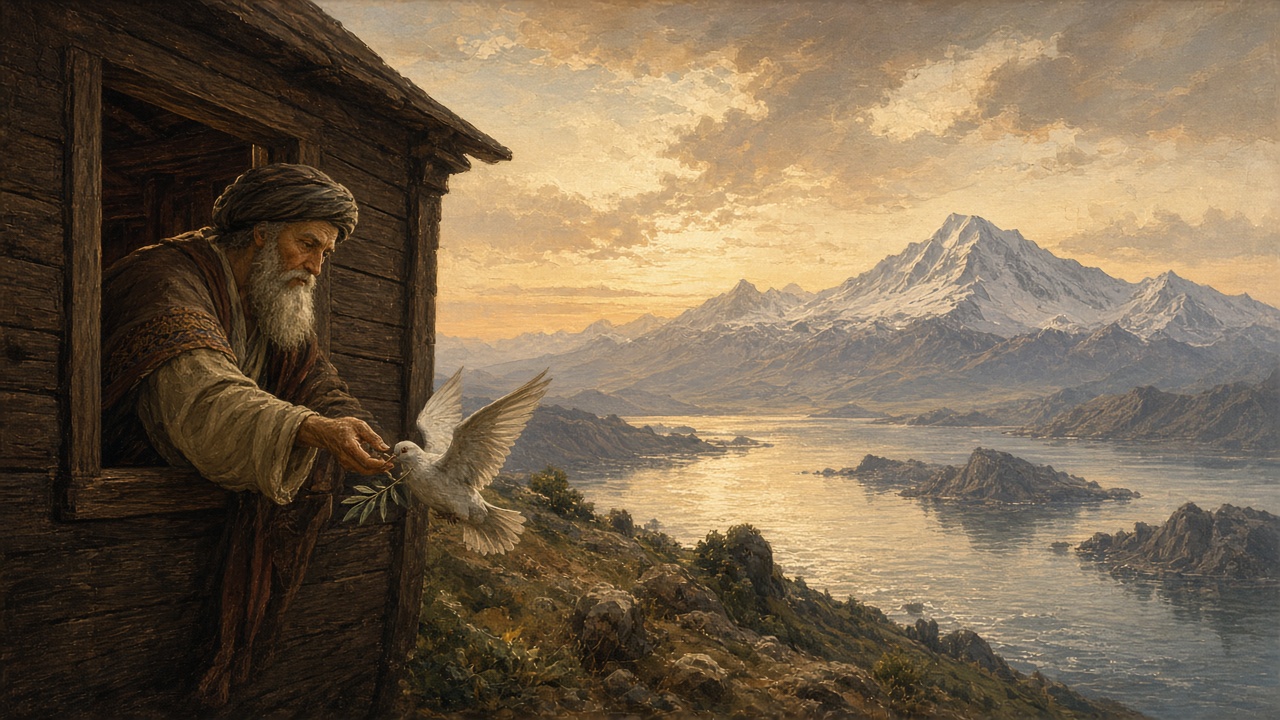
6And whanne fourti daies weren passid, Noe openyde the wyndow of the schip which he hadde maad, and sente out a crowe, 7which yede out, and turnede not ayen til the watris weren dried on erthe. 8Also Noe sente out a culuer aftir hym, to se if the watris hadden ceessid thanne on the face of erthe; 9and whanne the culuer foond not where hir foot schulde reste, sche turnede ayen to hym in to the schip, for the watris weren on al erthe; and Noe helde forth his hoond, and brouyte the culuer takun in to the schip. 10Sotheli whanne othere seuene daies weren abedun aftirward, eft he leet out a culuer fro the schip; 11and sche cam to hym at euentid, and bare in hir mouth a braunche of olyue tre with greene leeuys. Therfor Noe vndirstood that the watris hadden ceessid on erthe; 12and neuerthelesse he abood seuene othere daies, and sente out a culuer, which turnede `no more ayen to hym.
Exiting the Ark
13Therfor in the sixe hundrid and o yeer of the lijf of Noe, in the firste monethe, in the firste day of the monethe, watris weren decreessid on erthe; and Noe openede the roof of the schip, and bihelde and seiy that the face of the erthe was dried. 14In the secunde monethe, in the seuene and twentithe dai of the monethe, the erthe was maad drie. 15Sotheli the Lord spak to Noe; 16and seide, Go out of the schip, thou, and thi wijf, thi sones, and the wyues of thi sones with thee; 17and lede out with thee alle lyuynge beestis that ben at thee of ech fleisch, as wel in volatilis as in vnresonable beestis, and alle `reptils that crepen on erthe; and entre ye on the erthe, encreesse ye, and be ye multiplied on erthe. 18Therfor Noe yede out, and hise sones, and his wijf, and the wyues of hise sones with hym; 19but also alle lyuynge beestis, and werk beestis, and `reptils that crepen on erthe, bi her kynde, yeden out of the schip.
Noah Builds an Altar
20Forsothe Noe bildide an auter to the Lord, and he took of alle clene beestis and briddis, and offride brent sacrifices on the auter. 21And the Lord sauerede the odour of swetnesse, and seide to hym, Y schal no more curse the erthe for men, for the wit and thouyt of mannus herte ben redi in to yuel fro yong wexynge age; therfor Y schal no more smyte ech lyuynge soule as Y dide; 22in alle the daies of erthe, seed and ripe corn, coold and heete, somer and wyntir, nyyt and dai, shulen not reste.
Did you know?
The Waters Recede
- The ark came to rest on the mountains of Ararat, a name meaning “sacred land” or “high land” for a country on whose mountains the ark settled after the flood. Easton's Bible Dictionary (1897) suggests those mountains were probably the Kurdish range of southern Armenia, though the name is also commonly applied to a high, almost inaccessible peak rising from the plain of the Araxes. In 2 Kings 19:37 and Isaiah 37:38 the Authorized Version renders the name “Armenia” and the Revised Version “land of Ararat,” while Jeremiah 51:27 uses it for central or southern Armenia.Sources: Ararat · the Bible text itself
- Noah’s Hebrew name means “rest,” and in this chapter the ark itself comes to rest as the waters go down. He was the son of Lamech and the grandson of Methuselah, and the father of Shem, Ham, and Japheth. Easton's Bible Dictionary describes him as the connecting link between the old world and the new, and as a second great progenitor of the human family.Sources: Noah · the Bible text itself
- Chronological notes place the Great Flood in 2347 BC, lasting one year; the subsiding of the waters in 2346 BC, over 220 days; and the leaving of the ark in 2346 BC, as a single day. In the chapter itself, the waters have gone down after 150 days and the ark rests on the seventeenth day of the seventh month; on the first day of the first month of Noah’s six hundred and first year the waters have dried up, and by the twenty-seventh day of the second month the earth is fully dry.Sources: The Great Flood · The flood subsides · Leaving the Ark · the Bible text itself
Notes written with AI assistance from open sources (Theographic Bible Metadata, CC BY-SA 4.0; Easton’s Bible Dictionary, public domain) and reviewed before publishing.
Places in this chapter
- Ararat · Today: Urartu · 39.703, 44.300 · verse 4
Only places identified with high confidence are shown (90% or more according to the scholarly sources compiled by OpenBible). Period map: DARE (Digital Atlas of the Roman Empire), CC BY 4.0; modern map: © OpenStreetMap contributors; places: OpenBible.info (CC BY 4.0).
Credits and license for this translation
Wycliffe Bible
This is the Pentateuch and Gospels from The Holy Bible, containing the Old and New Testaments, with the apocryphal books, in the earliest English version made from the latin Vulgate by John Wycliffe and his followers. c.1395
Public Domain
Language: Middle English (English)
Dialect: Middle
Translation by: John Wycliffe
2016-11-08
Section headings adapted from the Berean Standard Bible (public domain); they are not part of this translation’s text.
Source: http://ebible.org/engWycliffe/ · eBible.org