Jonah 4
Plain English Version · Tap a verse to see its cross-references.
Jonah got angry with God
1But Jonah wanted God to punish the Nineveh people. Jonah saw that God changed his mind and that God didn’t finish up the Nineveh people. So Jonah got really upset and was very angry.
2Jonah prayed to God. He said, “God, that first time you talked to me, when I was still at home in Israel country, you told me to go and talk to the Nineveh people. But I knew that if I told the Nineveh people your message, they might stop doing bad things, and you might not finish them up. But God, I want you to finish up those Nineveh people. That is the reason why I didn’t want to go to Nineveh and tell them your message, and why I ran away to Tarshish. I knew that you feel sorry for people, and you are always kind. You don’t get angry quickly, and you are really good to people. You don’t do payback to people that stop doing bad things. 3So, God, please finish me up. I want to die, I don’t want to live and watch you be good to the Nineveh people.”
4Then God said, “You are very angry. Are you thinking the right way?”
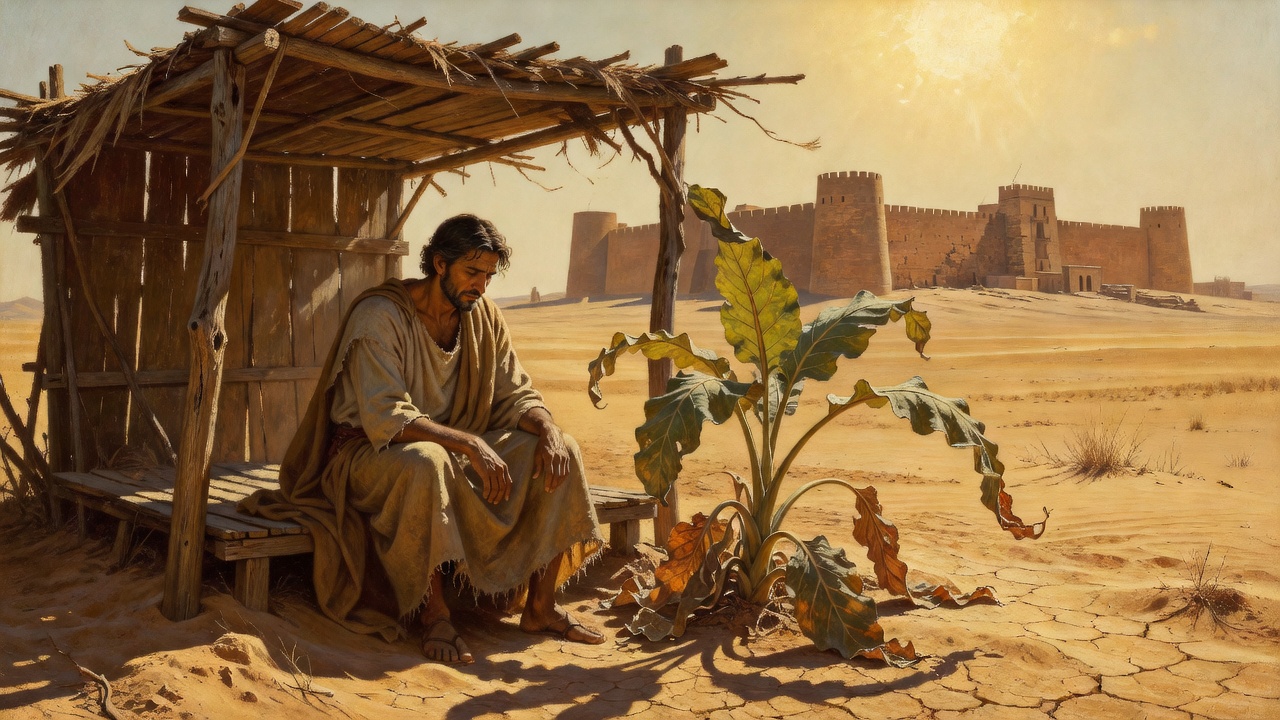
5Then Jonah went out of the city, to the east side. And he made a shelter for himself, and he sat under it in the shade. And he waited there to see what will happen to Nineveh. Jonah waited to see what will happen to Nineveh|src="AP-04-17c - edited.jpg" size="col" ref="4:5"
God used a plant to help Jonah understand
6Then God made a plant grow up near Jonah, to give him shade over his head, so that he will not be so hot. And Jonah was really happy about that plant.
7But early the next day, just before the sun came up, God sent a worm to eat that plant, and that plant died. 8Then the sun came up, and God sent a really hot wind that came from the east. And the sun was really hot on Jonah’s head, so he felt sick.
Then Jonah got angry, and he wanted to die. He said, “I don’t want to live any more. I want to die.”
9Then God said to Jonah, “You are very angry about that plant. Are you thinking the right way?”
Then Jonah said, “Yes, I am thinking the right way. I am so angry that I want to die.”
10Then God said to Jonah, “You really care about that plant. But you didn’t look after it or make it grow. It grew in one night, and it died in one night. 11But you think it’s wrong that I care about Nineveh. Nineveh is a big city, and it has lots and lots of people. It has more than 120,000 people, and those people don’t know what is right and what is wrong. And there are lots of animals there too.”
Did you know?
Jonah's Anger and God's Compassion
- Jonah admits that he originally attempted to flee toward Tarshish precisely because he knew God is gracious, compassionate, slow to anger, and relents from sending disaster. His distress arose when God chose to spare Nineveh rather than destroy it.Sources: the Bible text itself · Tarshish
- Nineveh, the flourishing capital of the Assyrian empire, is described at the conclusion of the book as home to more than 120,000 people who cannot discern between their right and left hand, along with many cattle. God highlights this massive population to contrast divine compassion with Jonah's concern for a single withered plant.Sources: the Bible text itself · Nineveh
Notes written with AI assistance from open sources (Theographic Bible Metadata, CC BY-SA 4.0; Easton’s Bible Dictionary, public domain) and reviewed before publishing.
Places in this chapter
- Nineveh · 36.359, 43.153 · verse 11
Only places identified with high confidence are shown (90% or more according to the scholarly sources compiled by OpenBible). Period map: DARE (Digital Atlas of the Roman Empire), CC BY 4.0; modern map: © OpenStreetMap contributors; places: OpenBible.info (CC BY 4.0).
Credits and license for this translation
Plain English Version
Portions of the Holy Bible in the Plain English Version translation for Australian Aboriginal people who speak English as a second language
Copyright © 2026 Wycliffe Bible Translators Australia
Language: Aboriginal English (English)
Dialect: Australian Aboriginal
Plain English Version © 2026 by Wycliffe Bible Translators Australia, licensed under Creative Commons Attribution-Share Alike 4.0 International (CC BY SA 4.0)
This licence allows you to copy and redistribute the material in any medium or format, even commercially. You may adapt, remix, transform, and build upon the material for any purpose, but if you do so, you must distribute your contributions under the same license as the original. You must always give appropriate credit, provide a link to the license, and indicate if changes were made. You may not suggest that Wycliffe Bible Translators endorses you or your use.
For full details of the licence, visit: creativecommons.org/licenses/by-sa/4.0/legalcode
This translation is made available to you under the terms of the
Creative Commons Attribution Share-Alike license 4.0.
You have permission to share and redistribute this Bible translation in any format and to make reasonable revisions and adaptations of this translation, provided that:
You include the above copyright and source information.
If you make any changes to the text, you must indicate that you did so in a way that makes it clear that the original licensor is not necessarily endorsing your changes.
If you redistribute this text, you must distribute your contributions under the same license as the original.
Pictures included with Scriptures and other documents on this site are licensed just for use with those Scriptures and documents.
For other uses, please contact the respective copyright owners.
Note that in addition to the rules above, revising and adapting God's Word involves a great responsibility to be true to God's Word. See Revelation 22:18-19.
2026-10-02
Source: http://ebible.org/engPEV/ · eBible.org