Leviticus 1
World English Bible (Catholic) · Tap a verse to see its cross-references.
About this book
About Leviticus
- Easton's Bible Dictionary (1897) presents Leviticus as the third book of the Pentateuch and as the third book of Moses. The name, used in the Vulgate following the LXX, reflects the book's chief concern: the Levitical service.Sources: Easton: Leviticus
- Easton states that every ordinance in the book was delivered within one month, the first month of the second year after the Exodus. His entry on Sinai, also called Horeb, says the Hebrews reached that mountain district in the third month after the Exodus and remained encamped for about a whole year, and that the whole of Leviticus records what occurred there.Sources: Easton: Leviticus · Mount Sinai
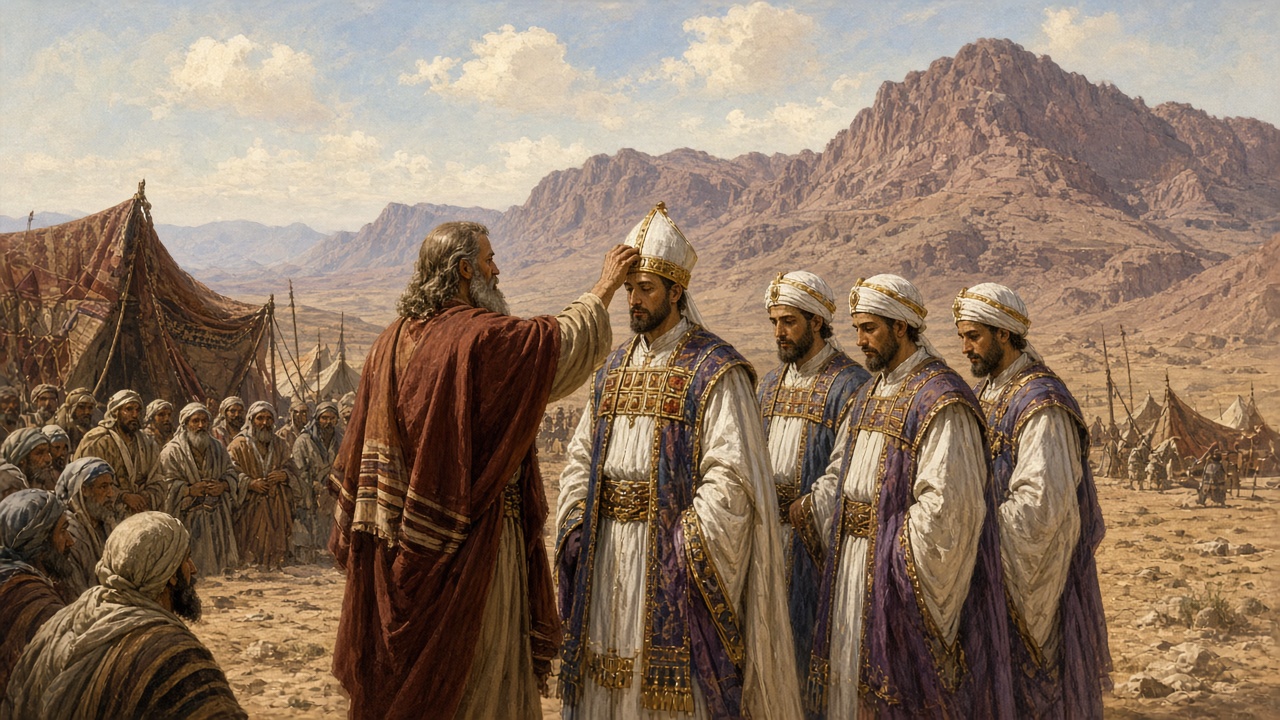
- Chapters 1–7 give laws for burnt offerings, meat offerings, and thank offerings, then for sin offerings and trespass offerings, and for the priests' duties in offering sacrifice. Chapters 8–10 recount the consecration of Aaron and his sons, Aaron's first offering for himself and the people, and the death of Nadab and Abihu, who were struck dead and buried outside the camp after offering strange, or common, fire not taken from the great brazen altar. Chapters 11–16 concern purity and the sacrifices and ordinances for putting impurity away.Sources: Easton: Leviticus · Nadab · Abihu
- Easton describes chapters 17–20 as laws marking the separation between Israel and other peoples. Further laws concern the priests' personal purity and their eating of holy things, offerings without blemish, and the due celebration of the great festivals in chapters 23 and 25. Promises and warnings about obedience follow, the book closes with a section on vows, and Easton notes that God is the direct speaker through almost the whole of it.Sources: Easton: Leviticus
- In the rites of chapter 16, one goat is associated with Azazel, which the Authorized Version renders scapegoat and the Revised Version leaves as Azazel. Easton reports that some Jewish interpreters take it as a place in the wilderness about twelve miles east of Jerusalem, while others take it as an evil spirit or even Satan, and he also notes a root meaning of separation.Sources: Azazel
Notes written with AI assistance from open sources (Theographic Bible Metadata, CC BY-SA 4.0; Easton’s Bible Dictionary, public domain) and reviewed before publishing.
Laws for Burnt Offerings
1The LORD called to Moses, and spoke to him from the Tent of Meeting, saying, 2“Speak to the children of Israel, and tell them, ‘When anyone of you offers an offering to the LORD, you shall offer your offering of the livestock, from the herd and from the flock.
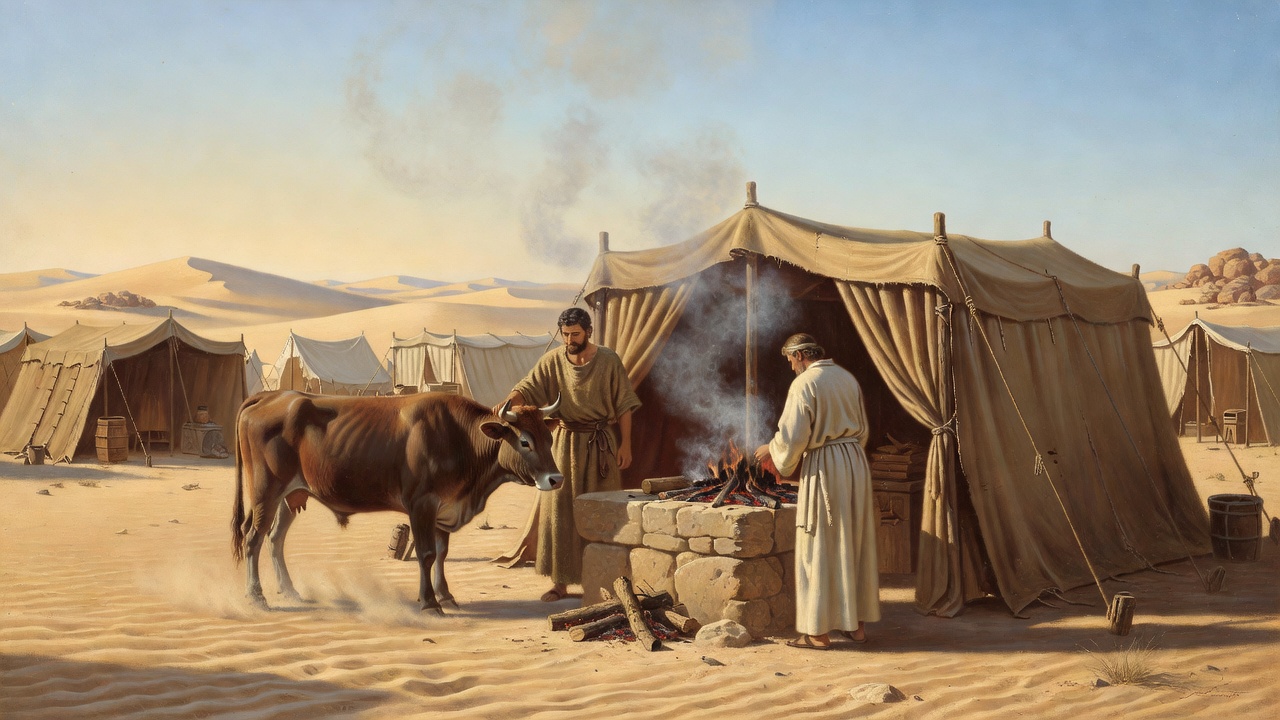
3“‘If his offering is a burnt offering from the herd, he shall offer a male without defect. He shall offer it at the door of the Tent of Meeting, that he may be accepted before the LORD. 4He shall lay his hand on the head of the burnt offering, and it shall be accepted for him to make atonement for him. 5He shall kill the bull before the LORD. Aaron’s sons, the priests, shall present the blood and sprinkle the blood around on the altar that is at the door of the Tent of Meeting. 6He shall skin the burnt offering and cut it into pieces. 7The sons of Aaron the priest shall put fire on the altar, and lay wood in order on the fire; 8and Aaron’s sons, the priests, shall lay the pieces, the head, and the fat in order on the wood that is on the fire which is on the altar; 9but he shall wash its innards and its legs with water. The priest shall burn all of it on the altar, for a burnt offering, an offering made by fire, of a pleasant aroma to the LORD.
10“‘If his offering is from the flock, from the sheep or from the goats, for a burnt offering, he shall offer a male without defect. 11He shall kill it on the north side of the altar before the LORD. Aaron’s sons, the priests, shall sprinkle its blood around on the altar. 12He shall cut it into its pieces, with its head and its fat. The priest shall lay them in order on the wood that is on the fire which is on the altar, 13but the innards and the legs he shall wash with water. The priest shall offer the whole, and burn it on the altar. It is a burnt offering, an offering made by fire, of a pleasant aroma to the LORD.
14“‘If his offering to the LORD is a burnt offering of birds, then he shall offer his offering from turtledoves or of young pigeons. 15The priest shall bring it to the altar, and wring off its head, and burn it on the altar; and its blood shall be drained out on the side of the altar; 16and he shall take away its crop and its feathers, and cast it beside the altar on the east part, in the place of the ashes. 17He shall tear it by its wings, but shall not divide it apart. The priest shall burn it on the altar, on the wood that is on the fire. It is a burnt offering, an offering made by fire, of a pleasant aroma to the LORD.
Did you know?
The Burnt Offering
- The instructions for the burnt offering accommodate different economic means by allowing offerings from the herd, the flock (sheep or goats), or birds (turtledoves or young pigeons). For livestock, the animal was required to be a male without blemish.Sources: the Bible text itself
- The ritual required a clear division of roles between the worshiper and the priests. The worshiper brought the animal, laid a hand on its head for atonement, slaughtered it, skinned it, and washed its inner parts, while the sons of Aaron sprinkled the blood and burned the entire offering on the altar.Sources: the Bible text itself · Aaron
Notes written with AI assistance from open sources (Theographic Bible Metadata, CC BY-SA 4.0; Easton’s Bible Dictionary, public domain) and reviewed before publishing.
Credits and license for this translation
The World English Bible
Catholic Book Order
The World English Bible is in the Public Domain. That means that it is not copyrighted. However, "World English Bible" is a Trademark of eBible.org.
You may copy, publish, proclaim, distribute, redistribute, sell, give away, quote, memorize, read publicly, broadcast, transmit, share, back up, post on the Internet, print, reproduce, preach, teach from, and use
the World English Bible as much as you want, and others may also do so. All we ask is that if you CHANGE the actual text of the World English Bible in any way, you not call the result the World English Bible any more.
This is to avoid confusion, not to limit your freedom. The Holy Bible is God's Word. It belongs to God. He gave it to us freely, and we who have worked on this translation freely give it to you by dedicating it to the
Public Domain.
Donations to help with the expenses of this project and thus help others have free access to the Word of God may be made to us, but are not required. Please see
https://MLJohnson.org/partner/ for more about that.
Although we are done with the editing for language updates, we might choose to consider corrections of obvious typos or problems in the translation.
Any updates will be posted on https://eBible.org/web/ and at https://WorldEnglish.Bible .
2020 stable text edition
Section headings adapted from the Berean Standard Bible (public domain); they are not part of this translation’s text.
Source: http://ebible.org/eng-web-c/ · eBible.org