Psalms 74
LXX2012: Septuagint in British/International English 2012 · Tap a verse to see its cross-references.
(75) For the end, Destroy not, a Psalm of a Song for Asaph.
Why Have You Rejected Us Forever?
1We will give thanks to you, O God, we will give thanks, and call upon your name: I will declare all your wonderful works.
2When I shall take a set time, I will judge righteously.
3The earth is dissolved, and all that dwell in it: I have strengthened its pillars. Pause.
4I said to the transgressors, Do not transgress; and to the sinners, Lift not up the horn.
5Lift not up your horn on high; speak not unrighteousness against God.
6For good comes neither from the east, nor from the west, nor from the desert mountains.
7For God is the judge; he puts down one, and raises up another.
8For there is a cup in the hand of the Lord, full of unmingled wine; and he has turned it from side to side, but its dregs have not been wholly poured out; all the sinners of the earth shall drink them.
9But I will exult for ever: I will sing praises to the God of Jacob.
10And I will break all the horns of sinners; but the horns of the righteous one shall be exalted.
Did you know?
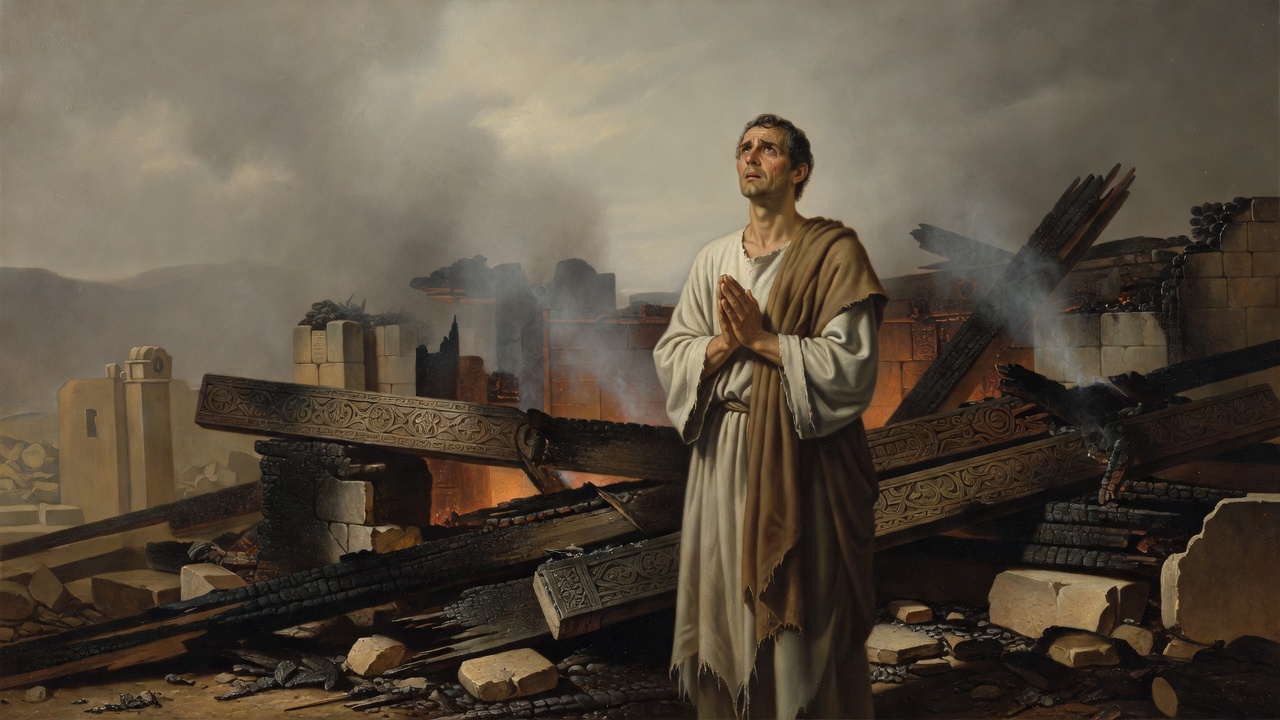
Lament over the Destroyed Sanctuary
- Psalms 73 through 83 are attributed to Asaph, a Levite musician and leader of David's choir. Because Psalm 74 laments the burning and total destruction of the sanctuary, many scholars connect it with the later "sons of Asaph," a guild of poets and singers who preserved his tradition.Sources: Asaph (Levite) · the Bible text itself
- The psalm appeals to God to remember Mount Zion, a prominent hill in Jerusalem where David established his citadel and where the sanctuary stood as the dwelling place of God's name.Sources: Mount Zion · the Bible text itself
- The destruction of the sanctuary is vividly described using the metaphor of woodcutters felling trees, as invaders smashed the intricate carved woodwork with axes and picks before burning the holy place to the ground.Sources: the Bible text itself
Notes written with AI assistance from open sources (Theographic Bible Metadata, CC BY-SA 4.0; Easton’s Bible Dictionary, public domain) and reviewed before publishing.
Places in this chapter
- Mount Zion · 31.772, 35.229 · verse 2
Only places identified with high confidence are shown (90% or more according to the scholarly sources compiled by OpenBible). Period map: DARE (Digital Atlas of the Roman Empire), CC BY 4.0; modern map: © OpenStreetMap contributors; places: OpenBible.info (CC BY 4.0).
Credits and license for this translation
LXX2012: Septuagint in British/International English 2012
The Septuagint with Apocrypha, translated from Greek to English by Sir Lancelot C. L. Brenton and published in 1885, with some language updates (British/International English)
Public Domain
Language: English
Dialect (if applicable): British
Language in English: English
Translation by: Sir Lancelot Charles Lee Breton
LXX2012: Septuagint in English 2012, British/International English Edition
This is a translation of the Old Testament and Apocrypha/Deuterocanon from Hebrew to Greek to 19th Century British English, with some updates of spelling and word usage to contemporary British/International English. The original English translation was done by Sir Lancelot Charles Lee Brenton and published by Samuel Bagster & Sons, Ltd., in London in 1851. It has entered the Public Domain due to the passage of sufficient time. In the process of scanning and typing the text, the original poetry and prose formatting, as well as peripheral material like introductions and notes, have been omitted.
This edition of the Septuagint has some language updates. Brenton's word order and punctuation has been mostly retained, meaning that quotation marks are not used, and sentences within quotes may not start with capital letters, as was standard usage in 1851. Names transliterated from Greek to those transliterated from Hebrew in the common English Bibles often differ. These language updates are dedicated to the Public Domain by the author of those edits, Michael Paul Johnson. Therefore this edition may be freely copied, published, etc.
Before considering making changes to the text of this work, I recommend that you consult with God, because this is really His Book.
If you find errors in the text, please report them so that we can correct them.
Donations to help with the expenses of operating this web site and thus help others have free access to the Word of God may be made to us, but are not required. Please see http://MLJohnson.org/partner/ for more about that.
Section headings adapted from the Berean Standard Bible (public domain); they are not part of this translation’s text.
Source: http://ebible.org/eng-uk-lxx2012/ · eBible.org