Job 6
LXX2012: Septuagint in British/International English 2012 · Tap a verse to see its cross-references.
Job Replies: My Complaint Is Just
1But Job answered and said, 2Oh that one would indeed weigh the wrath that is upon me, and take up my griefs in a balance together! 3And verily they would be heavier than the sand by the seashore: but, as it seems, my words are vain. 4For the arrows of the Lord are in my body, whose violence drinks up my blood: whenever I am going to speak, they pierce me. 5What then? will the wild ass bray for nothing, if he is not seeking food? or again, will the ox low at the manger, when he has a fodder? 6Shall bread be eaten without salt? or again, is there taste in empty words? 7For my wrath can’t cease; for I perceive my food as the smell of a lion to be loathsome. 8For oh that he would grant my desire, and my petition might come, and the Lord would grant my hope! 9Let the Lord begin and wound me, but let him not utterly destroy me. 10Let the grave be my city, upon the walls of which I have leapt: I will not shrink from it; for I have not denied the holy words of my God. 11For what is my strength, that I continue? what is my time, that my soul endures? 12Is my strength the strength of stones? or is my flesh of brass? 13Or have I not trusted in him? but help is far from me. 14Mercy has rejected me; and the visitation of the Lord has disregarded me. 15My nearest relations have not regarded me; they have passed me by like a failing brook, or like a wave. 16They who used to reverence me, now have come against me like snow or congealed ice. 17When it has melted at the approach of heat, it is not known what it was. 18Thus I also have been deserted of all; and I am ruined, and become an outcast. 19Behold the ways of the Thaemanites, you⌃ that mark the paths of the Sabaeans. 20They too that trust in cities and riches shall come to shame. 21But you⌃ also have come to me without pity; so that beholding my wound you⌃ are afraid. 22What? have I made any demand of you? or do I ask for strength from you, 23to deliver me from enemies, or to rescue me from the hand of the mighty ones? 24Teach you⌃ me, and I will be silent: if in anything I have erred, tell me. 25But as it seems, the words of a true man are vain, because I do not ask strength of you. 26Neither will your reproof cause me to cease my words, for neither will I endure the sound of your speech. 27Even because you⌃ attack the fatherless, and insult your friend. 28But now, having looked upon your countenances, I will not lie. 29Sit down now, and let there not be unrighteousness; and unite again with the just. 30For there is no injustice in my tongue; and does not my throat meditate understanding?
Did you know?
Job's Anguish and Unreliable Friends
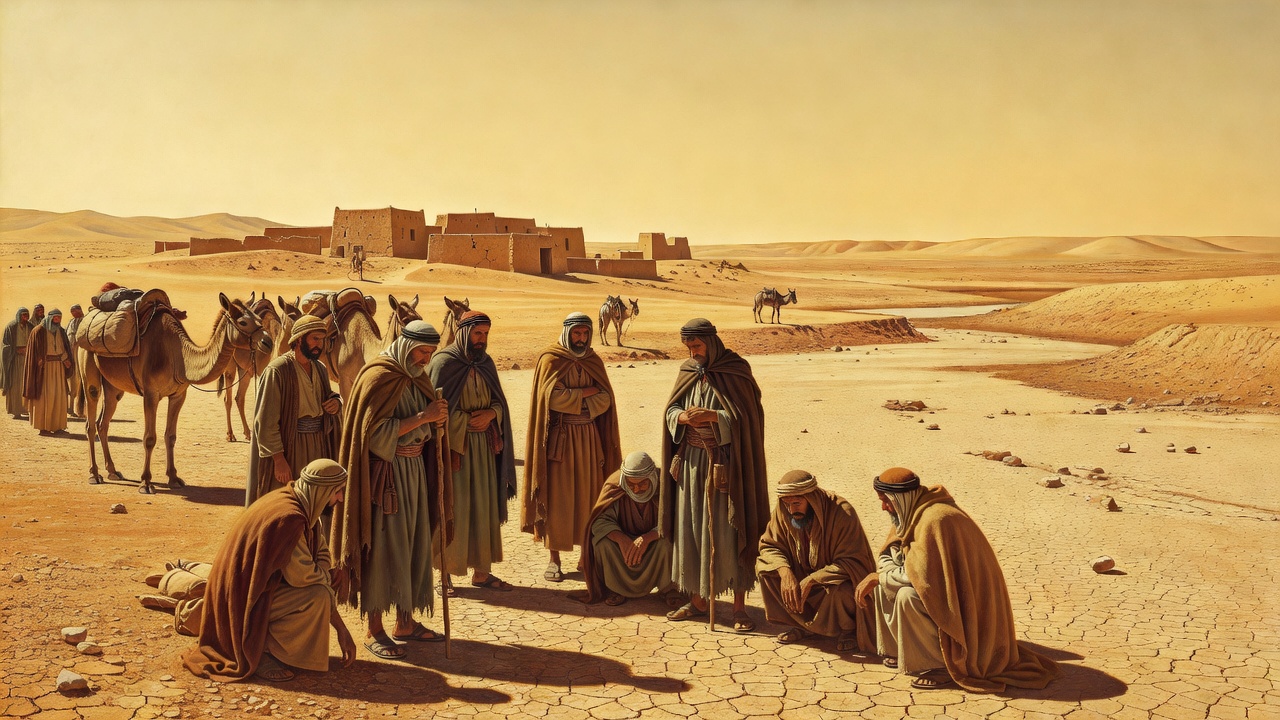
- Job compares his unsupportive companions to seasonal desert streams that overflow with melted ice and snow during cold weather, but completely vanish during the heat of the dry season when water is needed most.Sources: the Bible text itself
- The passage references merchant caravans from Tema in northern Arabia and travelers from Sheba in southern Arabia. Job describes these desert traders searching hopefully for water in seasonal streambeds, only to suffer bitter disappointment when the channels are dry.Sources: the Bible text itself · Tema · Sheba
Notes written with AI assistance from open sources (Theographic Bible Metadata, CC BY-SA 4.0; Easton’s Bible Dictionary, public domain) and reviewed before publishing.
Places in this chapter
Only places identified with high confidence are shown (90% or more according to the scholarly sources compiled by OpenBible). Period map: DARE (Digital Atlas of the Roman Empire), CC BY 4.0; modern map: © OpenStreetMap contributors; places: OpenBible.info (CC BY 4.0).
Credits and license for this translation
LXX2012: Septuagint in British/International English 2012
The Septuagint with Apocrypha, translated from Greek to English by Sir Lancelot C. L. Brenton and published in 1885, with some language updates (British/International English)
Public Domain
Language: English
Dialect (if applicable): British
Language in English: English
Translation by: Sir Lancelot Charles Lee Breton
LXX2012: Septuagint in English 2012, British/International English Edition
This is a translation of the Old Testament and Apocrypha/Deuterocanon from Hebrew to Greek to 19th Century British English, with some updates of spelling and word usage to contemporary British/International English. The original English translation was done by Sir Lancelot Charles Lee Brenton and published by Samuel Bagster & Sons, Ltd., in London in 1851. It has entered the Public Domain due to the passage of sufficient time. In the process of scanning and typing the text, the original poetry and prose formatting, as well as peripheral material like introductions and notes, have been omitted.
This edition of the Septuagint has some language updates. Brenton's word order and punctuation has been mostly retained, meaning that quotation marks are not used, and sentences within quotes may not start with capital letters, as was standard usage in 1851. Names transliterated from Greek to those transliterated from Hebrew in the common English Bibles often differ. These language updates are dedicated to the Public Domain by the author of those edits, Michael Paul Johnson. Therefore this edition may be freely copied, published, etc.
Before considering making changes to the text of this work, I recommend that you consult with God, because this is really His Book.
If you find errors in the text, please report them so that we can correct them.
Donations to help with the expenses of operating this web site and thus help others have free access to the Word of God may be made to us, but are not required. Please see http://MLJohnson.org/partner/ for more about that.
Section headings adapted from the Berean Standard Bible (public domain); they are not part of this translation’s text.
Source: http://ebible.org/eng-uk-lxx2012/ · eBible.org