Job 5
LXX2012: Septuagint in British/International English 2012 · Tap a verse to see its cross-references.
Eliphaz Continues: God Blesses those Who Seek Him
1But call, if any one will listen to you, or if you shall see any of the holy angels. 2For wrath destroys the foolish one, and envy slays him that has gone astray. 3And I have seen foolish ones taking root: but suddenly their habitation was devoured. 4Let their children be far from safety, and let them be crushed at the doors of vile men, and let there be no deliverer. 5For what they have collected, the just shall eat; but they shall not be delivered out of calamities: let their strength be utterly exhausted. 6For labour can’t by any means come out of the earth, nor shall trouble spring out of the mountains: 7yet man is born to labour, and even so the vulture's young seek the high places. 8Nevertheless I will beseech the Lord, and will call upon the Lord, the sovereign of all; 9who does great things and untraceable, glorious things also, and marvellous, of which there is no number: 10who gives rain upon the earth, sending water on the earth: 11who exalts the lowly, and raises up them that are lost: 12frustrating the counsels of the crafty, and their hands shall not perform the truth: 13who takes the wise in their wisdom, and subverts the counsel of the crafty 14In the day darkness shall come upon them, and let them grope in the noon-day even as in the night: 15and let them perish in war, and let the weak escape from the hand of the mighty. 16And let the weak have hope, but the mouth of the unjust be stopped. 17But blessed is the man whom the Lord has reproved; and reject not you the chastening of the Almighty. 18for he causes a man to be in pain, and restores him again: he smites, and his hands heal. 19Six time he shall deliver you out of distresses: and in the seventh harm shall not touch you. 20In famine he shall deliver you from death: and in war he shall free you from the power of the sword. 21He shall hide you from the scourge of the tongue: and you shall not be afraid of coming evils. 22You shall laugh at the unrighteous and the lawless: and you shall not be afraid of wild beasts. 23For the wild beasts of the field shall be at peace with you. 24Then shall you know that your house shall be at peace, and the provision for your tabernacle shall not fail. 25And you shall know that your seed shall be abundant; and your children shall be like the herbage of the field. 26And you shall come to the grave like ripe corn reaped in its season, or as a heap of the corn-flour collected in proper time. 27Behold, we have thus sought out these matters; these are what we have heard: but do you reflect with yourself, if you have done anything wrong.
Did you know?
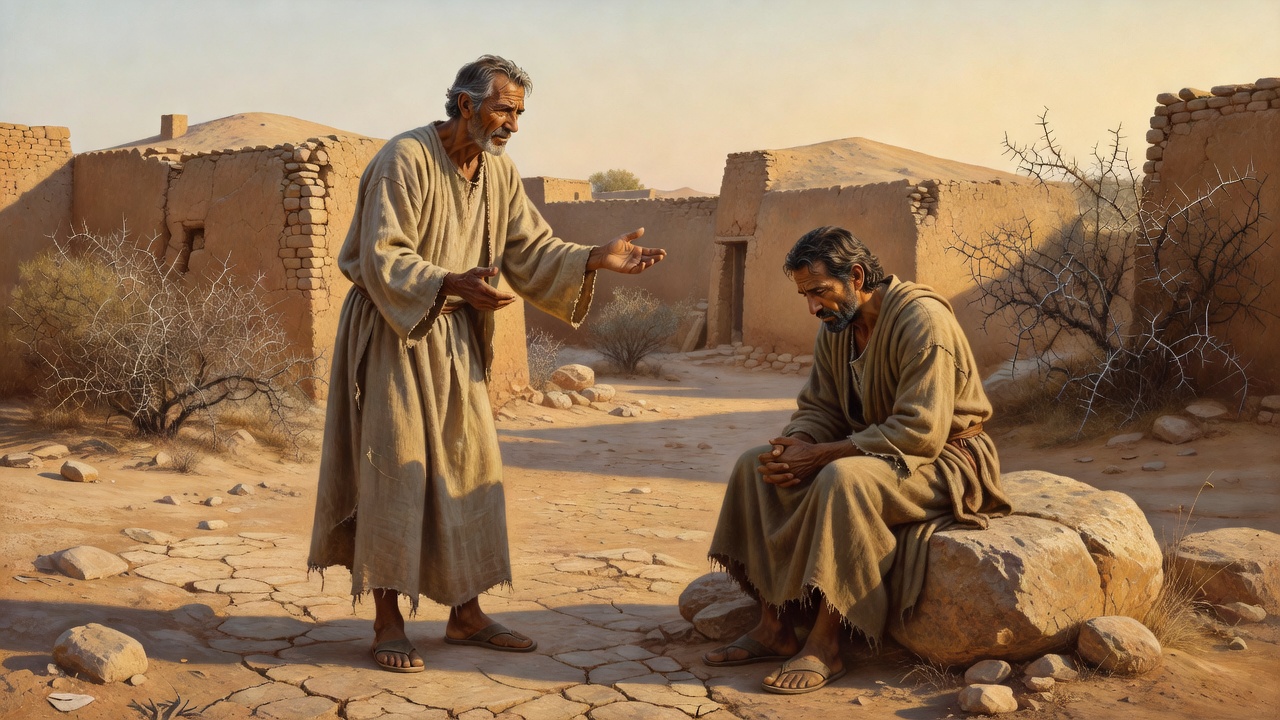
Eliphaz's Counsel on Suffering and Divine Correction
- Eliphaz portrays suffering as purposeful divine discipline rather than arbitrary misfortune, asserting that trouble does not arise without cause from the soil. He urges Job not to despise the correction of the Almighty, who wounds only to heal and restore.Sources: the Bible text itself
- In promising deliverance from six calamities and even seven, Eliphaz employs a traditional poetic formula known as graded numerical parallelism. This rhetorical pattern, common in ancient Near Eastern wisdom poetry, builds emphasis to express comprehensive and complete protection.Sources: the Bible text itself
- Eliphaz describes ultimate restoration in vivid agricultural and pastoral terms, depicting a life where wild beasts and stony soil cease to be hostile. He envisions a peaceful death occurring in full vigor, likened to a sheaf of grain harvested at the proper season.Sources: the Bible text itself
Notes written with AI assistance from open sources (Theographic Bible Metadata, CC BY-SA 4.0; Easton’s Bible Dictionary, public domain) and reviewed before publishing.
Credits and license for this translation
LXX2012: Septuagint in British/International English 2012
The Septuagint with Apocrypha, translated from Greek to English by Sir Lancelot C. L. Brenton and published in 1885, with some language updates (British/International English)
Public Domain
Language: English
Dialect (if applicable): British
Language in English: English
Translation by: Sir Lancelot Charles Lee Breton
LXX2012: Septuagint in English 2012, British/International English Edition
This is a translation of the Old Testament and Apocrypha/Deuterocanon from Hebrew to Greek to 19th Century British English, with some updates of spelling and word usage to contemporary British/International English. The original English translation was done by Sir Lancelot Charles Lee Brenton and published by Samuel Bagster & Sons, Ltd., in London in 1851. It has entered the Public Domain due to the passage of sufficient time. In the process of scanning and typing the text, the original poetry and prose formatting, as well as peripheral material like introductions and notes, have been omitted.
This edition of the Septuagint has some language updates. Brenton's word order and punctuation has been mostly retained, meaning that quotation marks are not used, and sentences within quotes may not start with capital letters, as was standard usage in 1851. Names transliterated from Greek to those transliterated from Hebrew in the common English Bibles often differ. These language updates are dedicated to the Public Domain by the author of those edits, Michael Paul Johnson. Therefore this edition may be freely copied, published, etc.
Before considering making changes to the text of this work, I recommend that you consult with God, because this is really His Book.
If you find errors in the text, please report them so that we can correct them.
Donations to help with the expenses of operating this web site and thus help others have free access to the Word of God may be made to us, but are not required. Please see http://MLJohnson.org/partner/ for more about that.
Section headings adapted from the Berean Standard Bible (public domain); they are not part of this translation’s text.
Source: http://ebible.org/eng-uk-lxx2012/ · eBible.org