Isaiah 9
LXX2012: Septuagint in British/International English 2012 · Tap a verse to see its cross-references.
Unto Us a Child Is Born
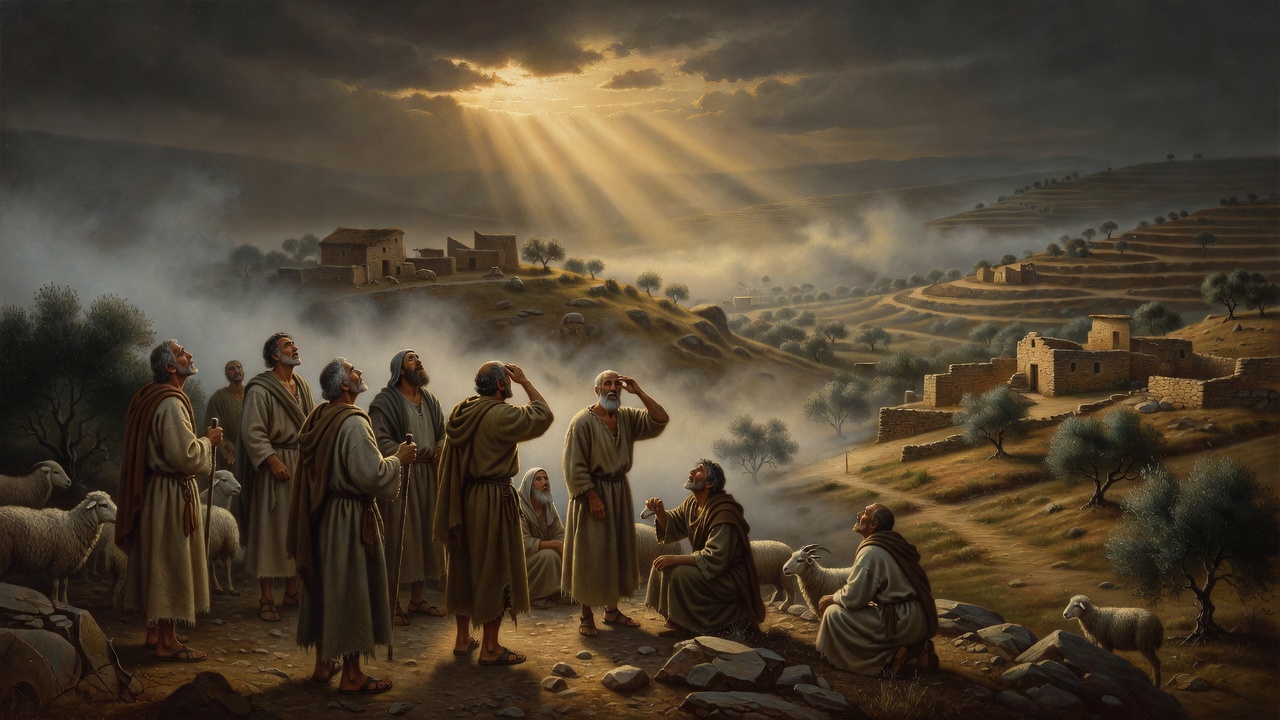
1Drink this first. Act quickly, O land of Zabulon, land of Nephthalim, and the rest inhabiting the sea-coast, and the land beyond Jordan, Galilee of the Gentiles. 2O people walking in darkness, behold a great light: you⌃ that dwell in the region and shadow of death, a light shall shine upon you. 3The multitude of the people which you have brought down in your joy, they shall even rejoice before you as they that rejoice in harvest, and as they that divide the spoil. 4Because the yoke that was laid upon them has been taken away, and the rod that was on their neck: for he has broken the rod of the exactors, as in the day of Madiam. 5For they shall compensate for every garment that has been acquired by deceit, and all raiment with restitution; and they shall be willing, even if they were burnt with fire. 6For a child is born to us, and a son is given to us, whose government is upon his shoulder: and his name is called the Messenger of great counsel: for I will bring peace upon the princes, and health to him. 7His government shall be great, and of his peace there is no end: it shall be upon the throne of David, and upon his kingdom, to establish it, and to support it with judgement and with righteousness, from henceforth and forever. The seal of the Lord of hosts shall perform this.
Judgment against Israel’s Pride
8The Lord has sent death upon Jacob, and it has come upon Israel. 9And all the people of Ephraim, and they that lived in Samaria shall know, who say in their pride and lofty heart, 10The bricks are fallen down, but come, let us hew stones, and cut down sycamores and cedars, and let us build for ourselves a tower. 11And God shall dash down them that rise up against him on mount Sion, and shall scatter his enemies; 12even Syria from the rising of the sun, and the Greeks from the setting of the sun, who devour Israel with open mouth. For all this his anger is not turned away, but still his hand is exalted.
Judgment against Israel’s Hypocrisy
13But the people turned not until they were struck, and they sought not the Lord. 14So the Lord took away from Israel the head and tail, great and small, in one day: 15the old man, and them that respect persons, this is the head; and the prophet teaching unlawful things, he is the tail. 16And they that pronounce this people blessed shall mislead them; and they mislead them that they may devour them. 17Therefore the Lord shall not take pleasure in their young men, neither shall he have pity on their orphans or on their widows: for they are all transgressors and wicked, and every mouth speaks unjustly. For all this his anger is not turned away, but his hand is yet exalted.
Judgment against Israel’s Unrepentance
18And iniquity shall burn as fire, and shall be devoured by fire as dry grass: and it shall burn in the thickets of the wood, and shall devour all that is round about the hills. 19The whole earth is set on fire because of the fierce anger of the Lord, and the people shall be as men burnt by fire: no man shall pity his brother. 20But one shall turn aside to the right hand, for he shall be hungry; and shall eat on the left, and a man shall by no means be satisfied with eating the flesh of his own arm. 21For Manasses shall eat the flesh of Ephraim, and Ephraim the flesh of Manasses; for they shall besiege Juda together. For all this his anger is not turned away, but his hand is yet exalted.
Did you know?
A Great Light and Judgment on the North
- The northern tribal territories of Zebulun and Naphtali were located in Galilee, a name derived from a word meaning circuit. Because original inhabitants long remained in the area alongside Israelites, it came to be known as Galilee of the nations or Gentiles.Sources: Galilee · the Bible text itself
- The reference to the day of Midian recalls the historic shattering of oppression by the Midianites, a nomadic people from the desert regions north of the Arabian peninsula.Sources: Midian · the Bible text itself
- The prophetic warning addresses the northern kingdom through its capital Samaria—built by King Omri atop a solitary mountain in the hills of Israel—and its leading tribe Ephraim, describing bitter civil strife between brother tribes such as Manasseh and Ephraim.Sources: Samaria · Ephraim · Manasseh (son of Joseph) · the Bible text itself
Notes written with AI assistance from open sources (Theographic Bible Metadata, CC BY-SA 4.0; Easton’s Bible Dictionary, public domain) and reviewed before publishing.
Places in this chapter
- Galilee · 32.760, 35.527 · verse 1
- Jordan · Today: Jordan River · 31.761, 35.558 · verse 1
- Midian · 28.495, 35.012 · verse 4
- Samaria · 32.276, 35.195 · verse 9
- Philistia · 31.664, 34.546 · verse 12
- Syria · Today: Aram · 33.511, 36.306 · verse 12
Only places identified with high confidence are shown (90% or more according to the scholarly sources compiled by OpenBible). Period map: DARE (Digital Atlas of the Roman Empire), CC BY 4.0; modern map: © OpenStreetMap contributors; places: OpenBible.info (CC BY 4.0).
Credits and license for this translation
LXX2012: Septuagint in British/International English 2012
The Septuagint with Apocrypha, translated from Greek to English by Sir Lancelot C. L. Brenton and published in 1885, with some language updates (British/International English)
Public Domain
Language: English
Dialect (if applicable): British
Language in English: English
Translation by: Sir Lancelot Charles Lee Breton
LXX2012: Septuagint in English 2012, British/International English Edition
This is a translation of the Old Testament and Apocrypha/Deuterocanon from Hebrew to Greek to 19th Century British English, with some updates of spelling and word usage to contemporary British/International English. The original English translation was done by Sir Lancelot Charles Lee Brenton and published by Samuel Bagster & Sons, Ltd., in London in 1851. It has entered the Public Domain due to the passage of sufficient time. In the process of scanning and typing the text, the original poetry and prose formatting, as well as peripheral material like introductions and notes, have been omitted.
This edition of the Septuagint has some language updates. Brenton's word order and punctuation has been mostly retained, meaning that quotation marks are not used, and sentences within quotes may not start with capital letters, as was standard usage in 1851. Names transliterated from Greek to those transliterated from Hebrew in the common English Bibles often differ. These language updates are dedicated to the Public Domain by the author of those edits, Michael Paul Johnson. Therefore this edition may be freely copied, published, etc.
Before considering making changes to the text of this work, I recommend that you consult with God, because this is really His Book.
If you find errors in the text, please report them so that we can correct them.
Donations to help with the expenses of operating this web site and thus help others have free access to the Word of God may be made to us, but are not required. Please see http://MLJohnson.org/partner/ for more about that.
Section headings adapted from the Berean Standard Bible (public domain); they are not part of this translation’s text.
Source: http://ebible.org/eng-uk-lxx2012/ · eBible.org