Isaiah 8
LXX2012: Septuagint in British/International English 2012 · Tap a verse to see its cross-references.
Assyrian Invasion Prophesied
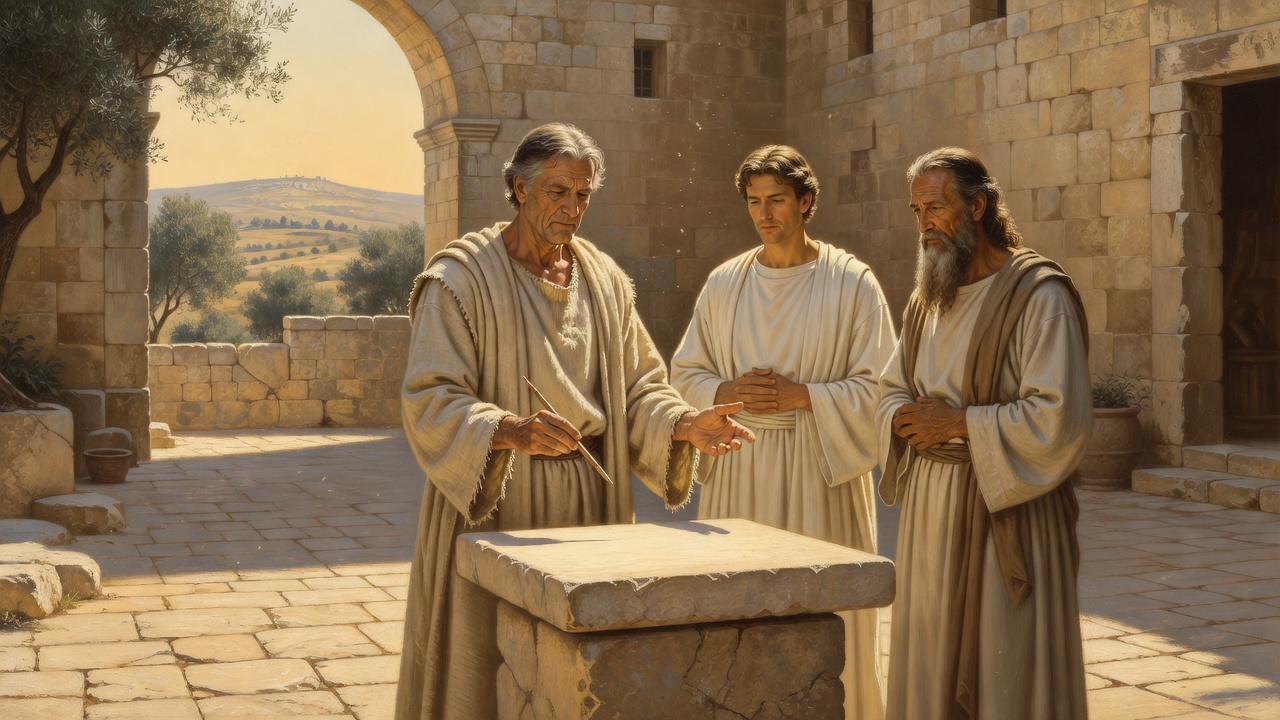
1And the Lord said to me, Take to yourself a volume of a great new book, and write in it with a man's pen concerning the making a rapid plunder of spoils; for it is near at hand. 2And make me witnesses of faithful men, Urias, and Zacharias the son of Barachias. 3And I went in to the prophetess; and she conceived, and bore a son. And the Lord said to me, Call his name, Spoil quickly, plunder speedily. 4For before the child shall know how to call his father or his mother, one shall take the power of Damascus and the spoils of Samaria before the king of the Assyrians. 5And the Lord spoke to me yet again, saying, 6Because this people chooses not the water of Siloam that goes softly, but wills to have Rassin, and the son of Romelias to be king over you; 7therefore, behold, the Lord brings up upon you the water of the river, strong and abundant, even the king of the Assyrians, and his glory: and he shall come up over every valley of yours, and shall walk over every wall of yours: 8and he shall take away from Juda every man who shall be able to lift up his head, and every one able to accomplish anything; and his camp shall fill the breadth of your land, O God with us. 9Know, you⌃ Gentiles, and be conquered; listen you⌃, even to the extremity of the earth: be conquered, after you⌃ strengthened yourselves; for even if you⌃ should again strengthen yourselves, you⌃ shall again be conquered. 10And whatever counsel you⌃ shall take, the Lord shall bring it to nothing; and whatever word you⌃ shall speak, it shall not stand amongst you: for God is with us.
A Call to Fear God
11Thus says the Lord, With a strong hand they revolt from the course of the way of this people, saying, 12Let them not say, It is hard, for whatever this people says, is hard: but fear not you⌃ their fear, neither be dismayed. 13Sanctify you⌃ the Lord himself; and he shall be your fear. 14And if you shall trust in him, he shall be to you for a sanctuary; and you⌃ shall not come against him as against a stumbling-stone, neither as against the falling of a rock: but the houses of Jacob are in a snare, and the dwellers in Jerusalem in a pit. 15Therefore many amongst them shall be weak, and fall, and be crushed; and they shall draw near, and men shall be taken securely. 16Then shall those who seal themselves that they may not learn the law be made manifest. 17And one shall say, I will wait for God, who has turned away his face from the house of Jacob, and I will trust in him. 18Behold I and the children which God has given me: and they shall be for signs and wonders in the house of Israel from the Lord of hosts, who dwells in mount Sion.
Darkness and Light
19And if they should say to you, Seek those who have in them a divining spirit, and them that speak out of the earth, them that speak vain words, who speak out of their belly: shall not a nation diligently seek to their God? why do they seek to the dead concerning the living? 20For he has given the law for a help, that they should not speak according to this word, concerning which there are no gifts to give for it. 21And famine shall come sorely upon you, and it shall come to pass, that when you⌃ shall be hungry, you⌃ shall be grieved, and you⌃ shall speak ill of the prince and your fathers' ordinances: and they shall look up to heaven above, 22and they shall look on the earth below, and behold severe distress, and darkness, affliction, and anguish, and darkness so that one can’t see; and he that is in anguish shall not be distressed only for a time.
Did you know?
The Impending Flood and the Trustworthy Sign
- The name Maher-shalal-hash-baz means "plunder speedeth; spoil hasteth." Isaiah was instructed to record this name publicly before reliable witnesses—Uriah the priest and Zechariah—and then give it to his newborn son, signifying that Damascus and Samaria would soon be plundered by the king of Assyria.Sources: the Bible text itself · Maher-shalal-hash-baz · Urijah
- The passage contrasts the gently flowing waters of Shiloah in Jerusalem with the raging floodwaters of the Euphrates River. Because the people rejected calm trust, the imagery depicts the invading king of Assyria sweeping across the land like a catastrophic deluge reaching up to the neck.Sources: the Bible text itself · Shiloah · River · Assyria
- Isaiah presents himself and his children as living signs and symbols given by the Lord to Israel. In a time of national crisis, he warns the people not to consult mediums and spiritists who whisper and mutter, insisting that they must seek God and His testimony instead.Sources: the Bible text itself
Notes written with AI assistance from open sources (Theographic Bible Metadata, CC BY-SA 4.0; Easton’s Bible Dictionary, public domain) and reviewed before publishing.
Places in this chapter
- Assyria · 36.359, 43.153 · verses 4, 7
- Damascus · 33.511, 36.306 · verse 4
- Samaria · 32.276, 35.195 · verse 4
- Shiloah · Today: Pool of Siloam · 31.771, 35.235 · verse 6
- Euphrates · Today: Euphrates River · 31.004, 47.442 · verse 7
- Jerusalem · 31.777, 35.234 · verse 14
- Mount Zion · 31.772, 35.229 · verse 18
Only places identified with high confidence are shown (90% or more according to the scholarly sources compiled by OpenBible). Period map: DARE (Digital Atlas of the Roman Empire), CC BY 4.0; modern map: © OpenStreetMap contributors; places: OpenBible.info (CC BY 4.0).
Credits and license for this translation
LXX2012: Septuagint in British/International English 2012
The Septuagint with Apocrypha, translated from Greek to English by Sir Lancelot C. L. Brenton and published in 1885, with some language updates (British/International English)
Public Domain
Language: English
Dialect (if applicable): British
Language in English: English
Translation by: Sir Lancelot Charles Lee Breton
LXX2012: Septuagint in English 2012, British/International English Edition
This is a translation of the Old Testament and Apocrypha/Deuterocanon from Hebrew to Greek to 19th Century British English, with some updates of spelling and word usage to contemporary British/International English. The original English translation was done by Sir Lancelot Charles Lee Brenton and published by Samuel Bagster & Sons, Ltd., in London in 1851. It has entered the Public Domain due to the passage of sufficient time. In the process of scanning and typing the text, the original poetry and prose formatting, as well as peripheral material like introductions and notes, have been omitted.
This edition of the Septuagint has some language updates. Brenton's word order and punctuation has been mostly retained, meaning that quotation marks are not used, and sentences within quotes may not start with capital letters, as was standard usage in 1851. Names transliterated from Greek to those transliterated from Hebrew in the common English Bibles often differ. These language updates are dedicated to the Public Domain by the author of those edits, Michael Paul Johnson. Therefore this edition may be freely copied, published, etc.
Before considering making changes to the text of this work, I recommend that you consult with God, because this is really His Book.
If you find errors in the text, please report them so that we can correct them.
Donations to help with the expenses of operating this web site and thus help others have free access to the Word of God may be made to us, but are not required. Please see http://MLJohnson.org/partner/ for more about that.
Section headings adapted from the Berean Standard Bible (public domain); they are not part of this translation’s text.
Source: http://ebible.org/eng-uk-lxx2012/ · eBible.org