Isaiah 18
LXX2012: Septuagint in British/International English 2012 · Tap a verse to see its cross-references.
A Message to Cush
1Woe to you, you⌃ wings of the land of ships, beyond the rivers of Ethiopia. 2He sends messengers by the sea, and paper letters on the water: for swift messengers shall go to a lofty nation, and to a strange and harsh people. Who is beyond it? a nation not looked for, and trodden down. 3Now all the rivers of the land shall be inhabited as an inhabited country; their land shall be as when a signal is raised from a mountain; it shall be audible as the sound of a trumpet. 4For thus said the Lord to me, There shall be security in my city, as the light of noonday heat, and it shall be as a cloud of dew in the day of harvest. 5Before the reaping time, when the flower has been completely formed, and the unripe grape has put forth its flower and blossomed, then shall he take away the little clusters with pruning-hooks, and shall take away the small branches, and cut them off; 6And he shall leave them together to the birds of the sky, and to the wild beasts of the earth: and the fowls of the sky shall be gathered upon them, and all the beasts of the land shall come upon him. 7In that time shall presents be brought to the Lord of hosts from a people afflicted and peeled, and from a people great from henceforth and for ever; a nation hoping and yet trodden down, which is in a part of a river of his land, to the place where is the name of the Lord of hosts, the mount Sion.
Did you know?
A Message Concerning Cush
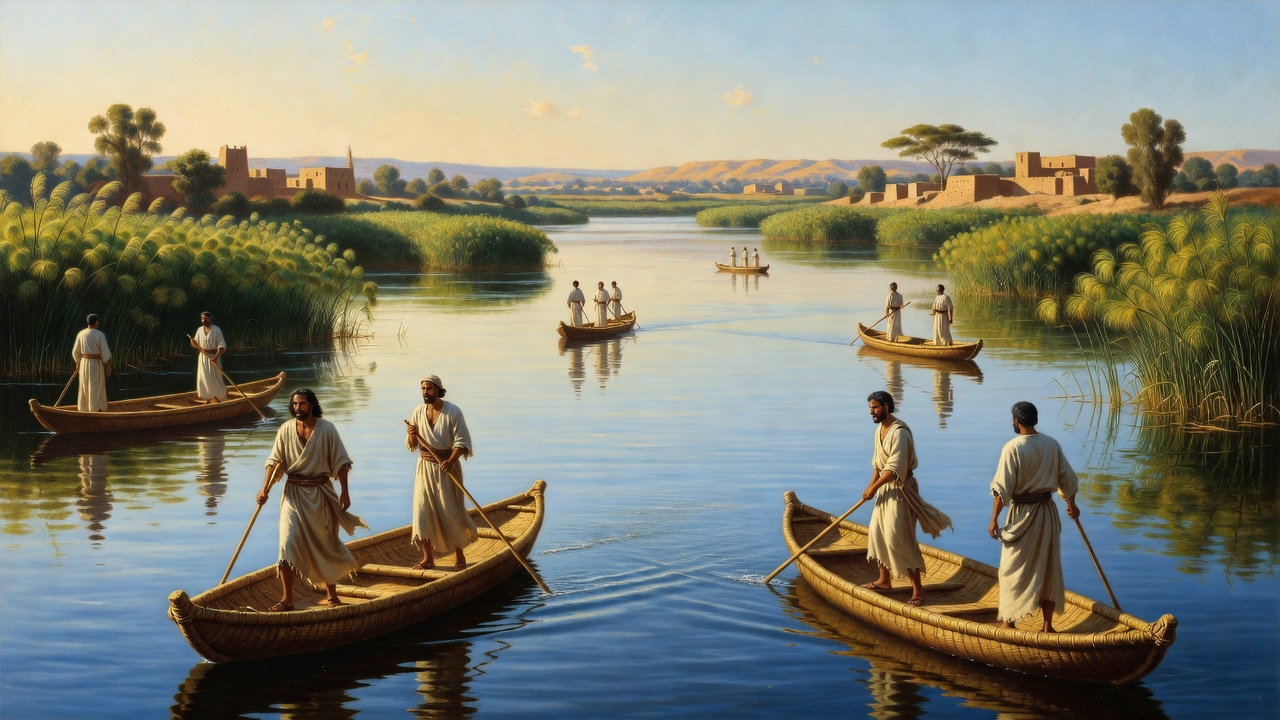
- The land of Cush referred to the region south of Egypt along the Upper Nile. Isaiah describes its messengers navigating the waters in swift vessels made of papyrus reeds.Sources: Cush · the Bible text itself
- The prophecy culminates with gifts being brought from this distant, formidable nation across the rivers to Mount Zion, the prominent hill in Jerusalem where the Lord's name dwelt.Sources: Mount Zion · the Bible text itself
Notes written with AI assistance from open sources (Theographic Bible Metadata, CC BY-SA 4.0; Easton’s Bible Dictionary, public domain) and reviewed before publishing.
Places in this chapter
- Cush · Today: Cush 1 · 16.935, 33.751 · verse 1
- Nile · Today: Nile River · 31.465, 30.367 · verses 1, 2
- Mount Zion · 31.772, 35.229 · verse 7
Only places identified with high confidence are shown (90% or more according to the scholarly sources compiled by OpenBible). Period map: DARE (Digital Atlas of the Roman Empire), CC BY 4.0; modern map: © OpenStreetMap contributors; places: OpenBible.info (CC BY 4.0).
Credits and license for this translation
LXX2012: Septuagint in British/International English 2012
The Septuagint with Apocrypha, translated from Greek to English by Sir Lancelot C. L. Brenton and published in 1885, with some language updates (British/International English)
Public Domain
Language: English
Dialect (if applicable): British
Language in English: English
Translation by: Sir Lancelot Charles Lee Breton
LXX2012: Septuagint in English 2012, British/International English Edition
This is a translation of the Old Testament and Apocrypha/Deuterocanon from Hebrew to Greek to 19th Century British English, with some updates of spelling and word usage to contemporary British/International English. The original English translation was done by Sir Lancelot Charles Lee Brenton and published by Samuel Bagster & Sons, Ltd., in London in 1851. It has entered the Public Domain due to the passage of sufficient time. In the process of scanning and typing the text, the original poetry and prose formatting, as well as peripheral material like introductions and notes, have been omitted.
This edition of the Septuagint has some language updates. Brenton's word order and punctuation has been mostly retained, meaning that quotation marks are not used, and sentences within quotes may not start with capital letters, as was standard usage in 1851. Names transliterated from Greek to those transliterated from Hebrew in the common English Bibles often differ. These language updates are dedicated to the Public Domain by the author of those edits, Michael Paul Johnson. Therefore this edition may be freely copied, published, etc.
Before considering making changes to the text of this work, I recommend that you consult with God, because this is really His Book.
If you find errors in the text, please report them so that we can correct them.
Donations to help with the expenses of operating this web site and thus help others have free access to the Word of God may be made to us, but are not required. Please see http://MLJohnson.org/partner/ for more about that.
Section headings adapted from the Berean Standard Bible (public domain); they are not part of this translation’s text.
Source: http://ebible.org/eng-uk-lxx2012/ · eBible.org