Isaiah 17
LXX2012: Septuagint in British/International English 2012 · Tap a verse to see its cross-references.
The Burden against Damascus
1THE WORD AGAINST DAMASCUS. Behold, Damascus shall be taken away from amongst cities, and shall become a ruin; 2abandoned for ever, to be a fold and resting-place for flocks, and there shall be none to go after them. 3And she shall no longer be a strong place for Ephraim to flee to, and there shall no longer be a kingdom in Damascus, or a remnant of Syrians; for you are no better than the children of Israel, even than their glory; thus says the Lord of hosts. 4There shall be in that day a failure of the glory of Jacob, and the riches of his glory shall be shaken. 5And it shall be as if one should gather standing corn, and reap the grain of the ears; and it shall be as if one should gather ears in a rich valley; 6and as if there should be left stubble therein, or as it were the berries of an olive tree, two or three on the topmost bough, or as if four or five should be left on their branches; thus says the Lord, the God of Israel. 7In that day a man shall trust in him that made him, and his eyes shall have respect to the Holy One of Israel. 8And they shall not at all trust in their altars, nor in the works of their hands, which their fingers made; and they shall not look to the trees, nor to their abominations. 9In that day your cities shall be deserted, as the Amorites and the Evaeans deserted theirs, because of the children of Israel; and they shall be desolate. 10Because you have forsaken God your Saviour, and have not been mindful of the Lord your helper; therefore shall you plant a false plant, and a false seed. 11In the day wherein you shall plant you shall be deceived; but if you sow in the morning, the seed shall spring up for a crop in the day wherein you shall obtain an inheritance, and as a man's father, you shall obtain an inheritance for your sons. 12Woe to the multitude of many nations, as the swelling sea, so shall you⌃ be confounded; and the force of many nations shall sound like water; 13many nations like much water, as when much water rushes violently: and they shall drive him away, and pursue him afar, as the dust of chaff when men winnow before the wind, and as a storm whirling the dust of the wheel. 14Towards evening, and there shall be grief; before the morning, and he shall not be. This is the portion of them that spoiled you, and the inheritance to them that robbed you of your inheritance.
Did you know?
Judgment on Damascus and Ephraim
- The oracle against Damascus connects the fate of the Syrian capital with that of the northern kingdom of Israel, referred to as Ephraim and Jacob. The prophecy foretells that both the sovereignty of Damascus and the fortified power of Israel would fade together.Sources: the Bible text itself · Damascus · Syria
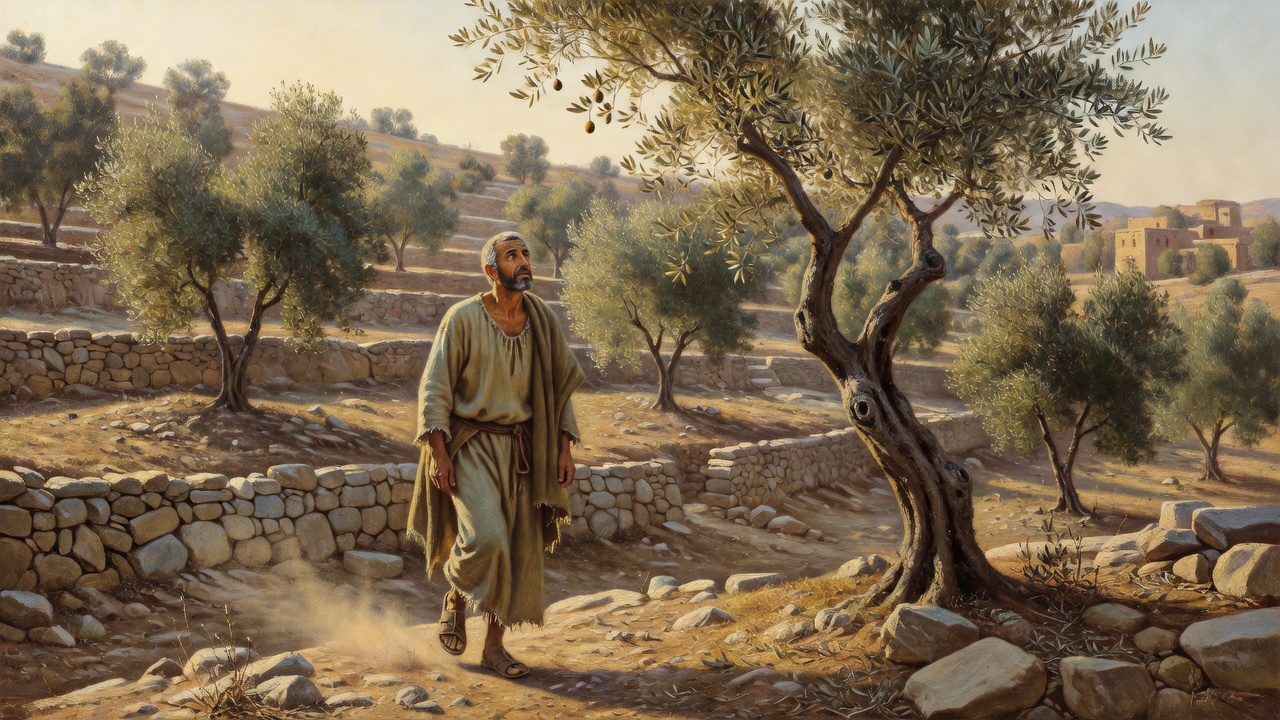
- The text uses familiar agricultural imagery to describe judgment and remnant: a harvester gathering grain in the Valley of Rephaim near Jerusalem, and a beaten olive tree left with only two or three olives at the very top.Sources: the Bible text itself · Valley of Rephaim
Notes written with AI assistance from open sources (Theographic Bible Metadata, CC BY-SA 4.0; Easton’s Bible Dictionary, public domain) and reviewed before publishing.
Places in this chapter
- Damascus · 33.511, 36.306 · verses 1, 3
- Syria · Today: Aram · 33.511, 36.306 · verse 3
- Valley of Rephaim · 31.763, 35.219 · verse 5
Only places identified with high confidence are shown (90% or more according to the scholarly sources compiled by OpenBible). Period map: DARE (Digital Atlas of the Roman Empire), CC BY 4.0; modern map: © OpenStreetMap contributors; places: OpenBible.info (CC BY 4.0).
Credits and license for this translation
LXX2012: Septuagint in British/International English 2012
The Septuagint with Apocrypha, translated from Greek to English by Sir Lancelot C. L. Brenton and published in 1885, with some language updates (British/International English)
Public Domain
Language: English
Dialect (if applicable): British
Language in English: English
Translation by: Sir Lancelot Charles Lee Breton
LXX2012: Septuagint in English 2012, British/International English Edition
This is a translation of the Old Testament and Apocrypha/Deuterocanon from Hebrew to Greek to 19th Century British English, with some updates of spelling and word usage to contemporary British/International English. The original English translation was done by Sir Lancelot Charles Lee Brenton and published by Samuel Bagster & Sons, Ltd., in London in 1851. It has entered the Public Domain due to the passage of sufficient time. In the process of scanning and typing the text, the original poetry and prose formatting, as well as peripheral material like introductions and notes, have been omitted.
This edition of the Septuagint has some language updates. Brenton's word order and punctuation has been mostly retained, meaning that quotation marks are not used, and sentences within quotes may not start with capital letters, as was standard usage in 1851. Names transliterated from Greek to those transliterated from Hebrew in the common English Bibles often differ. These language updates are dedicated to the Public Domain by the author of those edits, Michael Paul Johnson. Therefore this edition may be freely copied, published, etc.
Before considering making changes to the text of this work, I recommend that you consult with God, because this is really His Book.
If you find errors in the text, please report them so that we can correct them.
Donations to help with the expenses of operating this web site and thus help others have free access to the Word of God may be made to us, but are not required. Please see http://MLJohnson.org/partner/ for more about that.
Section headings adapted from the Berean Standard Bible (public domain); they are not part of this translation’s text.
Source: http://ebible.org/eng-uk-lxx2012/ · eBible.org