Genesis 37
LXX2012: Septuagint in British/International English 2012 · Tap a verse to see its cross-references.
Joseph’s Dreams
1And these are the generations of Jacob. And Joseph was seventeen years old, feeding the sheep of his father with his brethren, being young; with the sons of Balla, and with the sons of Zelpha, the wives of his father; and Joseph brought to Israel their father their evil reproach. 3And Jacob loved Joseph more than all his sons, because he was to him the son of old age; and he made for him a coat of many colours. 4And his brethren having seen that his father loved him more than all his sons, hated him, and could not speak anything peaceful to him. 5And Joseph dreamt a dream, and reported it to his brethren. 6And he said to them, Hear this dream which I have dreamt. 7I thought you⌃ were binding sheaves in the middle of the field, and my sheaf stood up and was erected, and your sheaves turned round, and did obeisance to my sheaf. 8And his brethren said to him, Shall you indeed reign over us, or shall you indeed be lord over us? And they hated him still more for his dreams and for his words. 9And he dreamt another dream, and related it to his father, and to his brethren, and said, Behold, I have dreamt another dream: as it were the sun, and the moon, and the eleven stars did me reverence. 10And his father rebuked him, and said to him, What is this dream which you have dreamt? shall indeed both I and your mother and your brethren come and bow before you to the earth? 11And his brethren envied him; but his father observed the saying.
Joseph Sold into Egypt
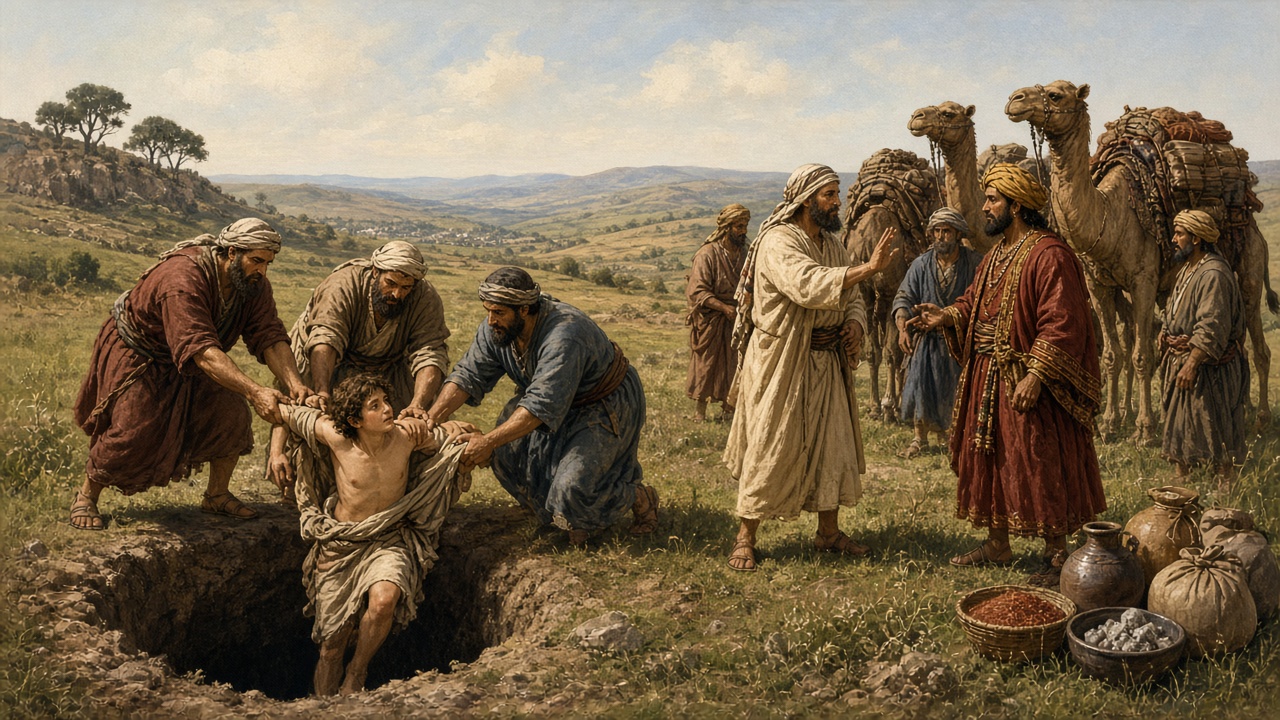
12And his brethren went to feed the sheep of their father to Sychem. 13And Israel said to Joseph, Do not your brethren feed their flock in Sychem? Come, I will send you to them; and he said to him, Behold, I am here. 14And Israel said to him, Go and see if your brethren and the sheep are well, and bring me word; and he sent him out of the valley of Chebron, and he came to Sychem. 15And a man found him wandering in the field; and the man asked him, saying, What seek you? 16And he said, I am seeking my brethren; tell me where they feed their flocks. 17And the man said to him, They have departed hence, for I heard them saying, Let us go to Dothaim; and Joseph went after his brethren, and found them in Dothaim. 18And they spied him from a distance before he drew near to them, and they wickedly took counsel to kill him. 19And each said to his brother, Behold, that dreamer comes. 20Now then come, let us kill him, and cast him into one of the pits; and we will say, An evil wild beast has devoured him; and we shall see what his dreams will be. 21And Ruben having heard it, rescued him out of their hands, and said, Let us not kill him. 22And Ruben said to them, Shed not blood; cast him into one of these pits in the wilderness, but do not lay your hands upon him; that he might rescue him out of their hands, and restore him to his father. 23And it came to pass, when Joseph came to his brethren, that they stripped Joseph of his many-coloured coat that was upon him. 24And they took him and cast him into the pit; and the pit was empty, it had not water. 25And they sat down to eat bread; and having lifted up their eyes they saw, and behold, Ismaelitish travellers came from Galaad, and their camels were heavily loaded with spices, and resin, and myrrh; and they went to bring them to Egypt. 26And Judas said to his brethren, What profit is it if we kill our brother, and conceal his blood? 27Come, let us sell him to these Ismaelites, but let not our hands be upon him, because he is our brother and our flesh; and his brethren listened. 28And the men, the merchants of Madian, went by, and they drew and lifted Joseph out of the pit, and sold Joseph to the Ismaelites for twenty pieces of gold; and they brought Joseph down into Egypt. 29And Ruben returned to the pit, and sees not Joseph in the pit; and he tore his garments. 30And he returned to his brethren and said, The boy is not; and I, whither am I yet to go?
Jacob Mourns Joseph
31And having taken the coat of Joseph, they killed a kid of the goats, and stained the coat with the blood. 32And they sent the coat of many colours; and they brought it to their father, and said, This have we found; know if it be your son's coat or no. And he recognised it, and said, It is my son's coat, an evil wild beast has devoured him; a wild beast has carried off Joseph. 33And Jacob tore his clothes, and put sackcloth on his loins, and mourned for his son many days. 34And all his sons and his daughters gathered themselves together, and came to comfort him; but he would not be comforted, saying, I will go down to my son mourning to Hades; and his father wept for him. 35And the Madianites sold Joseph into Egypt; to Petephres, the eunuch of Pharao, captain of the guard.
Did you know?
Joseph Sold by His Brothers
- Israel loved Joseph more than his other sons because he was the child of his old age, and he made him a robe of many colors. Easton's Bible Dictionary (1897) reads the Hebrew of Genesis 37:3 as a long, full garment with sleeves, the kind worn by the children of nobles. When the brothers saw that favor, they hated him and could not speak a kind word to him.Sources: Joseph (son of Jacob) · the Bible text itself
- Jacob sent seventeen-year-old Joseph from the Valley of Hebron to see how his brothers and the flocks were faring; they had pastured near Shechem and then gone on to Dothan. Easton's Bible Dictionary (1897) calls Dothan a famous pasture ground with two wells, identified with modern Tell-Dothan about twelve miles north of Samaria among the hills of Gilboa, and says it is mentioned on monuments in 1600 BC. There the brothers saw a caravan of Ishmaelites coming from Gilead, their camels carrying spices, balm, and myrrh on the way down to Egypt.Sources: Dothan · Gilead · the Bible text itself
- Reuben, Jacob's eldest son by Leah, tried to save Joseph from death and planned to return him to their father. Judah then persuaded the brothers to sell Joseph to the Ishmaelites rather than shed his blood. In Egypt the Midianites sold him to Potiphar, an officer of Pharaoh and captain of the guard; Easton's Bible Dictionary (1897) explains that name as 'dedicated to Ra,' the sun-god, and takes the title to mean, probably, chief of the state police, with a margin reading 'chief of the executioners.'Sources: Reuben · Judah (patriarch) · Potiphar · the Bible text itself
Notes written with AI assistance from open sources (Theographic Bible Metadata, CC BY-SA 4.0; Easton’s Bible Dictionary, public domain) and reviewed before publishing.
Places in this chapter
- Canaan · 32.767, 35.333 · verse 1
- Shechem · Today: Tell Balatah · 32.214, 35.282 · verses 12, 13, 14
- Valley of Hebron · 31.525, 35.102 · verse 14
- Egypt · 30.129, 31.308 · verses 25, 28, 36
- Gilead · Today: Gilead 1 · 32.187, 35.692 · verse 25
Only places identified with high confidence are shown (90% or more according to the scholarly sources compiled by OpenBible). Period map: DARE (Digital Atlas of the Roman Empire), CC BY 4.0; modern map: © OpenStreetMap contributors; places: OpenBible.info (CC BY 4.0).
Credits and license for this translation
LXX2012: Septuagint in British/International English 2012
The Septuagint with Apocrypha, translated from Greek to English by Sir Lancelot C. L. Brenton and published in 1885, with some language updates (British/International English)
Public Domain
Language: English
Dialect (if applicable): British
Language in English: English
Translation by: Sir Lancelot Charles Lee Breton
LXX2012: Septuagint in English 2012, British/International English Edition
This is a translation of the Old Testament and Apocrypha/Deuterocanon from Hebrew to Greek to 19th Century British English, with some updates of spelling and word usage to contemporary British/International English. The original English translation was done by Sir Lancelot Charles Lee Brenton and published by Samuel Bagster & Sons, Ltd., in London in 1851. It has entered the Public Domain due to the passage of sufficient time. In the process of scanning and typing the text, the original poetry and prose formatting, as well as peripheral material like introductions and notes, have been omitted.
This edition of the Septuagint has some language updates. Brenton's word order and punctuation has been mostly retained, meaning that quotation marks are not used, and sentences within quotes may not start with capital letters, as was standard usage in 1851. Names transliterated from Greek to those transliterated from Hebrew in the common English Bibles often differ. These language updates are dedicated to the Public Domain by the author of those edits, Michael Paul Johnson. Therefore this edition may be freely copied, published, etc.
Before considering making changes to the text of this work, I recommend that you consult with God, because this is really His Book.
If you find errors in the text, please report them so that we can correct them.
Donations to help with the expenses of operating this web site and thus help others have free access to the Word of God may be made to us, but are not required. Please see http://MLJohnson.org/partner/ for more about that.
Section headings adapted from the Berean Standard Bible (public domain); they are not part of this translation’s text.
Source: http://ebible.org/eng-uk-lxx2012/ · eBible.org